Mental development in adolescence
How your teen’s mind grows and changes

Updated January 13, 2026 • Medically reviewed by Dr. Katie Knight
Medically reviewed by Dr. Katie KnightIn this article
Quick summary
- Adolescence is a period of rapid mental development, affecting emotions, decision-making, social awareness, and self-identity
- Different types of development (emotional, social, and cognitive) interact, leading to mood swings, heightened sensitivity, and evolving independence
- Parents can support healthy growth through open communication, consistent routines, problem-solving guidance, and modeling calm, constructive behaviour
Watching your teen grow up can feel like witnessing a whirlwind.
One moment they’re laughing at a joke, the next they’re withdrawing into their room, scrolling endlessly, or having a big emotional reaction to what seems like nothing. All in under an hour.
These changes are all part of adolescence, which is a time when the brain and mind are developing rapidly.
You may remember adolescence. Yeah, it is full of big feelings and confusing thoughts. But what are the best ways to support your teen through it?
One way you can support your teen and help you feel a little less confused is by learning about mental development in adolescence. Ready to dive in?
What mental development means in adolescence
Adolescence isn’t just about physical growth. It’s also about how your teen thinks, feels, and sees themselves.
Mental development during these years covers a few key areas:
- Growth in thinking and reasoning: teens start to think more abstractly and question the world around them
- Awareness of identity and personal values: they explore who they are and what matters to them
- Emotional development and self-understanding: they experience stronger, more nuanced emotions and are learning how to manage them
- Stronger independence and decision-making: teens want to make choices for themselves, sometimes pushing boundaries in the process
- Changes in processing stress and relationships: social and emotional situations can feel more intense than ever before
Understanding these shifts can help parents appreciate why teens sometimes seem unpredictable, moody, or hypersensitive.
Different mental development types in adolescence
Teens' brains, emotions, and social skills are growing at lightning speed.
Different parts of their mental development often happen at different rates, which can make them seem unpredictable or moody one day and thoughtful the next.
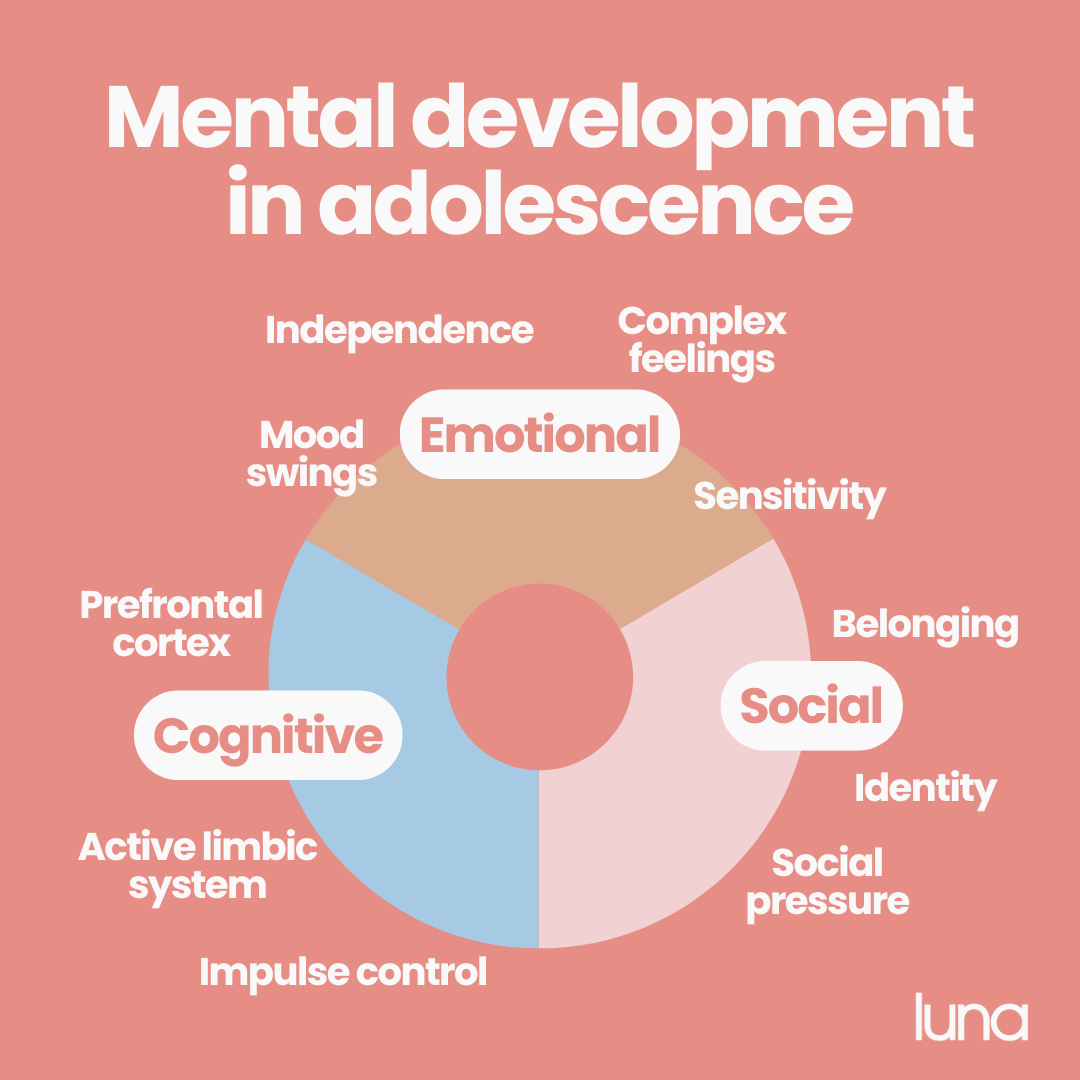
Understanding these “types” of development (emotional, social, and cognitive) can help you make sense of their behaviour and offer support in the ways they really need.
Emotional development during the teen years
Teens feel emotions more intensely than adults sometimes, and it can seem like their feelings shift every five minutes.
From excitement to frustration, they’re learning to understand and manage a whole new range of complex emotions.
Knowing what’s “normal” for this stage can help you respond with patience instead of panic.
Here’s what’s happening:
- Stronger and more complex emotions that are sometimes overwhelming
- Heightened sensitivity to stress and criticism
- Increased need for privacy and personal space
- Desire for independence and control over decisions
- Frequent mood swings that may feel sudden or unpredictable
Social development and relationships
The friends your teen makes suddenly matter more than ever, and they are learning what it means to fit in, stand out, and navigate tricky social dynamics.
This is a time of exploring identity, testing boundaries, and figuring out where they belong.
Social development in teens looks like:
- Greater focus on friendships and social connections
- Exploration of identity through peer interactions
- Increased awareness of social pressure and peer influence
- Desire for acceptance and belonging
- Learning to communicate effectively and resolve conflicts
How the brain develops during adolescence
Behind all the mood swings and big decisions, your teen’s brain is actually undergoing serious upgrades.
The prefrontal cortex is catching up with the limbic system, which explains why impulse control can still be a work in progress.
Understanding the science can make their behaviour feel a bit less random, and a lot less stressful:
- Prefrontal cortex development: this area, responsible for planning, organisation, and decision-making, continues to mature
- Active limbic system: the part of the brain that handles emotions is very active, which explains intense emotional responses
- Impulse control improves gradually: teens are still learning to manage urges and reactions
- Ongoing development into early adulthood: the brain continues maturing well into the mid-20s, meaning patience and guidance are essential
How can you support mental development at home
Helping your teen navigate adolescence doesn’t mean controlling every aspect of their life. It’s about creating a supportive environment where they can grow:
- Create space for open, judgment-free conversations
- Offer consistent routines and clear expectations
- Encourage problem-solving rather than giving quick answers
- Model calm responses during conflict
- Support healthy sleep, movement, and nutrition
- Celebrate small achievements and encourage independence
Even simple actions, like listening without immediately correcting them, can make a big difference.
Backing your teen through their teen years
Adolescence is a whirlwind of change, but it’s all part of your teen’s natural mental growth.
By understanding what’s happening in their brain and emotions, you can guide them with calm, compassionate support.
To support your teen’s ups and downs of adolescence, you can introduce them to luna.
On luna, your teen can track their cycles and learn more about their health and wellbeing.
How we created this article:
luna's team of experts comprises GPs, Dermatologists, Safeguarding Leads and Junior Doctors as well as Medical Students with specialised interests in paediatric care, mental health and gynaecology. All articles are created by experts, and reviewed by a member of luna's senior review team.
Sources:
Cleveland Clinic "Adolescent development" | Accessed 13.01.25
https://my.clevelandclinic.org/health/articles/7060-adolescent-developmentNHS "Early or delayed puberty" | Accessed 13.01.25
https://www.nhs.uk/conditions/early-or-delayed-puberty/NHS Healthier Together "Puberty" | Accessed 13.01.25
https://www.healthiertogether.nhs.uk/young-person/pubertyCambridgeshire Community Services NHS Trust "Hormones, puberty and sexuality" | Accessed 13.01.25
https://cambspborochildrenshealth.nhs.uk/child-development-and-growing-up/hormones-puberty-and-sexuality/We'd love to keep in touch!
Sign up to our parent newsletter for emails on the latest teen trends, insights into our luna community and to keep up to date
By signing up, you are agreeing that we can use your email address to market to you. You can unsubscribe from marketing emails at any time by using the link in our emails. For more information, please review our privacy statement.