How to talk to children about death
What to say, what to avoid, and how to support children

Updated March 18, 2026
In this article
How can I talk to my child about death?
You can talk to children about death by being honest, using simple language, and letting their questions guide the conversation.
It helps to explain death in clear, concrete terms without overwhelming detail, and to reassure them that they are safe and supported.
Children cope best when adults stay calm, consistent, and open to revisiting the topic over time.
It is helpful to let children know that everyone eventually dies, although not until they are much older.
This can help them feel less anxious about the people they love dying soon.

What is the best strategy for discussing death with my child?
The best strategy for discussing death with children is to be truthful, age-appropriate, and emotionally available.
Children benefit from clear explanations, reassurance, and the chance to ask questions at their own pace.
After the initial explanation, it’s helpful to:
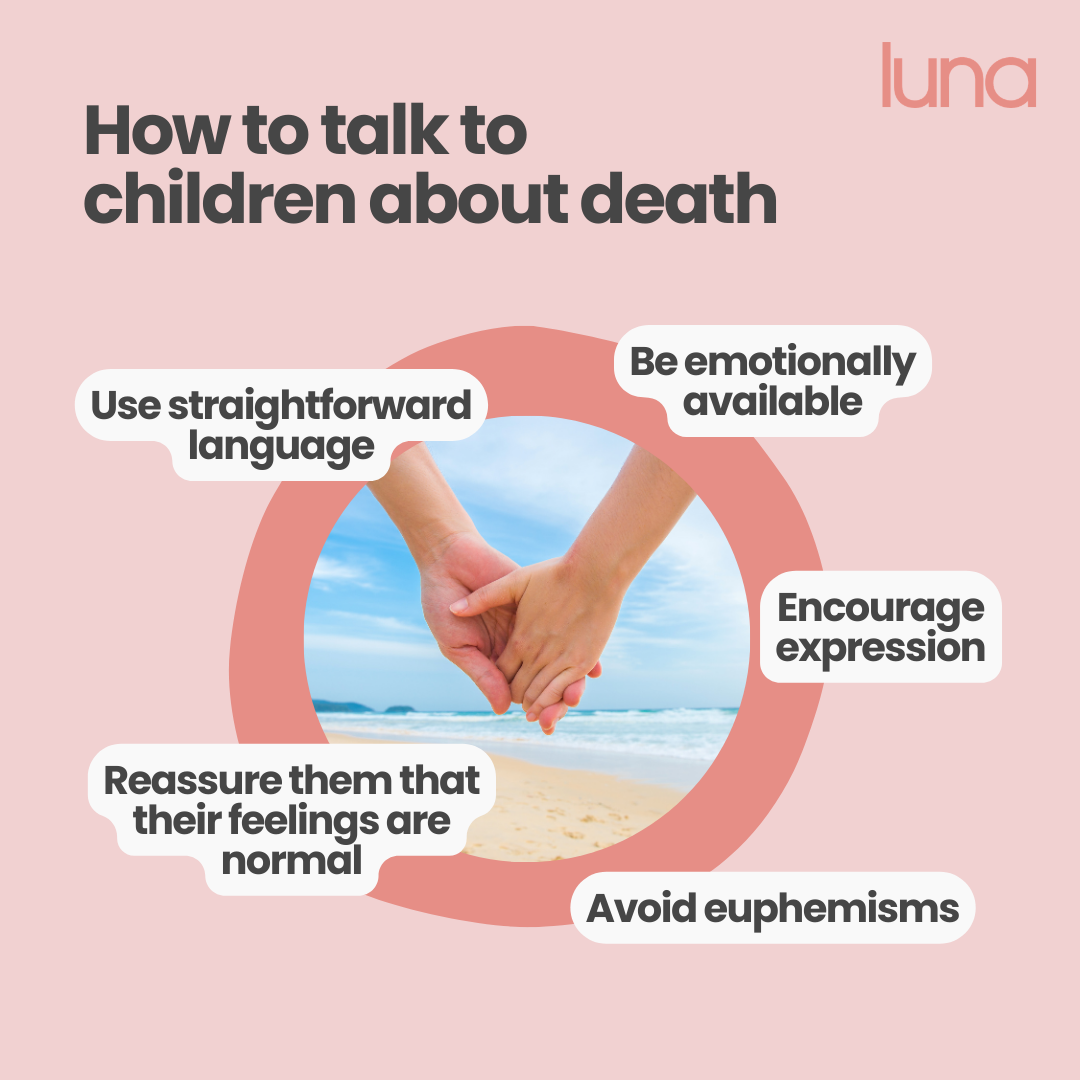
- Use straightforward language rather than euphemisms
- Use biological facts, such as the heart stopping beating
- Pause often and check what your child has understood
- Let them lead with their questions rather than giving long explanations
- Reassure them about what will stay the same in their life
Talking about death usually happens in short discussions over time, not all at once.
Certain common euphemisms, such as “they are in a better place now” or “they have gone to sleep,” can cause confusion and anxiety in children.
How can I talk to my child about grandparent death?
When talking to a child about the death of a grandparent, it helps to be clear, calm, and specific.
Saying that the grandparent has died, rather than using vague phrases, reduces confusion.
You can:
- Explain what has happened in simple terms
- Acknowledge feelings such as sadness or confusion
- Share that it’s okay to miss them and feel upset
- Reassure your child about who will continue to care for them
- Explain the cause of death
Children may react differently from adults, sometimes moving quickly between sadness and normal play.
This is a common and healthy response.
How can I talk to my teenager about death?
Talking to a teenager about death works best when you balance honesty with respect for their independence.
Teenagers usually understand that death is permanent.
But they may struggle to process the emotional impact and are often reluctant to seek help from parents.
Keeping communication open and avoiding pressure to “cope well” can help them feel supported.
In practice, this can mean:
- Being clear and truthful about what has happened, without softening facts in a way that feels patronising
- Letting them choose how and when to talk, including whether they want to speak to you, another trusted adult, or peers
- Offering support without forcing conversations, for example, saying “I’m here if you want to talk” and repeating this over time
- Giving choice around the funeral and rituals, such as whether to attend or how they want to be involved
- Keeping school routines where possible, while acknowledging that concentration, motivation, and schoolwork may be affected
- Avoiding adult responsibilities, such as asking them to be emotionally strong for others or take on a parental role
Teenagers may show grief through withdrawal, anger, risk-taking, or appearing unaffected.
These responses can be normal, but if changes persist or begin to interfere with daily life, additional support from school, a doctor, or a bereavement service may be helpful.
What is a good age to talk to my child about death?
There is no single “right” age to talk to children about death, because children encounter the idea at different times.
Many children begin asking questions in early childhood, and it is appropriate to answer honestly whenever those questions arise.
If death comes up through:
- A family loss
- A pet dying
- A story, TV programme, or news event
It is usually better to address it calmly rather than avoid the topic.
Avoiding the subject can make children feel more anxious or confused.
Simple explanations that match their level of understanding are usually enough.
At what age do children become aware of death?
Most children become aware of death in some form between the ages of 2 and 5, but their understanding changes as they grow.
Younger children often see death as temporary or reversible, while older children gradually understand that it is permanent.
Understanding often develops in stages:
- 2-5 years: may not understand permanence
- 5-8 years: begin to grasp that death is final
- 8+ years: start to understand emotional and biological aspects
It’s normal for children to revisit questions about death as their understanding matures.
How can I help my child cope with a death?
Children cope with death best when they are included, informed, and supported to express their feelings in their own way.
Being honest about what has happened, keeping routines where possible, and allowing children to take part in rituals like funerals or remembrance can help them feel safer and less confused.
After the initial conversation, helpful support can include:
- Explaining what has happened clearly, using simple language, and answering questions as they arise
- Letting children choose whether to attend the funeral, and preparing them for what will happen if they do
- Inviting them to be involved in remembering, such as drawing pictures, choosing music, or helping create a memory box
- Encouraging expression through play, drawing, writing, or talking, rather than expecting verbal conversations only
- Keeping familiar routines like school, meals, and bedtime, which can provide reassurance
- Reassuring them that their feelings are normal, including sadness, anger, confusion, or even moments of happiness
Some children return to questions about death weeks or months later as their understanding grows.
This is normal and not a sign that coping has gone “wrong”.
If grief is significantly affecting a child’s sleep, behaviour, or ability to manage daily life over time, extra support from a doctor, school, or bereavement service can be helpful.
What should I not do when my child is grieving?
When a child is grieving, it is best to avoid minimising their feelings or trying to rush them through their emotions.
Well-meant reassurance can sometimes shut down communication.
Try not to:
- Avoid the topic completely
- Say things like “don’t be sad” or “be brave”
- Overload them with adult details
- Assume silence means they are not affected
Grief often comes and goes. Letting children know they can return to the conversation at any time helps them feel emotionally safe.
When should I seek extra support for my child?
Parents should seek extra support if a child’s grief is ongoing, intense, or begins to interfere with their daily life.
This can include persistent changes in sleep, behaviour, mood, or school engagement that do not ease over time.
Trust your instincts - if you are worried, it is appropriate to ask for help.
You may want to seek support if your child:
- Seems withdrawn, distressed, or anxious most of the time
- Has ongoing sleep problems or frequent physical complaints
- Is struggling significantly at school or refusing to attend
- Shows persistent anger, fear, or guilt linked to the death
- Appears stuck or overwhelmed months after the loss
Support does not mean something has gone wrong.
A doctor, school staff, or bereavement service can help children and families make sense of grief and find ways to cope safely.
Reaching out early can provide reassurance and prevent children from feeling alone with difficult feelings.
How we created this article:
luna's team of experts comprises GPs, Dermatologists, Safeguarding Leads and Junior Doctors as well as Medical Students with specialised interests in paediatric care, mental health and gynaecology. All articles are created by experts, and reviewed by a member of luna's senior review team.
Sources:
NHS "Children and Bereavement" | Accessed 13.03.26
https://www.nhs.uk/mental-health/children-and-young-adults/advice-for-parents/children-and-bereavement/Child Bereavement UK "Explaining death and dying to children" | Accessed 13.03.26
https://www.childbereavementuk.org/explaining-death-and-dying-to-childrenBarnado's "How to talk to your child about grief" | Accessed 13.03.26
https://www.barnardos.org.uk/get-support/support-for-parents-and-carers/mental-health/grief-and-loss/how-to-talk-to-your-child-about-griefWe'd love to keep in touch!
Sign up to our parent newsletter for emails on the latest teen trends, insights into our luna community and to keep up to date
By signing up, you are agreeing that we can use your email address to market to you. You can unsubscribe from marketing emails at any time by using the link in our emails. For more information, please review our privacy statement.