Signs your daughter's boyfriend or partner is controlling
When young love doesn't feel right
Updated September 8, 2026 • Medically reviewed by Dr. Katie Knight
Medically reviewed by Dr. Katie KnightIn this article
- In short
- Is my daughter's boyfriend controlling, or am I overreacting?
- What are the signs my daughter's partner is controlling?
- Why can't my daughter see that her relationship is unhealthy?
- How do I talk to my daughter without pushing her away?
- When should I get help about my daughter's relationship?
- FAQs
- What can I do next?
In short
If your daughter's partner is isolating her from friends and family, monitoring her phone or location, telling her what to wear, or controlling her money, these are recognised signs of controlling behaviour.
The key is a pattern that shrinks her independence.
In England and Wales, controlling or coercive behaviour in a relationship is a criminal offence.
Is my daughter's boyfriend controlling, or am I overreacting?
When something feels off about your daughter's relationship, it's easy to talk yourself out of it.
Maybe it's just first love intensity.
Maybe you're being overprotective.
Here's a useful test: a healthy relationship adds to her life, while a controlling one shrinks her world.
The NSPCC describes a healthy relationship as one where she feels safe and respected, can be honest, can stay calm during arguments, and has an even power balance with her partner.
An even power balance usually means that they are the same age, and your daughter's boyfriend being older than her may be a sign of an unhealthy relationship.
If she seems smaller, quieter or more anxious since the relationship started, your instinct is worth listening to.
It's worth knowing that young people don't always realise when they're in an unhealthy relationship.
And as daughters get older, the adults around them can overestimate how well they can look after themselves.
Noticing is not overprotective. It's your job working as intended.
What are the signs my daughter's partner is controlling?
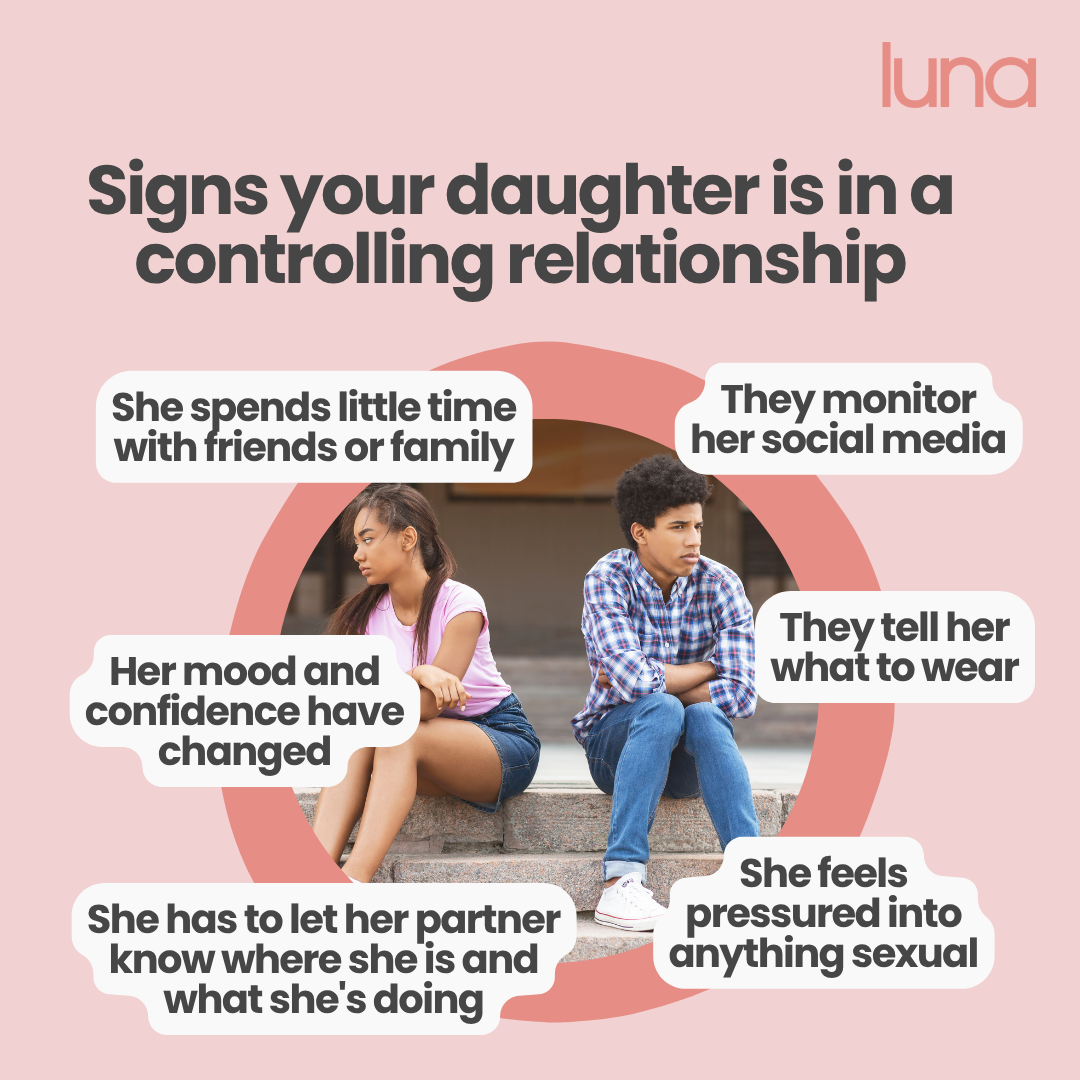
Controlling behaviour is a pattern of acts designed to make someone dependent: isolating her from support, taking away her independence, and regulating her everyday life.
You might notice she:
- Spends little time with friends or family, or has dropped people she used to love
- Always has to let her partner know where she is and what she's doing
- Has her social media monitored, or shares her location with her partner
- Is told what to wear, who to see, or where to go
- Has her own money, or access to day to day things, controlled
- Feels pressured into anything sexual, including sending nudes
- Seems reluctant to go to school, or her focus there has slipped
- Shows a persistent change in mood, confidence or behaviour
One of these on its own doesn't always mean control.
A cluster of them, alongside a change in who she is, is worth taking seriously.
This is also more common than most parents realise.
Across 101 studies of 13 to 18 year olds, 20% of teens reported experiencing physical dating violence and 9% reported sexual dating violence.
Controlling behaviour is often where that pattern starts.
Why can't my daughter see that her relationship is unhealthy?
Often because this is her first reference point.
If she's never been in a relationship before, constant texting and jealousy can read as devotion rather than control.
Isolation also does its work quietly.
The fewer people she sees, the fewer chances anyone has to say "that's not okay", and the louder her partner's voice becomes.
This is one reason a neutral source can help.
luna gives teen girls a space to learn what healthy and unhealthy relationships look like, with content reviewed by medical experts, so the message doesn't always have to come from you if you worry it won’t land fully.
How do I talk to my daughter without pushing her away?
Direct criticism of her partner, such as explicitly saying you hate your daughter’s boyfriend, usually makes a teen defend the relationship harder.
NHS guidance on supporting someone in an abusive relationship applies here too: listen without blaming, give her time to talk, and try not to tell her to end it before she's ready.
That decision has to feel like hers.
Some parents find it helps to:
- Talk in the car or on a walk, where there's no eye contact and less pressure
- Ask open questions about couples in shows you watch together, like "do you think that relationship is healthy?"
- Have several short chats rather than one big confrontation
- Name what you've noticed, not what you've concluded: "you've not seen Mia in ages" lands better than "he's isolating you"
- Stay warm about her, even when you're worried about the relationship
Building that kind of trust takes time, and luna’s guide to teen dating advice for parents has more on keeping the conversation open from the start.
When should I get help about my daughter's relationship?
Straight away if there are threats, physical harm, or sexual pressure.
You don't have to be certain it's abuse before asking for advice.
It's worth knowing that controlling or coercive behaviour in an intimate relationship is a criminal offence in England and Wales under the Serious Crime Act 2015.
This isn't teenage drama.
The law treats it seriously, and so can you.
Where to turn:
- The NSPCC helpline on 0808 800 5000, for confidential advice when you're worried about your daughter
- Childline on 0800 1111, which she can contact herself for free, any time
- Her doctor, who can support her wellbeing and connect her with local services
- 999, if you ever think she's in immediate danger
FAQs
Is a controlling relationship against the law?
In England and Wales, controlling or coercive behaviour in an intimate relationship is a criminal offence under the Serious Crime Act 2015.
Threats, harassment and physical or sexual violence are crimes whatever the age of the people involved.
What's the difference between controlling and coercive behaviour?
Controlling behaviour is a pattern of acts that makes someone dependent: isolating her, regulating her day, cutting off her independence.
Coercive behaviour is a pattern of threats, humiliation or intimidation used to punish or frighten.
In practice they usually overlap.
Should I check my daughter's phone to find out what's happening?
It's tempting, but if she finds out, it can feed the story a controlling partner often tells her: that home isn't on her side.
luna’s guide on whether to check your daughter's phone weighs up the trade-offs properly.
What if she's choosing her partner over the family?
Pulling away from family is one of the most common signs of a controlling relationship, because isolation is how control works.
luna’s written about what to do when your daughter chooses her partner over family if this is where you are.
Will telling her to break up work?
It usually backfires.
Ultimatums tend to push the relationship underground, where you can see even less of it.
Staying warm and keeping the door open gives her somewhere safe to land when she's ready.
What can I do next?
Keep noticing, keep the door open, and look after yourself too.
Watching this happen to your daughter is hard.
If you're becoming confident the relationship is controlling, luna’s guide on how to help your daughter leave a controlling relationship covers the next stage.
And whenever she's ready to work out what a healthy relationship feels like, luna is a judgement-free place for her to start.
How we created this article:
luna's team of experts comprises GPs, Dermatologists, Safeguarding Leads and Junior Doctors as well as Medical Students with specialised interests in paediatric care, mental health and gynaecology. All articles are created by experts, and reviewed by a member of luna's senior review team.
Sources:
NSPCC "Healthy relationships" | Accessed 15.06.26
https://www.nspcc.org.uk/advice-for-families/healthy-relationships/NHS "Domestic violence and abuse" | Accessed 15.06.26
https://www.nhs.uk/live-well/getting-help-for-domestic-violence/NHS England "Coercion" | Accessed 15.06.26
https://www.england.nhs.uk/long-read/coercion/NSPCC "Recognising abuse and neglect in teenagers" | Accessed 15.06.26
https://learning.nspcc.org.uk/child-abuse-and-neglect/teenagers-recognising-abuse-and-neglectWincentak K et al. "Teen dating violence: a meta-analytic review of prevalence rates" | Accessed 15.06.26
https://psycnet.apa.org/doiLanding?doi=10.1037/a0040194We'd love to keep in touch!
Sign up to our parent newsletter for emails on the latest teen trends, insights into our luna community and to keep up to date
By signing up, you are agreeing that we can use your email address to market to you. You can unsubscribe from marketing emails at any time by using the link in our emails. For more information, please review our privacy statement.