What is cosmeticorexia and could my daughter have it?
When skincare becomes something more
Updated June 12, 2026 • Medically reviewed by Dr. Simon Tso
Medically reviewed by Dr. Simon TsoIn this article
In short
Cosmeticorexia is a term for a culturally driven obsession with achieving perfect skin, leading to excessive or compulsive use of cosmetic products.
It is not a formal medical diagnosis, but researchers describe warning signs including anxiety when routines are disrupted, escalating spending, and using skincare to manage emotions.
Physical risks include skin barrier damage from adult actives like retinol and AHAs.
Social media is a key driver: #skincare and #skincareroutine have surpassed 64 million posts on TikTok and Instagram.
A simple three-step routine (cleanser, moisturiser, SPF) is all most teens need.
What is cosmeticorexia?
Before anything else: if your daughter enjoys skincare, that doesn't automatically mean something is wrong.
Cosmeticorexia (also called dermorexia) is a term used by researchers to describe a culturally driven obsession with achieving "flawless" skin, leading to excessive, age-inappropriate or compulsive use of cosmetic products and procedures.
A peer-reviewed paper published in Dermatology and Therapy in March 2026 defined its core features as escalating time and money spent on skincare, anxiety or distress when routines can't be completed, and relying on skincare to regulate difficult emotions.
It's not currently listed as a formal medical diagnosis in either the DSM-5 (used to classify mental health conditions) or the ICD-11.
Researchers compare it to "orthorexia", widely discussed but not yet formally classified, and are calling for standardised criteria and proper research.
What they are clear on is that it's becoming more visible in younger age groups, including preadolescents.
Why is my daughter so obsessed with skincare right now?
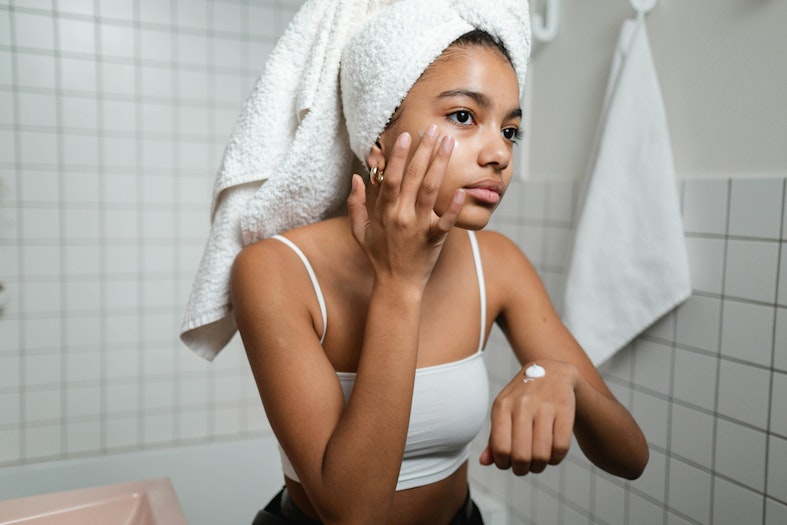
If you've watched your daughter spend an hour on a routine, or found your bathroom shelf taken over by serums, you're not imagining a shift.
Social media has created an environment where complex, multi-step routines feel like the cultural baseline.
Hashtags like #skincare and #skincareroutine have surpassed 64 million posts on TikTok and Instagram, generating hundreds of millions of views.
The "Sephora Kids" phenomenon (young girls, sometimes as young as nine or ten, buying adult anti-ageing regimens after seeing them on social media) has been documented by dermatologists who are concerned about the suitability of these products for young skin.
Research shows a clear link between social media use and appearance comparison in teens.
Higher social media use is associated with greater appearance-focused comparison, increased body image concerns, and compulsive grooming behaviours.
For a teen already navigating puberty and peer pressure, that's a potent combination.
luna's community reflects this directly.
In a 2026 poll of over 2,500 young people, 86% said they feel pressure to look a certain way sometimes or a lot of the time.
It's not a surface-level phase. It's the world they're growing up in.
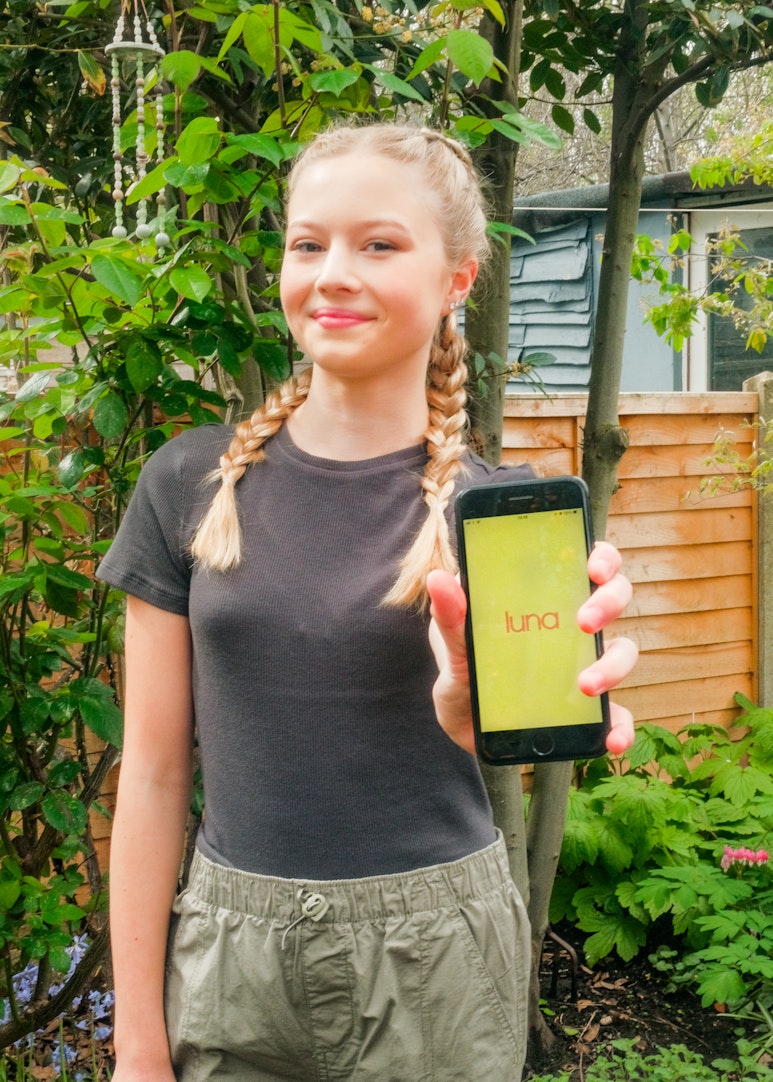
One thing worth knowing: luna gives teen girls a space to explore skin and body topics without the commercial noise.
Everything on luna is reviewed by medical experts, so it's a very different kind of resource from what she's finding on TikTok.
She can also ask questions directly, without judgement or anyone trying to sell her something.
You can read more about the TikTok skincare trends teens are following and why the content is so effective at driving purchase decisions.
What does too much skincare actually do to my daughter's skin?
Most skincare marketed to teens, and the adult anti-ageing products many are gravitating towards, are not designed for adolescent skin.
Retinol, glycolic acid, and salicylic acid are clinically useful for specific conditions in the right doses, but teen skin is more reactive than adult skin.
A 2025 analysis of TikTok videos created by minors found complex, costly routines with frequent use of potentially irritating actives, and critically, infrequent sunscreen use.
The physical risks include:
- Skin barrier disruption, causing redness, flaking, and increased sensitivity
- Irritant or allergic contact dermatitis from layering multiple products
- Photosensitivity from using actives without SPF, increasing the risk of post-inflammatory discolouration
- In some cases, scarring
Ironically, the routines marketed as achieving perfect skin can cause the very skin problems teens are trying to avoid.
luna has a detailed guide on whether retinol is safe for teens, and a closer look at how much skincare is too much if you want to understand where the threshold is.
It's a pattern Dr Simon Tso, NHS Consultant Dermatologist practising in Warwickshire, sees increasingly in clinic.
"Teen skin behaves differently from adult skin.
It doesn't need retinoids or exfoliating acids, and in many cases these products actively damage the skin barrier if inappropriately used.
What I see in practice is young people coming in with irritated, sensitised skin caused by routines they've built from social media.
The irony is that a simple cleanser, moisturiser and SPF routine would have served them far better."
How do I know if my daughter's skincare habit has become a mental health concern?
There's a difference between enjoying skincare and depending on it, and it can be hard to tell which one you're looking at.
Researchers identify a pattern of warning signs that suggest a routine has become compulsive rather than pleasurable:
- Anxiety or distress when the routine can't be completed (running late, products run out, travelling without her kit)
- Escalating amounts of time spent on the routine, sometimes over an hour
- Significant spending on products despite financial limits
- Using skincare to manage difficult emotions like anxiety or low mood
- Persistent preoccupation with perceived skin flaws that others don't notice
- Repeatedly checking skin in mirrors, or actively avoiding mirrors
- Cancelling plans or avoiding social situations because of skin concerns
This pattern can overlap with body dysmorphic disorder (BDD), a recognised mental health condition the NHS describes as spending a lot of time worrying about perceived flaws in appearance that are often unnoticeable to others.
BDD most commonly affects teenagers and young adults, and can contribute to depression, self-harm, and suicidal thoughts.
Around 1 to 2 in every 100 people have BDD.
luna's community data points to how real the emotional weight of skin concerns is for young people. In a poll of over 3,000 teens, nearly 19% said their skin concerns really affect their daily social activities.
If your gut is telling you something feels less like enthusiasm and more like anxiety, it's worth paying attention to that.
How do I talk to my daughter about her skincare routine?
Carefully. This territory carries a lot of feelings, and framing it as a problem can easily land as criticism.
Skincare is often tied up with self-care, social belonging, and identity.
Coming in with "I think you're overdoing it" tends to trigger defensiveness and close the conversation down.
Some parents find it more helpful to start from curiosity.
Asking what she enjoys about her routine, which products she feels are actually working, or whether she ever feels anxious if she can't complete it.
These questions invite reflection rather than resistance.
If you want to gently steer her towards something simpler, evidence tends to land better than opinion.
Framing it as "dermatologists say teen skin mostly just needs a cleanser, moisturiser and SPF" is often more persuasive than a parent's view.
Interestingly, when luna asked teens what matters most when buying skincare, dermatologically tested came out on top at 26%, while influencer or celebrity endorsements came last at just 5%.
She may be more receptive to expert-backed information than you'd expect.
luna can also be a useful resource to share with her directly.
It's built for teen girls, so she can explore skin topics at her own pace and ask questions without any of the judgement or selling that comes with social media.
All the content is reviewed by medical experts, which means what she reads is genuinely trustworthy in a way that influencer content isn't.
If she's showing signs of significant distress about her skin, a doctor can be a helpful next step.
A doctor can assess whether the concerns are appropriate and, if needed, refer her to mental health support.
FAQ
Is cosmeticorexia a medical diagnosis?
No. Cosmeticorexia is not listed in the DSM-5 or ICD-11, the two main classification systems used to diagnose mental health conditions.
Researchers describe it as a descriptive label for a risk pattern, similar to how "orthorexia" is widely discussed but not formally recognised.
Work is underway to develop standardised criteria, but these don't yet exist.
Can too much skincare actually make my daughter's skin worse?
Yes, it can.
Products like retinol and exfoliating acids can disrupt the skin barrier, causing irritation, redness, and sensitisation.
Layering multiple products increases this risk.
Using active ingredients without sun protection can lead to photosensitivity and pigmentation changes. A simple routine (cleanser, moisturiser, SPF) is what most dermatologists recommend for teen skin.
What is a normal skincare routine for a teenager?
Most dermatologists recommend three steps for teens: a gentle cleanser, a lightweight moisturiser, and a daily SPF.
In luna's community, the most common routine among young people is three steps, though many have more.
Products beyond the basics should be introduced carefully, and actives like retinol or AHAs ideally only on clinical advice.
When should I see a doctor about my daughter's skincare habits?
It's worth speaking to a doctor if your daughter is visibly distressed when she can't complete her routine, if her skin has become irritated or damaged from overuse of products, or if her appearance concerns seem to be affecting her daily life, school or social relationships.
A doctor can assess what's going on and refer to children and young people's mental health services if appropriate.
If you're not sure whether your daughter's routine sits in normal territory or something more, luna's guide to building a safe and age-appropriate teen skincare routine is a good starting point.
And if you'd like somewhere to send your daughter too, luna gives her a space to explore skin and health topics at her own pace, ask questions without pressure, and access content that's been reviewed by medical experts.
How we created this article:
luna's team of experts comprises GPs, Dermatologists, Safeguarding Leads and Junior Doctors as well as Medical Students with specialised interests in paediatric care, mental health and gynaecology. All articles are created by experts, and reviewed by a member of luna's senior review team.
Sources:
NHS "Body dysmorphic disorder (BDD)" | 08.06.26
https://www.nhs.uk/mental-health/conditions/body-dysmorphia/Stefana A et al. "Cosmeticorexia: what it is, where it comes from, and why it matters" | 08.06.26
https://pmc.ncbi.nlm.nih.gov/articles/PMC13013764/Young Minds "Body image" | 08.06.26
https://www.youngminds.org.uk/young-person/coping-with-life/body-image/Young Minds "Mental health statistics" | 08.06.26
https://www.youngminds.org.uk/about-us/media-centre/mental-health-statistics/We'd love to keep in touch!
Sign up to our parent newsletter for emails on the latest teen trends, insights into our luna community and to keep up to date
By signing up, you are agreeing that we can use your email address to market to you. You can unsubscribe from marketing emails at any time by using the link in our emails. For more information, please review our privacy statement.