How to help with your daughter's hormonal acne
What causes teen acne and what helps
Updated July 1, 2026
In this article
In short
Hormonal acne in teenagers is driven by rising levels of testosterone during puberty.
This hormone tells the skin's oil glands to produce more sebum than they need.
The excess oil blocks pores, which triggers inflammation and the bacteria that cause spots.
About 95% of people aged 11 to 30 are affected to some degree.
Acne is most common in girls aged 14 to 17. It usually improves by the mid-20s, and treatment can speed that up significantly.
Why does puberty cause so many spots?
Testosterone is the main driver, even in girls.
During puberty, rising testosterone makes the sebaceous glands (the tiny oil-producing glands next to hair follicles) go into overdrive.
The excess sebum mixes with dead skin cells and blocks pores.
Once a pore is blocked, a normally harmless skin bacterium becomes more aggressive, causing the redness, swelling, and pus your daughter is probably noticing.
Hormones also thicken the lining of the hair follicle itself, which makes the blockage worse.
What types of spots might my daughter have?
Acne comes in several forms, and your daughter may have more than one type at once:
- Blackheads: open clogged pores that turn dark due to the follicle lining (not dirt)
- Whiteheads: closed clogged pores with a white or yellowish top
- Papules: small, firm red bumps without a head
- Pustules: red bumps with a white or yellow tip full of pus
- Nodules: large, hard, painful lumps deep under the skin
- Cysts: the most severe type, pus-filled and most likely to cause scarring
Blackheads, whiteheads and pustules are very common.
Nodules and cysts need medical treatment to prevent lasting marks.
Where does teen acne usually appear?
The face is affected in almost everyone with acne.
Your daughter may also have spots on her back (affecting more than half of people with acne) and her chest (about 15% of cases).
Spots along the jaw, chin and lower cheeks can be a sign of hormonal activity and may flare before a period.
Does acne run in families?
Yes, genes play a real role.
If both parents had acne, their daughter is more likely to develop it earlier and more severely.
If one or both parents had adult acne, there's a higher chance she will too.
This isn't about anything she's done wrong: it's biology.
What can actually help at home?
Before reaching for prescription options, there are steps that genuinely make a difference:
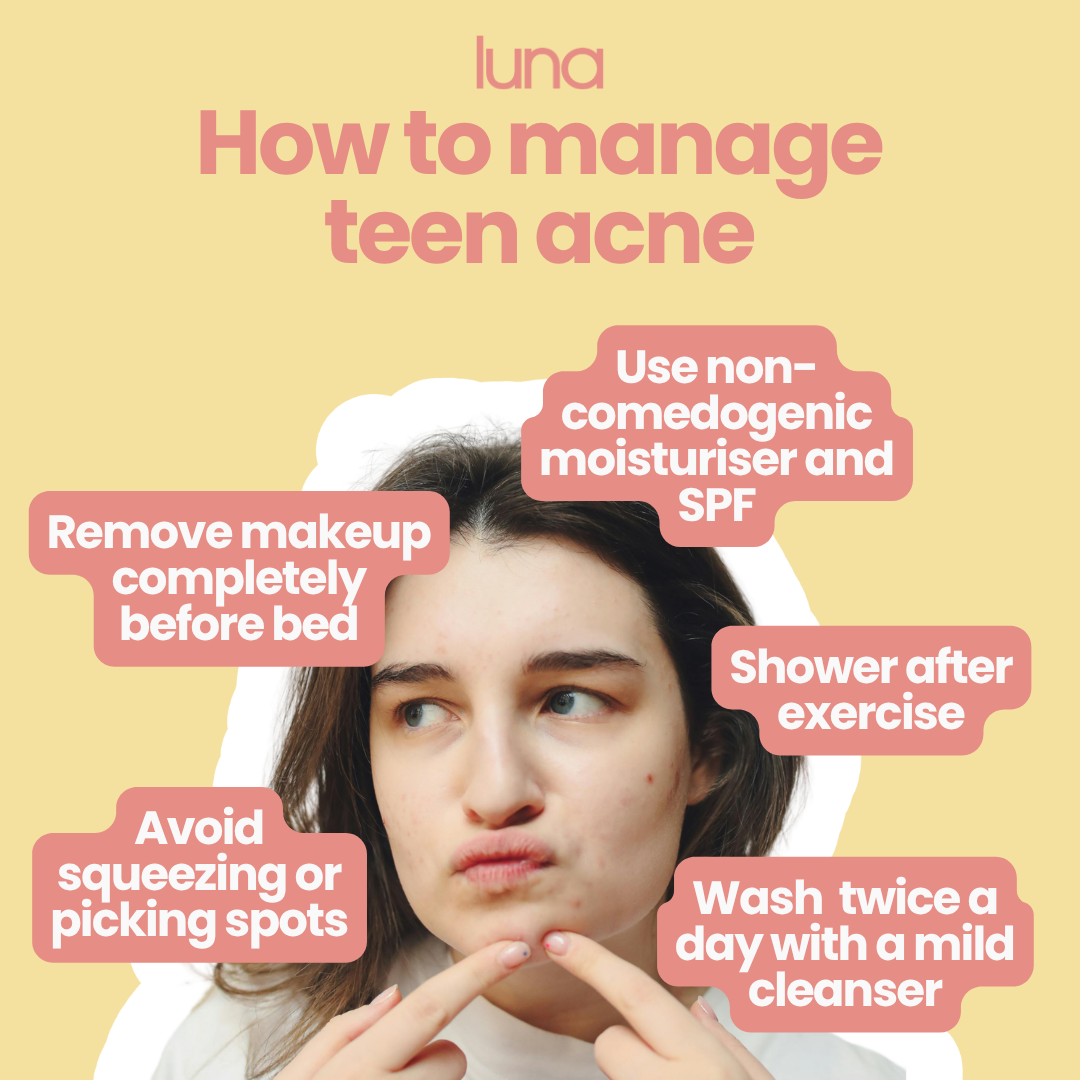
- Wash the affected skin gently twice a day with a mild cleanser and lukewarm water (not hot)
- Use non-comedogenic (non-pore-blocking) moisturiser and SPF
- Use pimple patches if she wants
- Remove makeup completely before bed
- Avoid squeezing or picking spots, which can cause scarring and spread bacteria
- Wash hair regularly and keep it off the face
- Shower after exercise
- Ensure she’s following an appropriate teen skincare routine
Over-the-counter products containing benzoyl peroxide can reduce bacteria and help with mild breakouts.
A pharmacist can advise on the right strength.
Be aware that benzoyl peroxide can bleach clothes and towels.
What treatments work for more stubborn acne?
If pharmacy products haven't helped after a couple of months, a doctor can prescribe:
- Topical retinoids (to prevent blocked pores)
- Topical or oral antibiotics (to tackle bacteria)
- Topical hormonal treatment (to reduce sebum/oil production)
- Azelaic acid (a gentler alternative to retinoids)
- For girls with moderate to severe acne, the combined contraceptive pill can help regulate hormones and reduce oil production (and oral spironolactone can help reduce sebum/oil production)
Most treatments take two to three months to show results.
Treatments such as topical hormonal treatment and oral spironolactone may not be available for prescribing by the GP and dermatologist.
Patience is genuinely part of the process.
FAQ
Is acne caused by a bad diet or not washing properly?
Neither, mostly.
The NHS is clear that most of the biological processes driving acne happen beneath the skin, not on the surface.
Washing more than twice a day can actually irritate skin and make things worse.
Diet may have some influence (see luna’s article on diet and acne), but poor hygiene isn't the cause.
Can the menstrual cycle make acne flare up?
Yes. Many girls notice more spots in the days before their period.
This is because hormones shift throughout the cycle, causing the oil glands to ramp up production at certain points.
It's very common and doesn't mean anything is wrong.
Will my daughter's acne go away on its own?
Acne often improves in the late teens and usually clears by the mid-20s.
However, moderate or severe acne that's left untreated is more likely to leave scars, so getting the right treatment early is worth it.
luna's article on helping your daughter manage acne covers how to support her day-to-day and what to expect from different treatments.
How we created this article:
luna's team of experts comprises GPs, Dermatologists, Safeguarding Leads and Junior Doctors as well as Medical Students with specialised interests in paediatric care, mental health and gynaecology. All articles are created by experts, and reviewed by a member of luna's senior review team.
Sources:
NHS "Acne overview" | Accessed 05.06.26
https://www.nhs.uk/conditions/acne/NHS "Acne causes" | Accessed 05.06.26
https://www.nhs.uk/conditions/acne/causes/NHS "Acne treatment" | Accessed 05.06.26
https://www.nhs.uk/conditions/acne/treatment/British Association of Dermatologists "Acne patient information leaflet" | Accessed 05.06.26
https://cdn.bad.org.uk/uploads/2021/11/15122928/Acne-PIL-JULY-2020.pdfWe'd love to keep in touch!
Sign up to our parent newsletter for emails on the latest teen trends, insights into our luna community and to keep up to date
By signing up, you are agreeing that we can use your email address to market to you. You can unsubscribe from marketing emails at any time by using the link in our emails. For more information, please review our privacy statement.