What do I do if my daughter compares herself to everyone online?
When the scroll feels personal

Updated May 4, 2026
In this article
In short
Comparison online isn't a personality flaw, it's a designed feature of the platforms.
Teen girls are particularly susceptible because their brains are wired for social comparison, and the algorithm shows them an infinite, edited version of everyone else.
The goal isn't to ban the phone (though sometimes it helps), it's to help her see what's happening and rebuild her relationship with the feed.
Why does my daughter compare herself to everyone online?
Comparison is what teen brains do. Social media just gives them an unlimited supply of material to do it with.
Three things are running at once:
- Her brain is wired to compare, because adolescence is when she's working out who she is, partly by measuring herself against peers
- What she's comparing to isn't real: in luna's research with teens, 54% said they edit or filter their appearance at least sometimes before posting
- The platforms are designed to keep her there, with engagement-driven feeds rewarding content that triggers strong emotion, including envy and insecurity
Comparison isn't a bug in the system; it's the business model.
In luna's research with teens, 61% said they compare themselves to others on social media.
She isn't unusual. She's having an entirely typical teenage reaction to a designed environment.
How does constant comparison actually affect her?
The effects are real, even when she'd never admit it. Worth knowing what to look for.
Common impacts include:
- Lower self-esteem and body image, especially around appearance, weight, skin, and lifestyle
- Mood drops after scrolling that she may not connect to the scrolling itself
- Sleep disruption from late-night use, especially if her phone is in her room
- Avoidance of real-world things that feel "less than" what she's seeing online
- Performance pressure to post, edit, and curate her own life back
In a luna poll of 1,522 girls, 46% said they feel drained and unproductive after scrolling, and only 17% feel happy.
Another luna poll of 2,036 girls found 1 in 5 (20%) feel insecure because of social media, and 21% feel overwhelmed or sad.
The cumulative impact tends to creep, not crash. She often won't notice it until something interrupts the loop.
How can I help her without making it a fight?
The instinct is to take the phone away, and sometimes that's the right move.
Most of the time, though, a fight over the phone fixes nothing because it skips the conversation she actually needs.
What tends to land better:
- Get curious about her feed before you criticise it, with something like "what's on your for-you page lately?"
- Watch a few minutes with her, without commentary, so you understand what she's seeing
- Talk about how she feels after, not while, because the moment after the scroll is when she's most honest about it
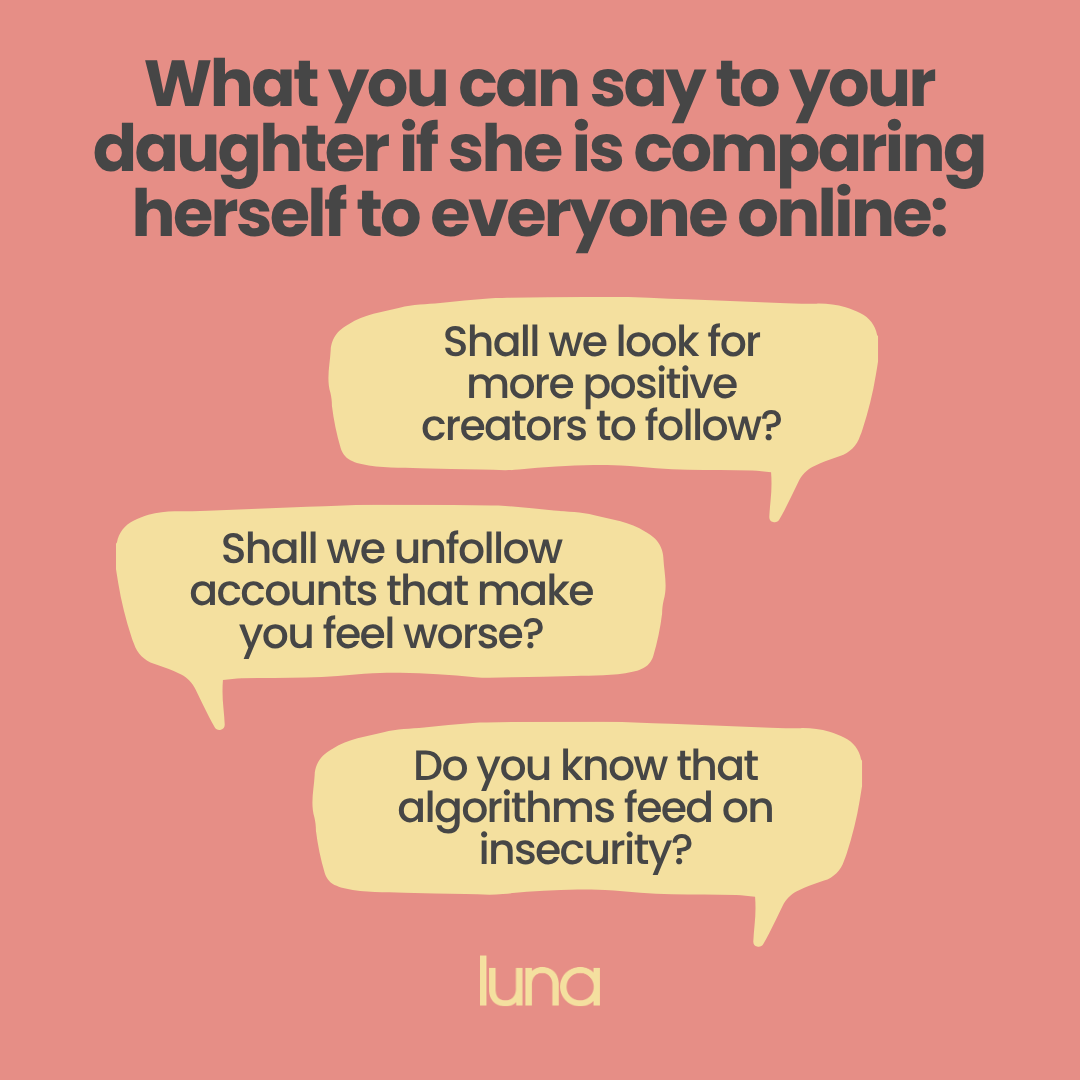
- Name the design, by explaining how algorithms reward emotional content, especially insecurity (most teens haven't had this explained to them)
- Audit the follows together, gently, because unfollowing accounts that consistently make her feel worse is one of the highest-impact actions she can take
- Model it yourself, by talking about how social media affects you, including the unflattering bits
In a luna poll of 1,873 girls, 21% said reassurance they won't be judged is what would help them open up to a parent. Lead with curiosity, not verdict.
How can she rebuild her relationship with the feed?
Most teen girls don't want to delete social media; they want to use it without it making them feel terrible. That's a reasonable goal and a teachable skill.
Practical steps that work:
- Curate ruthlessly, by unfollowing or muting any account that reliably makes her feel worse, no matter how popular
- Diversify the feed, with creators who are different from her in age, body, background, and interests
- Use built-in limits, like time limits in iOS Screen Time, Android Digital Wellbeing, or in-app daily caps
- Phone out of the bedroom at night, ideally charging in another room, because phone-in-bed scrolling is the highest-comparison time of day
- Replace the moment, not just the app, because if she's scrolling out of boredom or stress, taking the app away leaves the underlying need
- Notice the body, not the thought, by checking how her shoulders, breath, or stomach feel after a scroll, which often reveals what her thoughts are hiding
In a luna poll of 2,499 girls, 47% said TikTok is their favourite social media app.
The TikTok algorithm is particularly fast at building a comparison-heavy feed, so it's worth her knowing that engagement (likes, watches, lingers) is what trains it. What she watches, she gets more of.
For activities that build her sense of self off the feed, you may want to check out luna's article on body image tips for parents.
When could it be a sign of something more?
Most online comparison is a normal teen experience. Sometimes it's the visible edge of something heavier.
Worth a closer look if she also has:
- Persistent low mood, hopelessness, or harsh self-talk
- Disordered eating patterns or significant weight changes
- Avoidance of mirrors, photos, or activities that involve being seen
- Compulsive checking of her own posts, likes, or others' accounts
- Withdrawal from real-world friendships or activities
- Self-harm, or talk of not wanting to be here
These can be signs of body dysmorphia, depression, an eating disorder, anxiety, or something else worth a conversation with your GP.
For more on the wider mental health side, see how to help your teen's mental health.
FAQ
Should I just take her phone away?
Sometimes, briefly. A short break can reset the loop. But removal alone rarely changes the underlying habit, and a long ban can make her feel infantilised.
A more effective long-term move is helping her use it differently, with you involved in the conversation.
What apps are the worst for comparison?
Image-led platforms (Instagram, TikTok, Snapchat) tend to drive more appearance-based comparison than text-led ones.
Within those, the for-you and explore feeds are designed to maximise engagement, which often means content that triggers strong reactions. The app itself isn't the only issue, how she uses it matters more.
Can social media ever be good for her?
Yes. Lots of teens use social media to build communities, learn, find creativity, and feel less alone, especially around identity, neurodivergence, or interests not represented in her offline life.
The goal isn't to remove it, it's to make it work for her rather than on her.
Is filtering her own photos a problem?
It depends. Light filters are usually fine. Heavy edits that change her actual face or body can deepen the comparison loop, because she starts measuring her real face against the edited version.
Worth a gentle conversation if she's editing every photo she posts.
What if she says "everyone else does it"?
She's right. It's a system-level problem, not a personal failing, and that's exactly why curating her own feed and limiting her time matters.
The aim isn't to be the only one offline, it's to use it more deliberately.
If she's also showing signs of stress or low mood alongside the comparison, tips for helping a stressed-out teen is a useful next read.
You may also want to read up on phone addiction to know the warning signs.
How we created this article:
luna's team of experts comprises GPs, Dermatologists, Safeguarding Leads and Junior Doctors as well as Medical Students with specialised interests in paediatric care, mental health and gynaecology. All articles are created by experts, and reviewed by a member of luna's senior review team.
Sources:
NICE Guideline NG69 "Eating disorders: recognition and treatment" | Accessed 1 May 2026
https://www.nice.org.uk/guidance/ng69PubMed "The Impact of Social Media on Adolescent Body Image: A Comprehensive Review" | Accessed 1 May 2026
https://pmc.ncbi.nlm.nih.gov/articles/PMC12437731/We'd love to keep in touch!
Sign up to our parent newsletter for emails on the latest teen trends, insights into our luna community and to keep up to date
By signing up, you are agreeing that we can use your email address to market to you. You can unsubscribe from marketing emails at any time by using the link in our emails. For more information, please review our privacy statement.