What to do if your daughter feels invisible at school
Helping her feel seen, not just there
Updated July 29, 2026 • Medically reviewed by Dr. Katie Knight
Medically reviewed by Dr. Katie KnightIn this article
In short
Feeling invisible at school usually means your daughter doesn't feel noticed, included, or genuinely seen by peers or teachers.
It's painful but common in the early-to-mid teens, when friendship groups shift and social hierarchies harden.
Talk gently, validate before trying to fix, and help her build small "seen" moments rather than overhauling her social life.
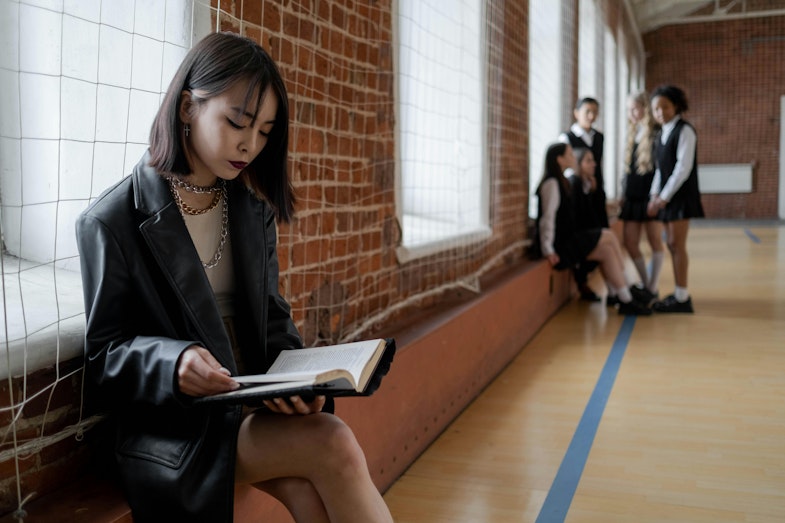
Why does my daughter feel invisible at school?
There are usually a few overlapping reasons, and they're rarely about her doing something wrong.
The biggest is friendship change.
Tween and teen friendships reshuffle constantly, and a girl can go from feeling at the centre to feeling on the edge in a term, especially as groups consolidate around Years 8 and 9.
Quieter, thoughtful, or kinder girls often slip into "background" roles even when they're well-liked.
In a luna poll of 2,014 girls, 1 in 3 (33%) said they find making new friends at school challenging or very difficult, and only 22% find it easy.
This shows that a lot of teen girls quietly feel this way, and friendship doubts and difficulties are more common than you may think.
Other common contributors:
- Class size and structure: in big classes, quiet kids genuinely get less airtime
- Teaching style: some teachers unintentionally lean on the same few hands going up
- Identity factors: girls who are neurodivergent, LGBTQ+, or one of few from their background often feel less seen
- Recent change: a school move, friend group split, or family upheaval can trigger a "lost in the room" feeling
- Body or development pace: looking different from peers, in either direction, can quietly knock how visible she feels
Is feeling invisible the same as being bullied?
No, but they can overlap.
Feeling invisible is usually about absence: not being noticed, included, or chosen.
Bullying is presence: targeted, repeated, deliberate harm.
That said, social exclusion is recognised as a form of bullying by the NSPCC.
If your daughter is being deliberately left out of conversations, group chats, or invitations by specific people, that's worth treating as bullying, not just shyness.
A useful question to ask gently: "Does it feel like nobody notices you, or like specific people are pushing you out?"
The answer tells you whether you're dealing with belonging or bullying.
You may wish to check out luna’s article on signs of bullying for more information on the subject.
How do I talk to her without making her shut down?
The instinct is to fix it. Resist that, at least at first.
Teen girls who feel unseen often need to feel heard at home before they can take action at school.
Things that tend to help:
- Lead with curiosity, not solutions, by asking open questions like "what's lunch like at the moment?" instead of "why don't you join a club?"
- Validate before reframing, with something like "that sounds really hard" rather than "I'm sure people like you"
- Avoid bright-siding, because "you've got loads of friends!" makes her stop talking
- Keep your reaction smaller than hers, because if your panic is bigger than her sadness, she'll start protecting you instead of confiding
- Pick low-pressure moments, like in the car, walking the dog, or making dinner
In a luna poll of 1,873 girls, 1 in 5 (21%) said reassurance they won't be judged is what would help them open up to a parent.
Listening without flinching is the foundation everything else builds on.
luna’s article on what daughters want to hear from their mothers may be worth checking out for extra insight.
What can help her feel more seen at school?
The fastest wins are usually small, repeatable "seen" moments rather than a friendship overhaul.
Try these:
- Help her find one or two small groups, not a big circle, like a club, a sports team, or a youth group
- Encourage one named adult relationship, like a tutor, librarian, music teacher, or pastoral lead she sees regularly
- Suggest a low-stakes way of contributing in class, like asking a question by email after a lesson, or volunteering for a small role
- Look outside school, with a part-time job, volunteering, a dance class, or a hobby with mixed ages
- Build one strong friendship over many shallow ones, by helping her invest in a single person she clicks with rather than chasing the popular group
It's also worth being honest that feeling seen at school usually follows finding her people, not the other way around.
For more on this, see how to help your teen make friends.
When should I speak to the school?
If she's struggling persistently, the school should know.
Most secondaries have a pastoral lead, head of year, or wellbeing team whose job is exactly this.
Speak to the school if:
- She's spent a half-term or more saying she feels invisible or alone
- She's avoiding school, faking illness, or asking to come home early
- She has no one to sit with at lunch on a regular basis
- You suspect deliberate exclusion, not just shyness
- Her mood, sleep, or eating has changed
In a luna poll of 2,230 girls, 2 in 3 (66%) said they avoid school in some way when they feel anxious about going.
School avoidance is a signal worth taking seriously, not a phase to wait out.
Frame the conversation as a partnership rather than a complaint.
Something like "we've noticed she's been struggling to feel part of things, and we'd love your view on what you're seeing and what we could try together" tends to land better than a list of demands.
Could it be more than feeling invisible?
Sometimes "I feel invisible" is the only language a teen has for something heavier, like depression, anxiety, an unrecognised neurodivergence, or low self-worth.
Watch for signs that suggest more than a friendship rough patch:
- Persistent low mood or hopelessness for more than two weeks
- Withdrawal from things she used to love, not just school
- Sleep, appetite, or energy changes
- Sudden grade or behaviour changes
- Self-harm, or talk of not wanting to be here
If any of these are present, talk to your GP. NHS CYPMHS (formerly CAMHS) referrals can take time, and earlier is better.
For a wider view, see how to help your teen's mental health.
FAQ
What if my daughter says "everyone hates me"?
Most teen girls who say this don't literally mean everyone.
They usually mean a recent painful exclusion has spiralled in their head.
Ask gently who specifically she's thinking of and what happened, rather than reassuring her it isn't true.
Should I message her teacher directly?
A short, calm email to her form tutor or head of year is almost always welcome.
Frame it as "we'd love your view" rather than "fix this."
Schools see this often and have more tools than parents realise.
Should I invite friends over to help?
Only if she's keen. Forced socialising can deepen the feeling she's a project.
Better to make it easy for her to say yes when something does come up by keeping schedules light and being relaxed about lifts, food, and sleepovers.
My daughter has friends but still feels invisible. Is that normal?
Yes. Feeling invisible is about being seen, not being surrounded.
A girl can have a busy social life and still feel nobody knows the real her.
That's worth taking just as seriously as having no friends.
Could moving schools help?
Sometimes, but it's a big move and not a guaranteed fix.
Many girls feel invisible because of where they are developmentally, not just where they're enrolled.
Try smaller fixes first, and if you're seriously considering a move, involve her closely in the decision.
If she's also showing signs of stress or low mood alongside this, tips for helping a stressed-out teen is a useful next read.
How we created this article:
luna's team of experts comprises GPs, Dermatologists, Safeguarding Leads and Junior Doctors as well as Medical Students with specialised interests in paediatric care, mental health and gynaecology. All articles are created by experts, and reviewed by a member of luna's senior review team.
Sources:
NHS "Bullying: Information for parents and carers" | Accessed 07.05.26
https://www.newcastle-hospitals.nhs.uk/services/great-north-childrens-hospital/childrens-health-psychology/resources/bullying-information-for-parents-and-carers/NSPCC "Bullying and cyberbullying" | Accessed 07.05.26
https://www.nspcc.org.uk/keeping-children-safe/types-of-abuse/bullying-and-cyberbullying/King's College London "Loneliness in adolescence: how can we support young people?" | Accessed 07.05.26
https://www.kcl.ac.uk/loneliness-in-adolescence-how-can-we-support-young-peopleYoungMinds "School anxiety and refusal" | Accessed 07.05.26
https://www.youngminds.org.uk/parent/parents-a-z-mental-health-guide/school-anxiety-and-refusal/We'd love to keep in touch!
Sign up to our parent newsletter for emails on the latest teen trends, insights into our luna community and to keep up to date
By signing up, you are agreeing that we can use your email address to market to you. You can unsubscribe from marketing emails at any time by using the link in our emails. For more information, please review our privacy statement.