How to help your daughter set real goals
Goals that stick, not just stack up

Updated July 29, 2026 • Medically reviewed by Dr. Katie Knight
Medically reviewed by Dr. Katie KnightIn this article
In short
A real goal for a teen is specific, time-bound, and her idea, not yours.
The difference between a wish and a goal is a written plan with small weekly steps and a reason she cares about it.
Help her break big things into bite-sized actions, focus on effort over outcome, and review weekly without judgement.
Why is goal-setting hard for teen girls?
Goal-setting is hard for adults, and the teenage brain makes it harder still.
The part of the brain that plans ahead (the prefrontal cortex) isn't fully wired until the mid-twenties, so even motivated teens genuinely struggle to break long timelines into daily steps.
They can want the result and still find the path overwhelming.
School piles on, too: in a luna poll of 4,636 girls, 38% said school-related pressure is what stresses them most.
Add social comparison (everyone else looks like they've got it together on TikTok) and the cultural pressure to "find your passion" by 16, and goal-setting can feel paralysing.
The reassuring bit: it's a skill, and you can teach it.
What's the difference between a real goal and a wish?
A real goal has a clear what, when, and how.
A wish stops at the what.
"Get fitter" is a wish.
"Run 5k without stopping by July, training three times a week" is a goal.
Goal-setting researchers Locke and Latham, whose work underpins most modern advice on this, found goals work best when they're specific, challenging but achievable, and personally meaningful.
The classic SMART framework (specific, measurable, achievable, relevant, time-bound) is a useful test.
Run her goal through these questions:
- Is it specific enough that she'd know when she'd hit it?
- Does it have a deadline?
- Is there a weekly action attached?
- Is it her goal, or is it really yours?
If any answer is "no", it's still a wish.
How do I help my daughter set goals she'll stick to?
The most important thing is letting her own it.
Teens stick to goals they chose themselves, not ones their parents picked for them.
A simple framework that works:
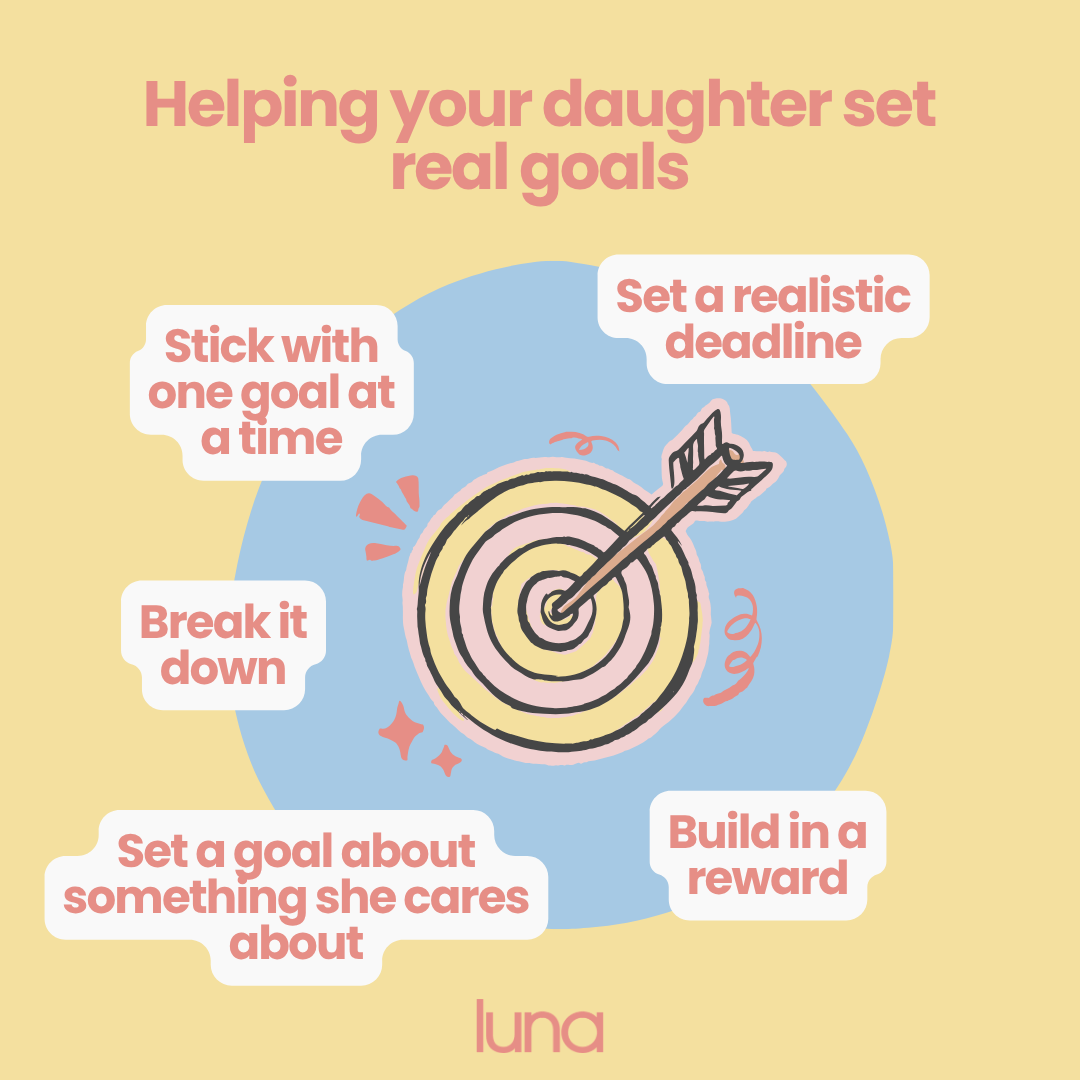
- Start with what she already cares about, like a sport, subject, hobby, or cause
- Pick one goal at a time, not five
- Set a deadline that feels real (eight weeks works well for teens)
- Break it into weekly actions, not just a final target
- Decide together how she'll track it, like a notes app, paper checklist, or Sunday review chat
- Build in a reward she chose
That last one matters more than people think. In a luna poll of 1,811 girls, 36% said rewards are what motivate them most when it comes to homework, while only 11% respond to encouragement alone.
Keep your role to facilitator, not project manager.
For more on the line between supporting and pushing, see how to motivate a teenager.
What kinds of goals work best for teens?
Goals that mix effort she controls with an outcome she wants tend to stick best.
Outcome-only goals (get an A, make the team) can backfire because they depend on things outside her hands.
Strong teen goal types:
- Skill goals, like learning to drive, cooking five dishes from scratch, or finishing a coding course
- Habit goals, like reading 20 minutes a night or moving her body four times a week
- Project goals, like writing 10,000 words, organising a charity bake sale, or saving £200
- Social goals, like making one new friend at college or asking the teacher for help twice this term
- Recovery goals, like a set bedtime, less screen time after 9pm, or a no-phone hour
Avoid framing weight, body, or appearance as a goal.
22% of teen girls told luna body image is their top worry going into summer, and goal-setting around bodies often slides into something less healthy.
How do I help her bounce back when she misses a goal?
Missing a goal is part of the process, not the end of it.
How you respond shapes whether she'll set another one.
When she falls behind:
- Get curious, not critical, by asking what got in the way before suggesting a fix
- Separate the slip from the goal, because missing a week doesn't mean the goal is wrong
- Adjust the plan, not the person, scaling down if it was too ambitious
- Praise the noticing, because spotting she's off-track is half the skill
Goal-setting is one of the few areas where failing well is genuinely the lesson.
If she's repeatedly setting goals and crashing, tips for helping a stressed-out teen goes deeper.
What should I avoid when helping her set goals?
The well-meaning moves that backfire are usually these:
- Setting the goal for her, even subtly, through leading questions
- Stacking too many at once, which scatters her energy
- Making the goal about you, like grades that affect your ego or sport tied to your identity
- Tracking her progress for her, which removes the feedback loop she needs to learn from
- Linking love or approval to outcomes, even unintentionally, by going quiet when she misses
The aim isn't a perfect kid hitting every target.
It's a teen who learns how to want something, plan for it, and try again when it doesn't work the first time.
FAQ
What's a good first goal for a teen?
A short, easy-to-track habit goal usually works best, like reading 15 minutes before bed, three home workouts a week, or one phone-free meal a day.
The aim is the win of completion, not the size of the goal.
Should I help my daughter set academic goals?
Yes, but carefully.
Frame them around effort and habits she controls (revision sessions per week, homework done by 7pm) rather than grades.
Outcome-only academic goals are linked to higher anxiety in teens.
How often should we review her goals?
Weekly works for most teens.
A 10-minute Sunday check-in (what went well, what got in the way, what to tweak) is plenty.
Daily reviews can feel like surveillance.
What if my daughter doesn't want to set any goals at all?
Don't push it. Start with curiosity: ask what she'd like to be different in three months.
If nothing comes up, that's information too, and can point to low mood, burnout, or simply needing a rest.
If goals feel out of reach because she's stressed or low, how to help your teen's mental health is a useful next read.
How we created this article:
luna's team of experts comprises GPs, Dermatologists, Safeguarding Leads and Junior Doctors as well as Medical Students with specialised interests in paediatric care, mental health and gynaecology. All articles are created by experts, and reviewed by a member of luna's senior review team.
Sources:
Ulster University "Mastering goal setting and motivation" | Accessed 04.05.26
https://www.ulster.ac.uk/student/success/study-skills/mastering-goal-setting-and-motivationCleveland Clinic "Prefrontal cortex" | Accessed 04.05.26
https://my.clevelandclinic.org/health/body/prefrontal-cortexStanford Medicine "Building a practically useful theory of goal setting and task motivation" | Accessed 04.05.26
https://med.stanford.edu/content/dam/sm/s-spire/documents/PD.locke-and-latham-retrospective_Paper.pdfWe'd love to keep in touch!
Sign up to our parent newsletter for emails on the latest teen trends, insights into our luna community and to keep up to date
By signing up, you are agreeing that we can use your email address to market to you. You can unsubscribe from marketing emails at any time by using the link in our emails. For more information, please review our privacy statement.