My teenage daughter has zero confidence
Where to start when she's stuck

Updated May 2, 2026
In this article
- In short
- Why does my teenage daughter have no confidence?
- Is it normal for teenage girls to lose confidence?
- What are the signs of low confidence in my daughter?
- How can I help my daughter rebuild her confidence?
- What should I avoid saying to a teen with low confidence?
- When should I worry, and who can help?
- FAQs
- What to do next
In short
Teenage girls often lose confidence between ages 11 and 14, driven by brain changes, hormonal shifts, social pressure, and a harsh inner critic.
It's developmentally normal, but still painful to watch. The most helpful thing isn't a pep talk: it's listening without fixing, gently naming what you see in her, and letting her take small, low-stakes risks where failure feels safe.
Why does my teenage daughter have no confidence?
Confidence in teen girls usually dips because of a perfect storm: mental development, hormones, and a much louder social world all hitting at once. It's rarely one thing, and it's rarely her fault.
Research has found that:
- According to neuroscientist Sarah-Jayne Blakemore, the parts of the brain tied to social awareness and self-consciousness become heightened in adolescence, even more so than in adult brains
- In adolescence, the parts of the brain that regulate emotion are still developing (at a slower rate than those tied to social awareness)
- This means that your teen daughter is noticing everything about herself, but is unable to fully process the emotions
On top of that, girls are growing up in a world of near-constant social comparison.
Ofcom's latest research on children's media use puts average daily smartphone time for UK teens at several hours a day, much of it on social platforms.
As the link between social media use and body image dissatisfaction is well documented, it makes sense that the more your teen uses it, the more their confidence is knocked.
So when she says "I'm rubbish at everything", she often means: I'm comparing myself to dozens of people a day and I can't keep up.
Is it normal for teenage girls to lose confidence?
Yes, a dip in confidence during early adolescence is extremely common and rarely a sign that something is seriously wrong. Most girls rebuild it as their sense of identity settles.
That said, "normal" doesn't mean "not painful", for her or for you. You can acknowledge it's developmentally typical and still take it seriously.
Here's what tends to be normal versus what's worth paying closer attention to:
Usually part of typical teen development:
- Feeling ugly, awkward, or "cringe" in phases
- Comparing herself unfavourably to friends
- Going quiet in big groups
- Dropping a hobby she "isn't good at"
- Mood swings around periods
- Not wanting photos taken
Worth paying closer attention to:
- Refusing to leave the house or be seen
- Cutting off all friendships
- Going quiet everywhere, including at home
- Dropping everything she used to enjoy
- Persistent low mood for 2+ weeks
- Avoiding mirrors, eating changes, self-harm
What are the signs of low confidence in my daughter?
Low confidence doesn't always look like sadness. In teen girls, it often looks like avoidance, perfectionism, or a very loud inner critic she's started voicing out loud.
Common signs include:
- Saying "I can't" or "I'm rubbish at this" before even trying something
- Dropping hobbies, sports, or subjects she used to love
- Extreme reactions to small mistakes, like tearing up homework or refusing to resit
- Constant comparison to friends, influencers, or siblings
- Outfit changes, avoiding photos, or a sudden dislike of her body
- Going unusually quiet in class or around new people
- Perfectionism: redoing work endlessly, or refusing to hand it in at all
- Needing a lot of reassurance, then not believing it when you give it
You might also notice she's fine one day and convinced she's hopeless the next. That's not her being dramatic; that's the teenage brain's emotional regulation still wiring up.
How can I help my daughter rebuild her confidence?
The short answer: stop trying to convince her she's great, and start helping her collect small bits of evidence that she can trust herself.
Confidence doesn't come from being told you're confident. It comes from doing hard things and surviving them.
Here are things that tend to help:
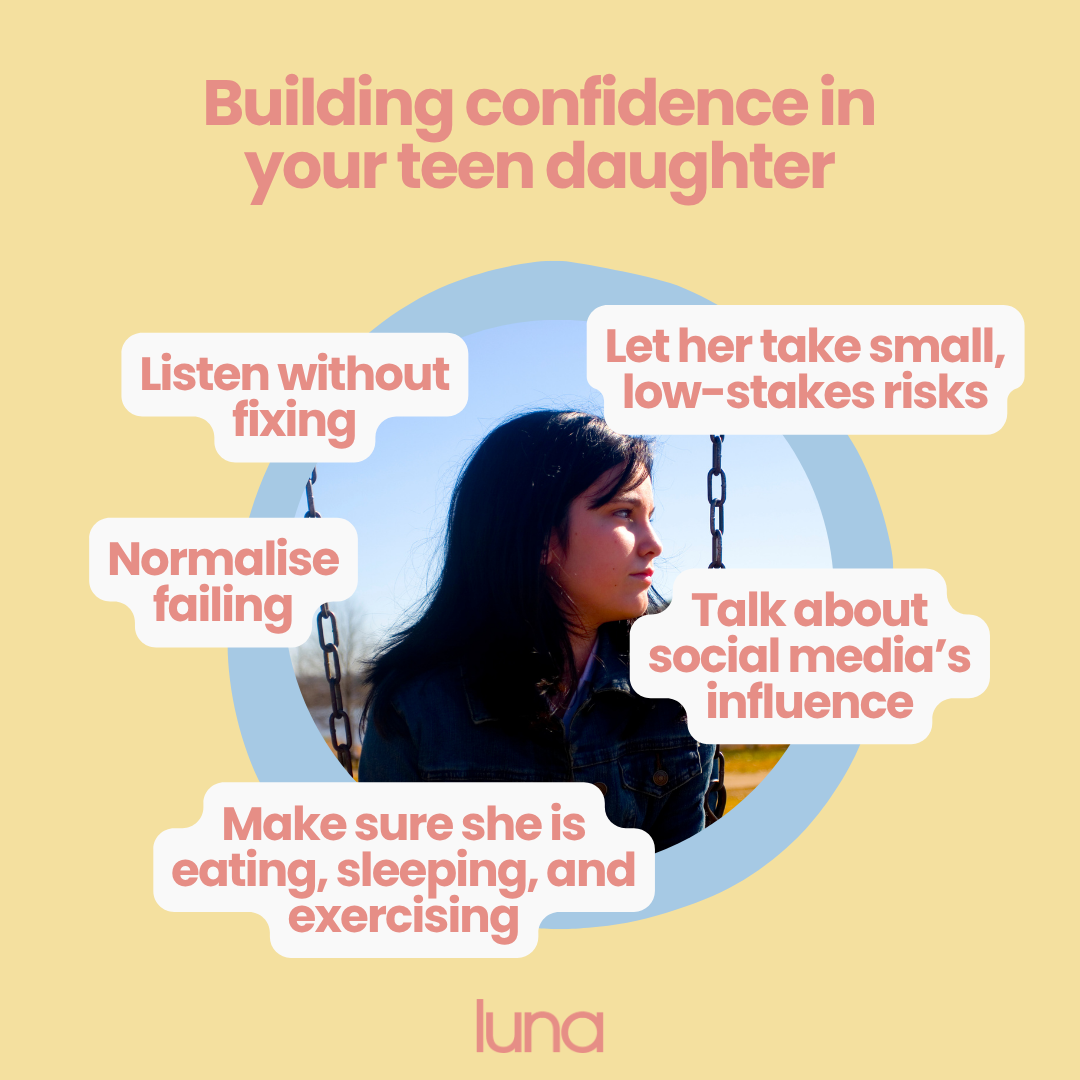
- Listen without fixing. When she says "I'm rubbish at maths", resist the urge to contradict her. Try: "that sounds really frustrating, tell me more". Feeling heard lowers the volume of her inner critic faster than any pep talk
- Name what you see, quietly. Instead of "you're so clever!", try "I noticed you kept going with that essay even when it was hard". Specific beats sweeping
- Let her take small, low-stakes risks. Ordering her own coffee, going to a new club once, sending the tricky text. Confidence grows in the gap between "I can't" and "I just did"
- Normalise failing. Share your own small flops from the week. If mistakes are survivable in your house, they become survivable in her head
- Watch the comparison inputs. You can't ban TikTok, but you can talk about what she's seeing. Ask: "who makes you feel good after you watch them, and who makes you feel rubbish?"
- Protect the basics. Sleep, healthy eating, and movement affect confidence more than any mindset advice. A tired, under-fuelled teen cannot feel good about herself, no matter what you say
What should I avoid saying to a teen with low confidence?
Even the most loving phrases can backfire when she's feeling low. The issue isn't your intent, it's that her inner critic will argue back with anything too sweeping.
Try to avoid:
- "You're beautiful, what are you talking about?"
- "Just be confident!"
- "When I was your age…"
- "Stop comparing yourself to her"
- "You've got nothing to worry about"
Instead, try:
- "That sounds really horrible. What's made you feel that way today?"
- "Confidence is a weird one: it usually comes after doing the thing, not before"
- "I don't know exactly what you're dealing with, but I'm here"
- "Who are you following that's making you feel like this?"
- "What you're feeling makes sense. Can I just sit with you?"
The underlying rule: validate first, advise second (or not at all). She knows you think she's wonderful. What she needs is to feel understood, not corrected.
When should I worry, and who can help?
Low confidence becomes a concern when it stops her from living her life, or when it lasts longer than a few weeks without any lift.
If she's withdrawn from most things, stopped eating properly, hurting herself, or talking about not wanting to be here, that's not a confidence dip; it's a sign she needs more support than home can give.
Book in with your GP if you notice:
- Low mood, tearfulness, or hopelessness lasting more than two weeks
- Changes in eating, sleeping, or weight
- Avoiding school, friends, or leaving the house
- Self-harm, or talking about not wanting to be alive
- Panic attacks or intense, frequent anxiety
Your GP can refer her to CAMHS (Child and Adolescent Mental Health Services) or a specialist service. You can also contact YoungMinds (0808 802 5544, free parent helpline) or explore the advice from Place2Be.
If she's in immediate crisis, call 999 or take her to A&E. You are not overreacting.
FAQs
At what age does teenage confidence drop the most?
Girlguiding's Girls' Attitudes Survey shows confidence and happiness decline steadily across the secondary school years, with the sharpest changes often showing up in the early teens.
Most girls rebuild confidence in the later teens as their sense of identity settles, though the path is rarely linear.
Can social media really destroy my daughter's confidence?
It's not the only factor, but it's a significant one. Studies have found that image-led platforms like Instagram have a big negative impact on young people's self-esteem and body image.
It's less about banning it and more about talking about what she sees and follows.
My daughter used to be so confident. What happened?
Most likely: puberty. The same girl who sang on stage at nine often goes quiet at twelve, because she's suddenly aware of being watched.
It's not a personality change, it's her brain coming online to how she's perceived. It usually loosens up again by mid-teens.
Is low confidence the same as low self-esteem?
They overlap but aren't identical. Confidence is how capable she feels at specific things ("I can do this maths test"). Self-esteem is how she feels about herself as a whole ("I'm a worthwhile person").
Low confidence can feed low self-esteem over time, which is why it's worth addressing early.
Should I push her to do things even when she doesn't want to?
Gentle nudging beats hard pushing. The goal is to keep her in the "uncomfortable but possible" zone, not the "terrified" zone.
If something causes real distress, back off and try a smaller step. If she never tries anything, that's when to lean in a little more.
What to do next
If you take one thing from this article, make it the quiet observation: "I noticed you…". It's the simplest tool, and it works.
For more on navigating the teen years without losing your mind (or hers), take a look at luna’s article on body image tips for parents.
To find out more about the wider issues she is up against, you may want to learn about the pressure of back to school glow up trends and how you can help.
And if you're worried she needs more support, please do reach out to your GP. Getting help early is never overreacting: it's good parenting.
How we created this article:
luna's team of experts comprises GPs, Dermatologists, Safeguarding Leads and Junior Doctors as well as Medical Students with specialised interests in paediatric care, mental health and gynaecology. All articles are created by experts, and reviewed by a member of luna's senior review team.
Sources:
PubMed "Development of the social brain in adolescence" | Accessed 2 May 2026
https://pmc.ncbi.nlm.nih.gov/articles/PMC3308644/PubMed "Neurocognitive bases of emotion regulation development in adolescence" | Accessed 2 May 2026
https://pmc.ncbi.nlm.nih.gov/articles/PMC6989808/Ofcom "Top trends from our latest look at UK children’s online lives" | Accessed 2 May 2026
https://www.ofcom.org.uk/media-use-and-attitudes/media-habits-children/top-trends-from-our-latest-look-at-uk-childrens-online-livesPubMed "The Impact of Social Media on Adolescent Body Image: A Comprehensive Review" | Accessed 2 May 2026
https://pmc.ncbi.nlm.nih.gov/articles/PMC12437731/NHS "Children and young people's mental health services" | Accessed 2 May 2026
https://www.nhs.uk/mental-health/children-and-young-adults/mental-health-support/mental-health-services/YoungMinds "Parents Helpline" | Accessed 2 May 2026
https://www.youngminds.org.uk/parent/parents-helpline/Place2Be "Support for parents and carers" | Accessed 2 May 2026
https://www.place2be.org.uk/our-services/parents-and-carers/Girlguiding " Impact report 2023" | Accessed 2 May 2026
https://www.girlguiding.org.uk/about-us/press-releases/impact-report-2023/We'd love to keep in touch!
Sign up to our parent newsletter for emails on the latest teen trends, insights into our luna community and to keep up to date
By signing up, you are agreeing that we can use your email address to market to you. You can unsubscribe from marketing emails at any time by using the link in our emails. For more information, please review our privacy statement.