How much pocket money should you give your teenage daughter?
What other parents pay, and why

Updated September 16, 2026 • Medically reviewed by Dr. Emma Dickie
Medically reviewed by Dr. Emma DickieIn this article
In short
There's no single right amount.
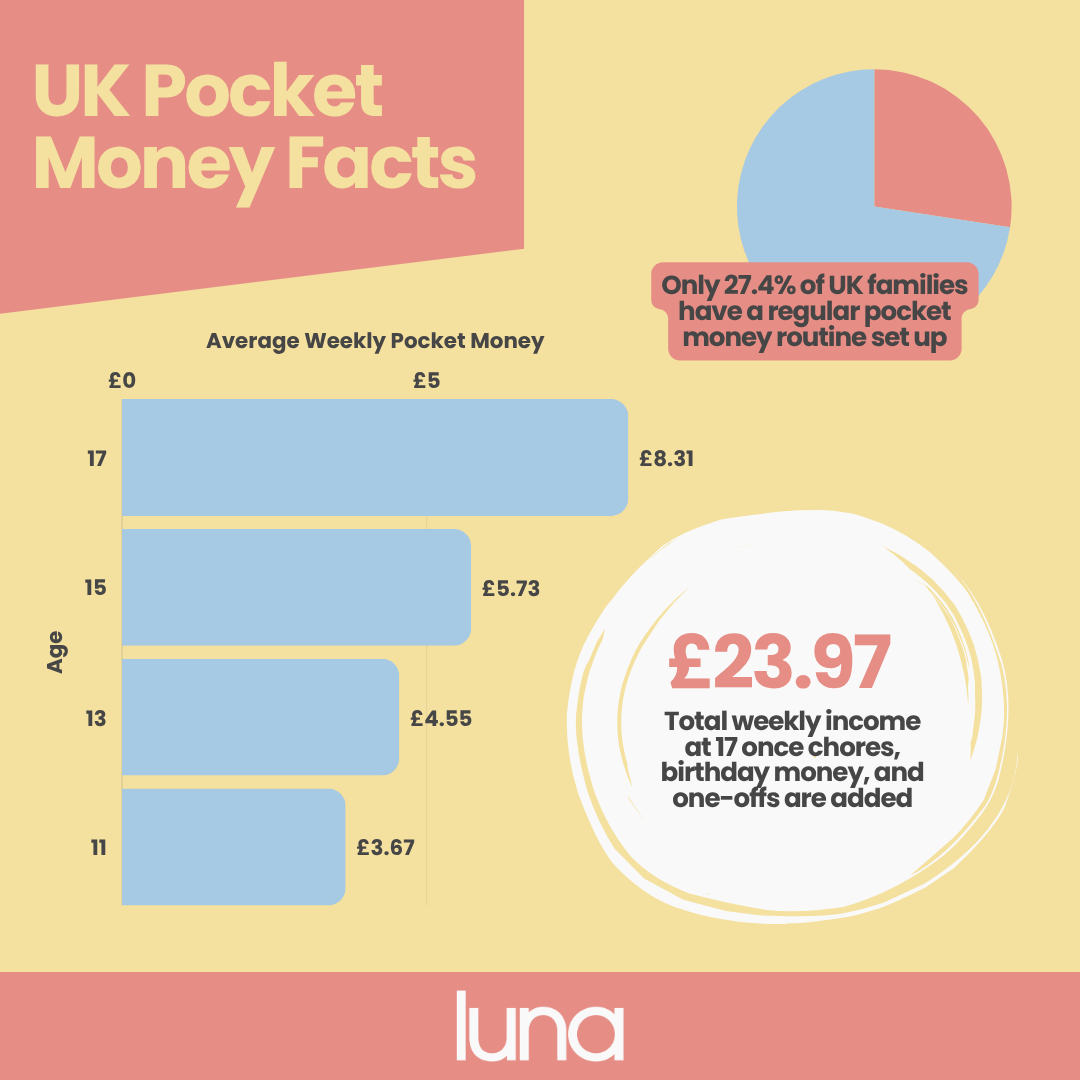
UK parents give an average of £3.67 a week in regular pocket money, rising to £8.31 by 17, according to NatWest.
Once chores and top-ups are counted, a 17 year old's weekly income averages £23.97.
Consistency, and letting your daughter manage the money herself, matter more than the exact figure.
How much pocket money should I give my teenage daughter?
If you've been wondering whether you're giving too much or too little, you're in good company.
Most parents have no idea what anyone else pays, because nobody really talks about it.
The most reliable UK data comes from the NatWest Rooster Money Pocket Money Index, which tracks the real spending and saving of more than 350,000 children.
Average regular weekly pocket money by age (2025):
- 11 years: £3.67
- 12 years: £4.05
- 13 years: £4.55
- 14 years: £5.08
- 15 years: £5.73
- 16 years: £6.59
- 17 years: £8.31
That's regular pocket money only.
Once chores, birthday money and one-off top-ups are added, total weekly income rises to £7.61 at 11 and £23.97 at 17.
Only 27.4% of UK families have a regular pocket money routine set up.
So if you've been winging it with ad hoc top-ups, you're far from alone.
Should my daughter earn her pocket money through chores?
There's no right answer here, and plenty of families mix both.
Of those with a fixed pocket money routine, just over a third (34.8%) make payment conditional on chores getting done.
Some parents find a hybrid works well: a small guaranteed amount, plus extra for bigger jobs like washing the car or mowing the lawn.
One thing worth watching is which chores she's given.
Research from Starling Bank found chores still fall into stereotypes, with girls more likely to be paid for cooking and cleaning while boys do the gardening and the car.
If getting her to lift a finger is the real battle, there are practical ideas in luna's guide to getting your teen involved in household tasks.
Do girls really get less pocket money than boys?
Yes, on average.
In a study of more than 4,000 UK parents by Starling Bank and Loughborough University, boys earned 20% more pocket money than girls, at £3.00 a week compared with £2.50.
The gap isn't just in the amount.
Girls were more likely to have to earn their money through chores and good behaviour, while boys were more likely to get it simply by asking.
Products marketed at girls also cost around 5% more, so her money buys less too.
The researchers call this the "play gap", an early echo of the gender pay gap many women meet later.
None of this is something parents do deliberately.
But if your daughter has a brother, it can be worth a quick mental audit of who gets what, and for what.
How can pocket money help my daughter learn about money?
Pocket money is less about the amount and more about the practice.
Financial education isn't taught consistently in class, so most of what she learns about money will come from home.
Handing over a set amount and letting her make her own choices, including the odd regrettable one, builds budgeting skills in a way no lecture can, which is a valuable life skill teens aren’t learning enough about in school.
Some things parents find helpful:
- Letting her run out before payday rather than topping up, so she feels the consequence safely
- Helping her split money into spending and saving pots
- Talking openly about real costs, like the food shop or her phone contract
- Encouraging her to earn extra through teen-friendly side hustles as she gets older
What if money is too tight for pocket money?
With costs still high, plenty of families can't stretch to a weekly amount right now.
That doesn't put your daughter at a disadvantage.
YoungMinds notes that money worries can have a real impact on a young person's mental health, and that open, age-appropriate conversations help far more than silence.
Teens usually pick up on financial stress at home even when nothing is said.
If a regular amount isn't possible, involving her in small money decisions, like planning meals or hunting down cheaper options, builds the same skills.
And if she's feeling pressure to keep up with friends, luna has a guide on helping your daughter feel included in trends without overspending.
FAQs
Is £20 a month enough for a 13 year old?
That's almost exactly the UK average.
Thirteen year olds receive £4.55 a week in regular pocket money, which works out at around £19.70 a month.
Should pocket money be weekly or monthly?
Weekly is the norm, and Saturday is the most popular payday, used by 45% of families.
Some parents switch to monthly at 15 or 16 to give budgeting practice before a first job.
Should pocket money stop if she misbehaves?
That's your call to make.
It's worth knowing the Starling research found girls are far more likely than boys to have money tied to behaviour, and consistency tends to teach more than deductions do.
Is cash or a pocket money app better?
Both work.
Digital cards and apps make it easier for her to track spending and set savings goals, though the Starling study found boys are currently more likely than girls to be paid digitally.
What age should pocket money stop?
There's no fixed cut-off.
Many families taper it once a part-time job starts, often between 16 and 18, sometimes shifting to an allowance for essentials instead.
However you handle pocket money, the fact you're thinking about it this carefully says a lot.
If you're treating it as a step towards bigger freedoms, luna's guide to encouraging independence in your teen is a good next read.
And for your daughter, luna offers a pressure-free space to explore growing up with expert-reviewed content.
How we created this article:
luna's team of experts comprises GPs, Dermatologists, Safeguarding Leads and Junior Doctors as well as Medical Students with specialised interests in paediatric care, mental health and gynaecology. All articles are created by experts, and reviewed by a member of luna's senior review team.
Sources:
NatWest Rooster Money "The pocket money index 2025" | Accessed 22.06.26
https://roostermoney.com/pocket-money-index-hub/Starling Bank "It's time to make pocket money equal" | Accessed 22.06.26
https://www.starlingbank.com/campaign/makemoneyequal/closing-the-gender-play-gap/gender-inequality-and-pocket-money-the-play-gap/YoungMinds "Money, the cost-of-living crisis and mental health" | Accessed 22.06.26
https://www.youngminds.org.uk/parent/parents-a-z-mental-health-guide/money-and-mental-health/We'd love to keep in touch!
Sign up to our parent newsletter for emails on the latest teen trends, insights into our luna community and to keep up to date
By signing up, you are agreeing that we can use your email address to market to you. You can unsubscribe from marketing emails at any time by using the link in our emails. For more information, please review our privacy statement.