How to talk to my daughter about body odour
A kind, practical conversation guide
Updated June 1, 2026
In this article
In short
Body odour is a normal, expected part of puberty. It happens because puberty causes the sweat glands to enlarge and produce more sweat, which bacteria on the skin then break down.
The conversation does not need to be dramatic or embarrassing. Framing it as practical body knowledge, delivered kindly and privately, is what makes it land well.
Starting the chat before she becomes self-conscious about it is always easier than waiting until it is already a source of distress.

Why does body odour happen during puberty?
During the stages of puberty, the body develops larger sweat glands, particularly under the arms and in the groin. The skin also starts producing more oils.
It is not the sweat itself that smells, but the bacteria on the skin breaking it down that creates body odour.
This is a normal biological process, not a hygiene failure. Understanding why it happens is a useful first thing to share with her.
When should I bring it up?
Ideally, before it becomes a problem rather than after. If she is showing other signs of puberty, such as breast buds or underarm hair, it is the right time to talk about body odour and introduce deodorant.
If you have already noticed a smell, it is still fine to bring it up. The key is how you do it.
How do I actually have the conversation?
NHS guidance is clear that personal hygiene is often a sensitive subject, and conversations should be approached gently and kindly.
A few approaches that tend to work:
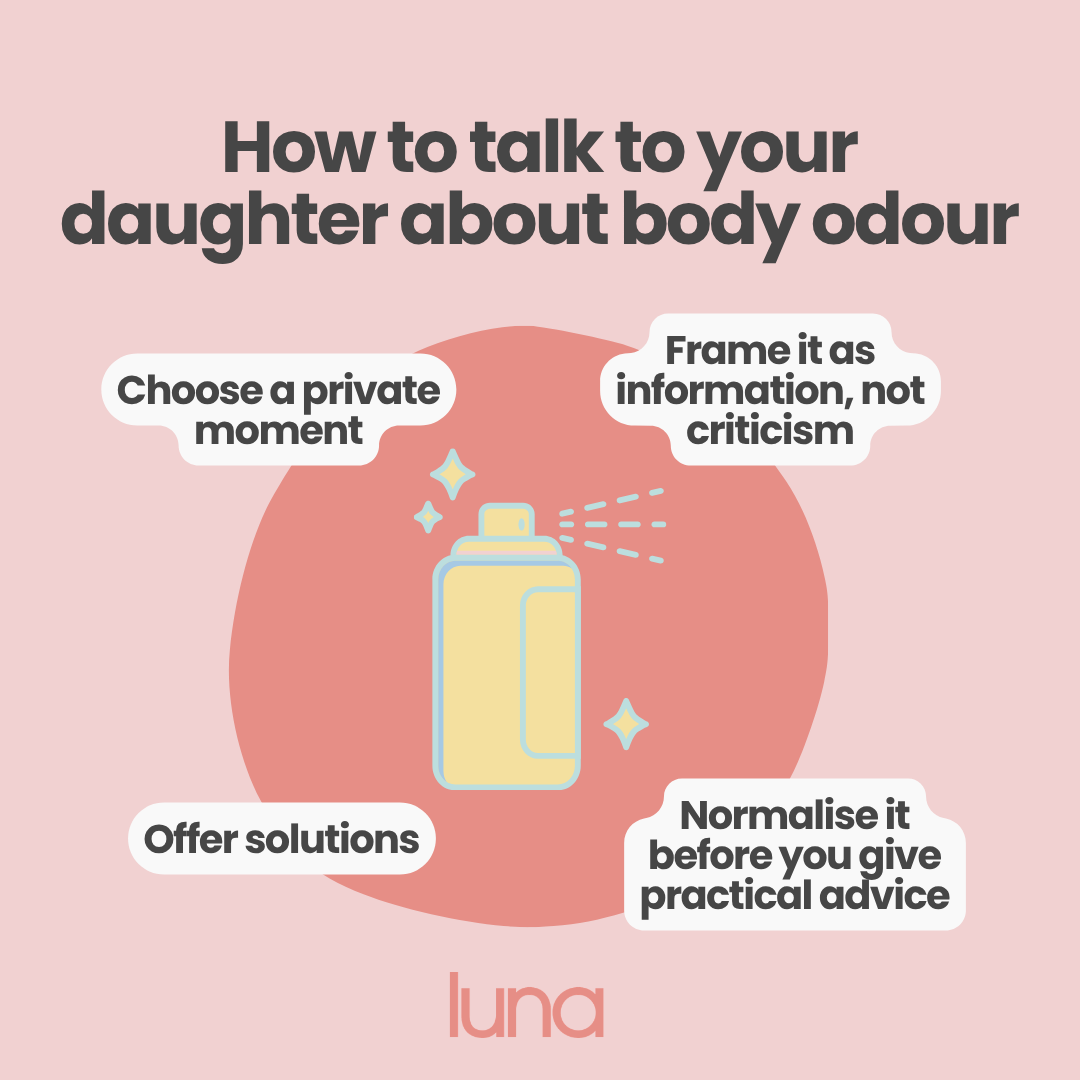
- Choose a private moment, not in front of siblings or when she is already stressed
- Frame it as information, not criticism: "I wanted to let you know about something that happens to everyone going through puberty"
- Normalise it before you give practical advice: "your body is changing, and that means your hygiene routine needs to change too"
- Offer solutions at the same time as raising the topic, so she does not sit with embarrassment
Keep it brief. You do not need a long lecture. A short, warm, practical exchange is enough.
For more on this, check out luna’s article on how to talk to your daughter about puberty.
What hygiene routine should she have?
NHS guidance recommends daily showering or bathing, with particular attention to underarms and feet.
Practical steps to cover:
- Shower or bath at least once a day, more if she exercises
- Wash underarms and feet thoroughly with soap or shower gel
- Wear clean clothes each day, especially fresh underwear
- Use deodorant or antiperspirant under the arms daily
- Wash sports kit regularly
Showing her where you keep deodorant and making sure she has her own, in a scent she likes, is often the simplest way to get a routine started.
You may also want to build her a puberty kit that includes self-care items to encourage independence in her hygiene routines.
What if she gets defensive?
Defensiveness is a normal teenage reaction to feeling criticised. If she pushes back, stay calm and do not push back yourself.
NHS guidance on coping with teenagers notes that teenagers can be largely emotional rather than logical because of their hormones, and responding calmly and consistently is the most effective approach.
You might simply say: "I'm not criticising you. Every person who goes through puberty has to deal with this. Here's what helps." Then drop it for now.
FAQ
My daughter doesn't seem to notice her own body odour. Is that normal?
Yes. People adapt to their own smell very quickly. It does not mean she is ignoring it or being careless. She may genuinely not notice.
Is deodorant safe for teenagers?
Yes, there is no minimum age restriction. Look for fragrance-free or sensitive skin formulas if she has any skin sensitivity.
What is the difference between deodorant and antiperspirant?
Deodorant masks or neutralises smell. Antiperspirant also reduces the amount of sweat produced. Some products combine both. Either is appropriate for teenagers.
What if she refuses to wear deodorant?
Try not to make it a battle. Keeping deodorant visible in the bathroom, buying one in a scent she chose, and returning to the conversation calmly a few days later tends to be more effective than enforcing it.
A little patience and a lot of kindness goes a long way. Once body odour management becomes part of her daily routine, it usually sticks.
How we created this article:
luna's team of experts comprises GPs, Dermatologists, Safeguarding Leads and Junior Doctors as well as Medical Students with specialised interests in paediatric care, mental health and gynaecology. All articles are created by experts, and reviewed by a member of luna's senior review team.
Sources:
NHS Cambridgeshire & Peterborough Children's Health "Hygiene for young people and teenagers" | 01.06.26
https://cambspborochildrenshealth.nhs.uk/child-development-and-growing-up/hygiene/hygiene-for-young-people-and-teenagers/NHS "Coping with your teenager" | 01.06.26
https://www.nhs.uk/mental-health/children-and-young-adults/advice-for-parents/cope-with-your-teenager/NHS CNWL School Health Service "Personal hygiene for teenagers" | 01.06.26
https://www.schoolhealth.cnwl.nhs.uk/young-people/health-and-wellbeing-zone/personal-hygiene/We'd love to keep in touch!
Sign up to our parent newsletter for emails on the latest teen trends, insights into our luna community and to keep up to date
By signing up, you are agreeing that we can use your email address to market to you. You can unsubscribe from marketing emails at any time by using the link in our emails. For more information, please review our privacy statement.