How do I talk to my daughter about the manosphere?
And what is the manosphere?

Updated May 7, 2026 • Medically reviewed by Dr. Emma Dickie
Medically reviewed by Dr. Emma DickieIn this article
- In short
- What is the manosphere?
- How does the manosphere show up in my daughter's world?
- What are the signs my daughter might be affected?
- How do I actually start the conversation?
- What do I say if she defends Andrew Tate or "alpha" culture?
- What if my daughter's boyfriend is into manosphere content?
- How do I help her push back without shutting her down?
- What slang and emojis might she hear or see?
- What if I still feel out of my depth?
- FAQs
In short
The best way to talk to your daughter about the manosphere is calmly, curiously, and often.
Start with what she's already seeing: boys at school repeating Andrew Tate clips, friends joking about "alphas", or content slipping onto her TikTok feed.
Ask questions, share your own worries honestly, and give her the language to push back, without shutting the conversation down.
If you've just watched Adolescence, or Louis Theroux's Inside the Manosphere, or had a letter home from school about it, you're probably sitting with a lot of questions and a knot in your stomach.
You're not alone.
luna hears from parents every day who are worried about how online misogyny is shaping the boys their daughters are growing up alongside, dating, or sharing a classroom with.
The good news: you don't need to be an expert in every TikTok trend to help your daughter navigate this.
You just need to know what's out there, and have a few conversation points ready.
This guide gives you scripts, signs, and starting points, so the next time the manosphere comes up in your house, you've got something to work with.
What is the manosphere?
The manosphere is a network of online spaces where some men and boys share views that are often angry, sexist, and anti-women.
A lot of the content is dressed up as advice on how to be more confident, "high-value", or "alpha", but a lot of it pushes the idea that women are the problem.
The most well-known figure associated with it is Andrew Tate, whose clips spread widely on TikTok, YouTube Shorts, and Instagram Reels.
How does the manosphere show up in my daughter's world?
Even if your daughter never searches for this content, she's almost certainly coming into contact with it.
Given that nearly 1 in 2 teen girls (47%) say TikTok is their favourite app, according to a luna poll, manosphere clips are hard to avoid.
Here's where it tends to show up:
- On her TikTok or Instagram For You Page, often as short clips that look like self-improvement advice
- In the boys around her, repeating "alpha/beta" jokes, quoting Tate, or using words like "simp" and "high-value"
- In her friendship group, where girls might defend or dismiss this content to keep the peace with male friends
- In school, sometimes so much that schools are now sending letters home to parents
- In her relationships, particularly when a boyfriend or love interest starts repeating manosphere ideas
A teen girl recently asked this in the luna app:
"Some of my friends support Andrew Tate, and that makes me uncomfortable because of all the sexist things he has said. Me and some of my friends have tried to talk to them about it, but they get annoyed with us for 'always bringing it up'. I'm not sure if I should unfriend them or not, but I am worried that I will lose the rest of my friendgroup if I do."
So even girls who clearly reject this content are having to navigate it socially.
What are the signs my daughter might be affected?
This is rarely obvious, and the signs can look a lot like "normal teen stuff". Trust your gut, but here's what to watch for:
- Language: she starts using words like "high-value", "alpha", "simp" or "red-pilled", even jokingly
- Self-image: she talks about her body, age or looks in harsher terms, or compares herself to an "ideal"
- Her friendships: she's spending more time around boys who dismiss or mock girls, and laughing along to keep the peace
- Her boyfriend or love interest: he's changed how he talks about girls, feminism, or what a relationship "should" look like
- Her views on feminism: she rolls her eyes at it, or tells you it's "cringe" or "unfair to men"
- Her mood: she seems flatter, more anxious, or less sure of herself after being online or with certain friends
None of these on their own mean something is wrong. But a cluster of them is a cue to open a conversation.
How do I actually start the conversation?
You don't need a perfect opener, just a low-pressure one. The goal is to get her talking, not to deliver a lecture.
A luna poll of 1,873 girls found that 1 in 5 (21%) say reassurance that they won't be judged is what would help them open up to parents. So lead with that energy.
Try one of these:
- "Have you heard anyone at school talk about Andrew Tate? What do they actually say?"
- "I watched something about the manosphere and it made me think, have you come across any of that online?"
- "If a boy ever says something that feels off to you, I want you to know you can tell me, even if you're not sure whether it's a big deal."
- "I'm not here to tell you what to think, I just want to understand what you're seeing."
Then:
- Listen more than you talk
- Ask follow-ups instead of reacting: "how did that make you feel?" / "what did your friends say?"
- Resist the urge to lecture, even if what she says winds you up
- Keep the door open for next time: "thanks for telling me, come back to me whenever"
What do I say if she defends Andrew Tate or "alpha" culture?
This is where a lot of parents freeze. Try not to panic, defending this content is often a test to see how you'll react.
Some scripts that can help:
- "I get why some of it sounds funny or empowering. Can I share what worries me underneath the jokes?"
- "You don't have to agree with me. I just want us to think about what he's actually saying about girls and women."
- "What do you think he'd say about you, or your best friend? Would you be okay with it?"
Try to avoid: calling her stupid, banning the app on the spot, or making her defend a position she was only half-committed to. All of those make her dig in harder.
What if my daughter's boyfriend is into manosphere content?
This is one of the most common worries parents are bringing up online right now, and it's a tricky one, because telling her to dump him almost never works.
Here's an approach that tends to land better:
- Name what you've noticed, calmly: "I've noticed some of the things he's said lately sound different. Have you?"
- Put the focus on how she's treated, not on him: "I'm not going to tell you who to be with. I do want you to have the same respect in your relationship that you give to him."
- Ask questions, not ultimatums: "How does he talk about other girls when you're not there? How does that feel?"
- Stay close: the more supported she feels at home, the less she'll feel she has to defend him to you
If you ever see signs of controlling, coercive, or unsafe behaviour, that's different, and a conversation with a doctor, school safeguarding lead, or a service like Women's Aid or The Mix is the right next step.
How do I help her push back without shutting her down?
You want her to come away feeling more confident, not more confused.
A few things that help:
- Give her language: if she's not sure how to respond to a boy saying something sexist, practise a few lines together, like "that's actually not true" or "I'm not going to laugh at that"
- Validate how hard it is: speaking up in a group of boys who all agree with each other is genuinely difficult
- Remind her she doesn't always have to respond: sometimes walking away, leaving the group chat, or unfollowing an account is the answer
- Point her to positive voices: creators, athletes, and writers who model different versions of masculinity and strong young women
- Tell her when she gets it right: a simple "I'm proud of how you handled that" goes a long way
What slang and emojis might she hear or see?
Some manosphere language is obvious. A lot of it isn't. Here's a quick reference so you're not caught off guard.
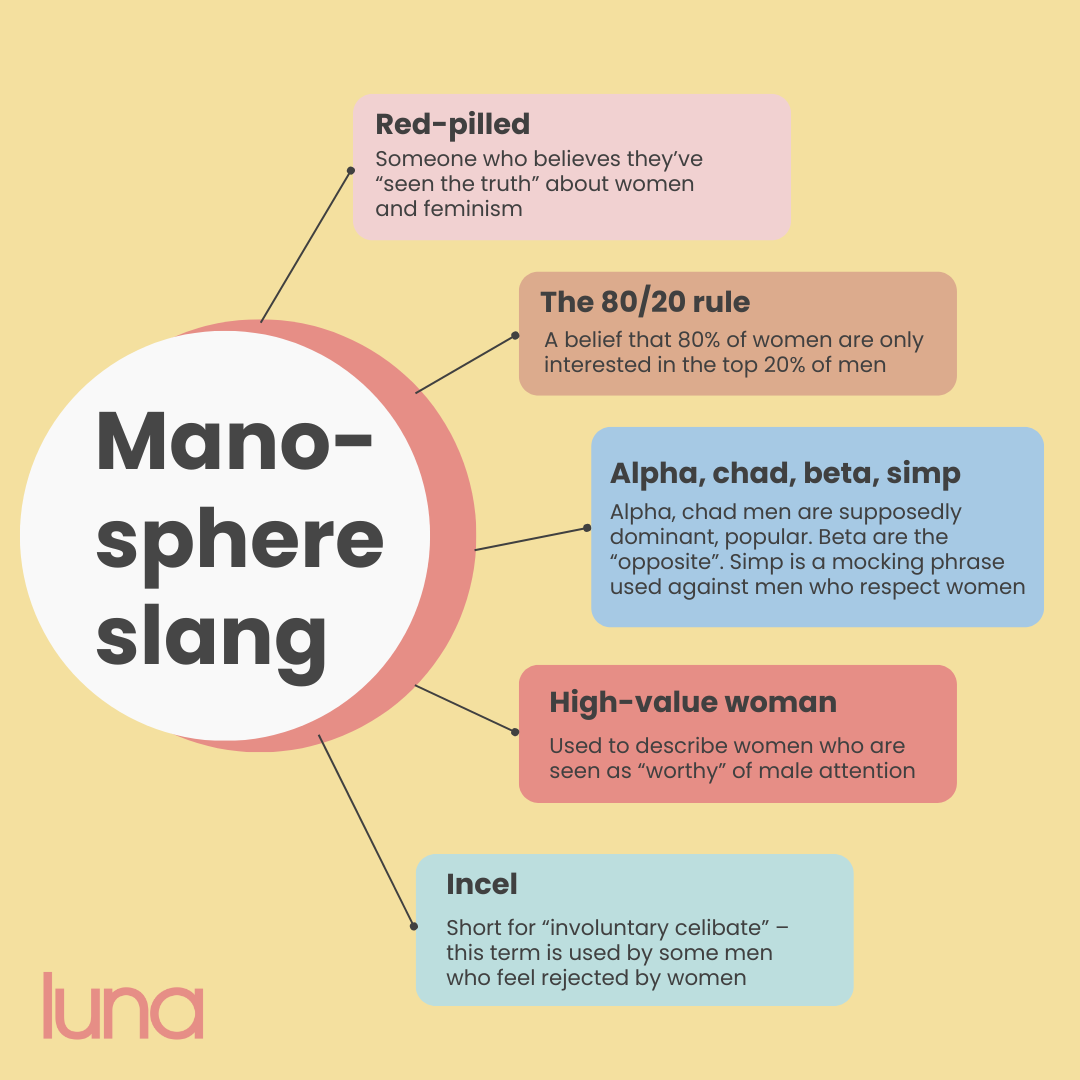
Common slang:
- "Red-pilled": someone who believes they've "seen the truth" about women and feminism
- "Simp": an insult aimed at boys who are kind or respectful towards girls
- "Alpha": a so-called strong, dominant man
- "Beta": an insult for men seen as weak or not dominant, the opposite of "alpha"
- "High-value woman": a woman seen as "worthy" of male attention, usually based on looks, youth, or how "submissive" she is
- "Chad": a stereotypically good-looking, popular, "alpha" man, often used mockingly
- "Incel": short for "involuntary celibate"; used by men who feel rejected by women, with parts of the community promoting extreme views
- "The 80/20 rule": the belief that 80% of women only want the top 20% of men, often used to justify bitterness
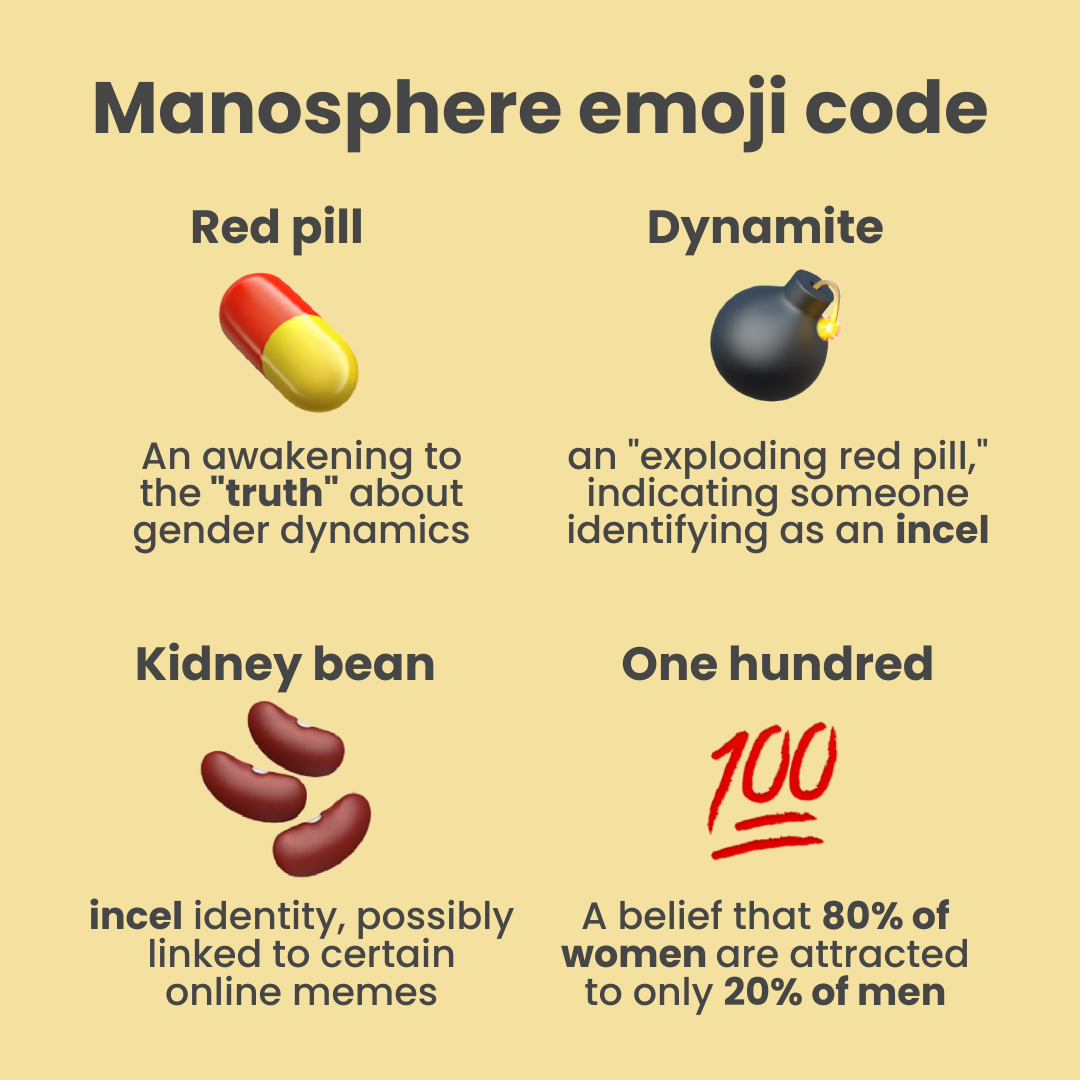
Emojis to know about:
- 💊 Red pill: an "awakening" to the manosphere's view of women
- 💣 Dynamite: an "exploding red pill", often used by incels
- 💯: associated with the "80/20 rule"
- 🫘 Kidney bean: used to signal incel identity in some memes
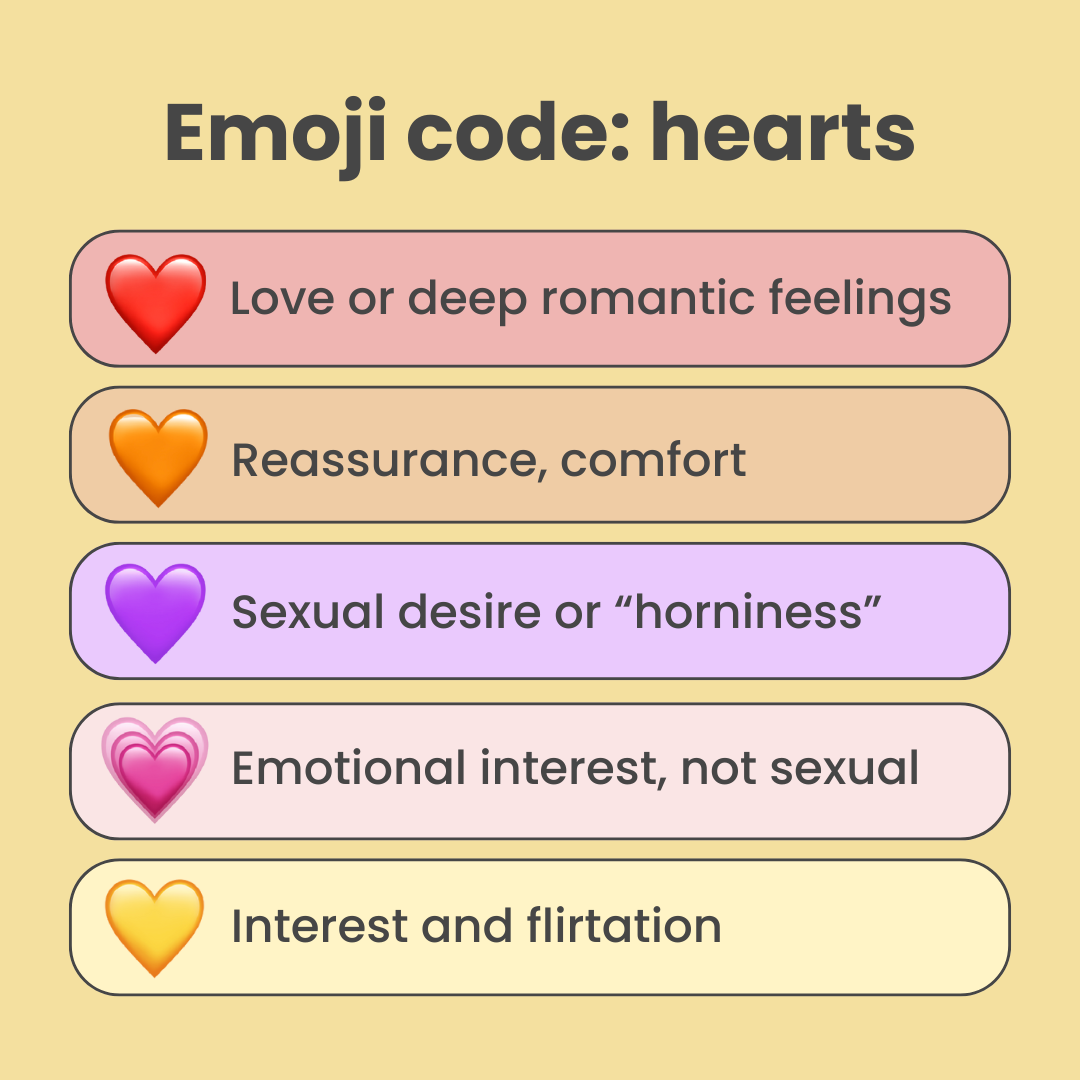
- ❤️ Red heart: love or deep romantic feelings
- 💜 Purple heart: sexual desire or "horny" intentions
- 💛 Yellow heart: flirtation or interest
- 💗 Pink heart: emotional interest without sexual intent
- 🧡 Orange heart: reassurance or comfort
💡 Helpful to know: your daughter may not use these this way herself, but knowing the meanings helps you read the room if something feels off.
What if I still feel out of my depth?
Honestly, there isn't a perfect way to navigate this, and the manosphere isn't always easy to spot: that's often the point.
But the more you understand how it works, the better you can help your daughter feel safe, supported, and sure of herself.
If you want a positive space to point her to, luna is an app dedicated to helping teen girls feel more confident and empowered.
At the end of the day, you don't need to decode every slang word or emoji. You just need to stay curious, keep talking, and let her know you're always there.
FAQs
What age should I start talking to my daughter about the manosphere?
By around 10 or 11, before Andrew Tate clips reach her through classmates or her feed. Keep it light and ongoing rather than one big chat.
Can the manosphere affect my daughter even if she doesn't watch it?
Yes, and this is the bit parents most often miss. Boys at school repeating manosphere language, jokes in group chats, or a boyfriend who's been influenced can all shape her self-esteem, her dating experiences, and how safe she feels socially.
How do I talk to my daughter about Andrew Tate specifically?
Start with curiosity: "what do people at school say about him?" Share what concerns you, without banning the name. The more you forbid, the more interesting he gets. Focus on the ideas, not the person.
My daughter's boyfriend has got into the manosphere, what should I do?
Stay close to your daughter first. Name what you've noticed, ask how she feels, and focus on whether she's being treated with respect. Telling her to leave him rarely works and usually pushes her away from you.
Are schools doing anything about the manosphere?
More and more schools in the UK are addressing it through RSHE (Relationships, Sex and Health Education) lessons, and some send letters home to parents. If your daughter's school hasn't mentioned it, asking pastoral staff what they're doing is completely reasonable.
How we created this article:
luna's team of experts comprises GPs, Dermatologists, Safeguarding Leads and Junior Doctors as well as Medical Students with specialised interests in paediatric care, mental health and gynaecology. All articles are created by experts, and reviewed by a member of luna's senior review team.
Sources:
Internet Matters "What is the manosphere and why is it a concern?" | Accessed 22.04.26
https://www.internetmatters.org/hub/news-blogs/what-is-the-manosphere-and-why-is-it-a-concern/Internet Matters "Online misogyny and young people" | Accessed 22.04.26
https://www.internetmatters.org/wp-content/uploads/2023/11/Internet-Matters-Online-misogyny-and-young-people-teacher-briefing-Nov-2023.pdfHarriet Over, Carl Bunce, Delali Konu, David Zendle "What do we need to know about the manosphere and young people’s mental health?" | Accessed 22.04.26
https://acamh.onlinelibrary.wiley.com/doi/10.1111/camh.12747PSHE Association "Addressing the influence of online misogyny and the manosphere through RSHE/PSHE" | Accessed 22.04.26
https://pshe-association.org.uk/news/addressing-the-influence-of-online-misogyny-and-the-online-manosphere-through-rshe/psheUCL "Social media algorithms amplify misogynistic content to teens" | Accessed 22.04.26
https://www.ucl.ac.uk/news/2024/feb/social-media-algorithms-amplify-misogynistic-content-teensSSS Learning "Manosphere emojis" | Accessed 22.04.26
https://ssslearning.co.uk/safeguarding-articles/manosphere-emojisWe'd love to keep in touch!
Sign up to our parent newsletter for emails on the latest teen trends, insights into our luna community and to keep up to date
By signing up, you are agreeing that we can use your email address to market to you. You can unsubscribe from marketing emails at any time by using the link in our emails. For more information, please review our privacy statement.