How to get your teenage daughter assessed for ADHD or autism
From first worry to assessment

Updated September 8, 2026 • Medically reviewed by Dr. Katie Knight
Medically reviewed by Dr. Katie KnightIn this article
- In short
- How do I get my daughter assessed for ADHD or autism?
- Why didn't anyone spot my daughter's ADHD or autism sooner?
- What happens at my daughter's ADHD or autism assessment?
- How long will my daughter wait for an NHS assessment?
- Should I pay for a private ADHD or autism assessment?
- How can I support my daughter while she waits?
- FAQs
- Where do we go from here?
In short
If you think your daughter might have ADHD or be autistic, the route to answers usually starts with her school and a doctor, who can refer her for a specialist assessment.
Only a specialist can diagnose either condition.
NHS waits can stretch to years, but Right to Choose in England may find a shorter list, and support at school can start before any diagnosis.
How do I get my daughter assessed for ADHD or autism?
Speak to a doctor or her school's special educational needs coordinator (SENCO) and ask for a referral to a specialist.
Only a specialist, such as a paediatrician or a child and adolescent psychiatrist, can diagnose ADHD or autism.
It can feel like a big step to say it out loud.
Most parents have spent months quietly wondering before they get this far, so if you're reading this at midnight, you're in good company.
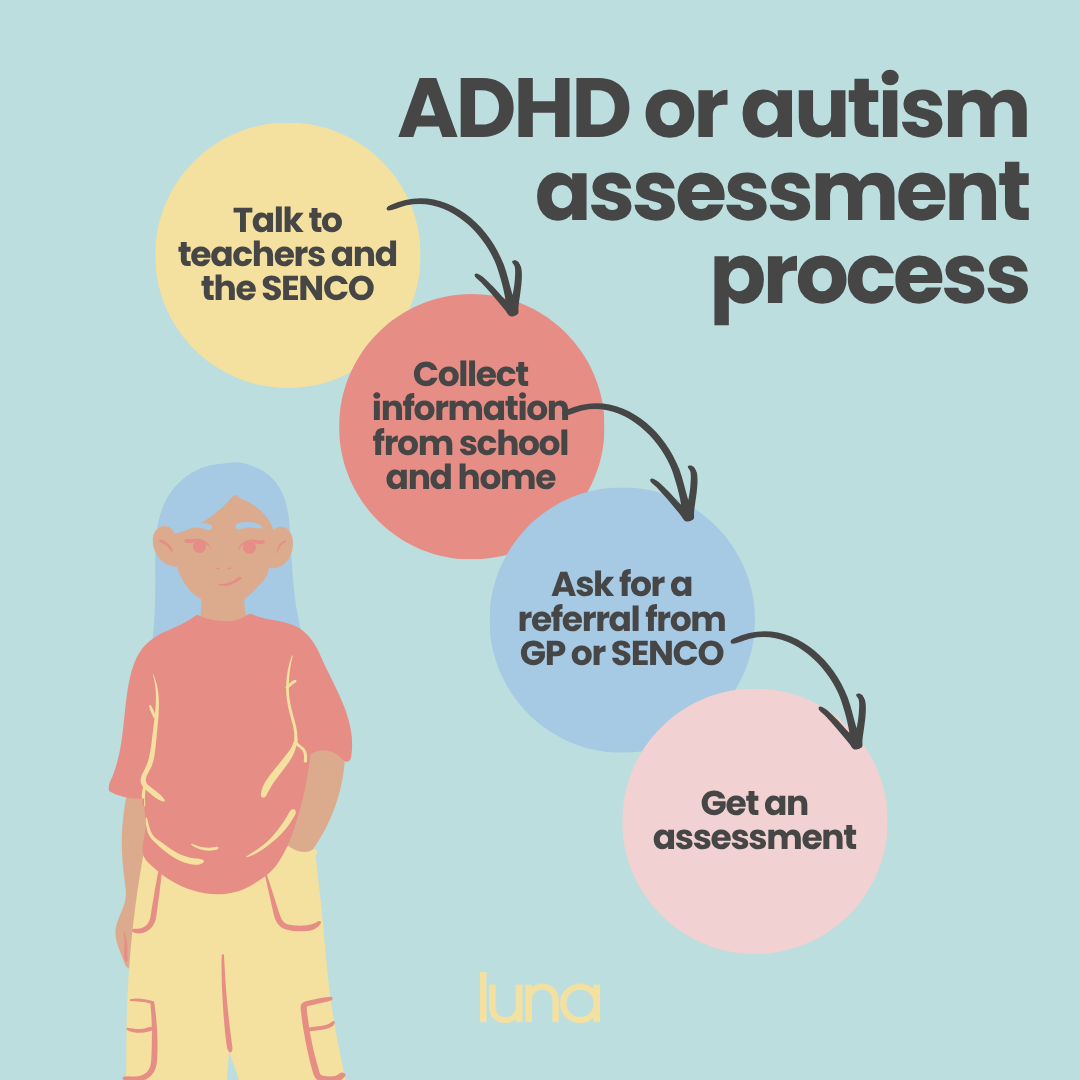
The route usually looks like this:
- Talk to her teachers and the SENCO about what you're both noticing at home and at school
- Ask the SENCO to write a short summary of how she's doing at school and bring it to the appointment
- Write a list of the signs you've noticed, with examples, and ask people who know her well what they've seen
- Book a doctor's appointment and ask for a referral for an ADHD or autism assessment
The doctor can't diagnose either condition themselves, but they can rule out other explanations for her symptoms and start the referral.
Why didn't anyone spot my daughter's ADHD or autism sooner?
Often because girls don't look like the textbook picture.
ADHD is recognised less often in girls, partly because girls more commonly have inattentive symptoms, which are quieter and easier to miss than hyperactivity.
The research backs this up.
Girls meet the diagnostic criteria for ADHD at just under half the rate boys do, yet by adulthood the numbers are almost equal.
That gap represents years of girls flying under the radar.
Autistic girls, meanwhile, often mask: copying how other children behave, staying quiet in situations they find hard and appearing to cope socially.
Masking can make everyday life exhausting, and it can hide the signs until the demands of secondary school outgrow her coping strategies.
If you’re still unsure, it can help to read up on the signs of ADHD in teenage girls and the signs of autism in girls before the appointment.
What happens at my daughter's ADHD or autism assessment?
There's no blood test or brain scan.
A specialist team builds a detailed picture of your daughter from several angles, and you'll get a report or diagnosis at the end.
An assessment usually involves:
- Talking with you and your daughter about her symptoms, her development and family life
- Questionnaires or forms for you, for her and sometimes for her school
- The specialist contacting her teacher or SENCO to hear how she's doing in class
- For autism, watching how she interacts and speaking to people who know her well
For an ADHD diagnosis, her symptoms need to show up in more than one setting, such as home and school.
That's why the school's input matters so much.
How long will my daughter wait for an NHS assessment?
It varies hugely, and it can be a long time.
The NHS itself says children may wait several months or even years for an ADHD assessment, and autism waits can also be very long.
There are ways to shorten or soften the wait:
- Ask the doctor how long the local waiting list is before the referral goes in
- In England, Right to Choose means you can ask to be referred to a provider with a shorter list, anywhere in the country
- Ask for a second opinion if you feel the referral is going nowhere
- Keep notes of incidents, school feedback and anything else that adds to the picture
One thing worth holding onto: she doesn't need a diagnosis to get help at school.
Support from the SENCO should be based on her needs, not a diagnosis, so it can start while she's still on the list.
Should I pay for a private ADHD or autism assessment?
Some families choose to, and it's understandable when the wait is measured in years.
It's worth asking a few questions before spending the money, though, because private routes have trade-offs.
Questions worth asking before going private:
- Does the provider follow NICE guidelines, the same diagnostic standards the NHS uses?
- Will the local NHS accept the diagnosis afterwards, including any shared care agreement for medicine?
- How will her school treat a private report when deciding on support?
- Could Right to Choose get her seen at the same clinic on the NHS instead?
That last one surprises a lot of parents.
In England, you can ask for an NHS appointment at a private clinic if it provides ADHD services for the NHS, which can mean seeing the same specialists without the bill.
And if medicine is ever on the table, it has to be started and monitored by a specialist.
A doctor can usually only take over prescribing under a shared care agreement.
How can I support my daughter while she waits?
The wait is frustrating, but it isn't dead time.
Support at home and at school can start now, and everything you learn along the way makes the assessment stronger.
Some parents find it helps to:
- Meet the SENCO each term to review what's working in class
- Break tasks into short chunks with breaks, and give instructions one at a time
- Protect sleep, healthy eating, and physical activity she actually enjoys
- Ask the local authority about an education, health and care plan (EHCP) if school support isn't enough, something you can request yourself
Her own understanding matters too.
luna gives teen girls a space to explore health and wellbeing topics at their own pace, with content reviewed by medical experts, so she can start making sense of how her brain works without judgement or noise.
If the wait is taking a toll on her mood, there are small everyday ways to support her mental health while you wait for the professionals.
FAQs
Can our family doctor diagnose ADHD or autism?
No.
A doctor can listen, rule out other causes and make the referral, but only a specialist such as a paediatrician or a child and adolescent psychiatrist can make the diagnosis.
Will a diagnosis get my daughter extra time in exams?
Not automatically.
Exam support such as extra time or rest breaks is arranged through school, based on her needs and the evidence the school holds rather than a diagnosis alone.
The SENCO can explain exactly what's needed, which is especially worth checking before paying for a private report.
Is 15 or 16 too late for a diagnosis?
No.
ADHD symptoms start before age 12, but plenty of girls aren't diagnosed until their teens or even adulthood, precisely because the signs were missed earlier.
A diagnosis can still make a real difference at any age.
What happens after my daughter is diagnosed?
The specialist will talk you both through what the diagnosis means and what support is available, from school adjustments to talking therapies.
Medicine is an option for some young people with ADHD, never a requirement, and it must be started and monitored by a specialist.
Where do we go from here?
Whatever the waiting list says, you've already done the most useful thing: taken her seriously.
Whether the answer turns out to be ADHD, autism, both or neither, support that helps her is available at school and at home right now.
If ADHD is looking likely, luna's guide to parenting a teen with ADHD is full of practical strategies for daily life.
And luna's expert-reviewed content in the app gives her somewhere safe to explore it all in her own time too.
How we created this article:
luna's team of experts comprises GPs, Dermatologists, Safeguarding Leads and Junior Doctors as well as Medical Students with specialised interests in paediatric care, mental health and gynaecology. All articles are created by experts, and reviewed by a member of luna's senior review team.
Sources:
NHS "ADHD in children and young people" | Accessed 15.06.26
https://www.nhs.uk/conditions/adhd-children-teenagers/NHS "How to get an autism assessment" | Accessed 15.06.26
https://www.nhs.uk/conditions/autism/assessments/NHS "Signs of autism in children" | Accessed 15.06.26
https://www.nhs.uk/conditions/autism/signs-in-children/YoungMinds "ADHD" | Accessed 15.06.26
https://www.youngminds.org.uk/parent/parents-a-z-mental-health-guide/adhd/NICE "Attention deficit hyperactivity disorder: diagnosis and management" | Accessed 15.06.26
https://www.nice.org.uk/guidance/ng87Hinshaw SP et al. "Annual research review: attention-deficit/hyperactivity disorder in girls and women: underrepresentation, longitudinal processes, and key directions" | Accessed 15.06.26
https://pubmed.ncbi.nlm.nih.gov/34231220/We'd love to keep in touch!
Sign up to our parent newsletter for emails on the latest teen trends, insights into our luna community and to keep up to date
By signing up, you are agreeing that we can use your email address to market to you. You can unsubscribe from marketing emails at any time by using the link in our emails. For more information, please review our privacy statement.