How do I know if my daughter's behaviour is normal or a sign something's wrong?
Normal teen vs red flags: a parent's guide
Updated June 2, 2026
In this article
In short
Most challenging teen behaviour is developmentally normal: moodiness, pushing boundaries, wanting privacy, preferring friends to family.
But some behaviours signal something more serious, such as persistent low mood, withdrawal from all activities, signs of self-harm, sudden dramatic changes, or disordered eating.
The key is pattern and persistence. Occasional difficult behaviour is part of growing up. Sustained, escalating distress is different and warrants professional attention.
What counts as normal teenage behaviour?
It helps to know what's within the expected range before worrying about what isn't.
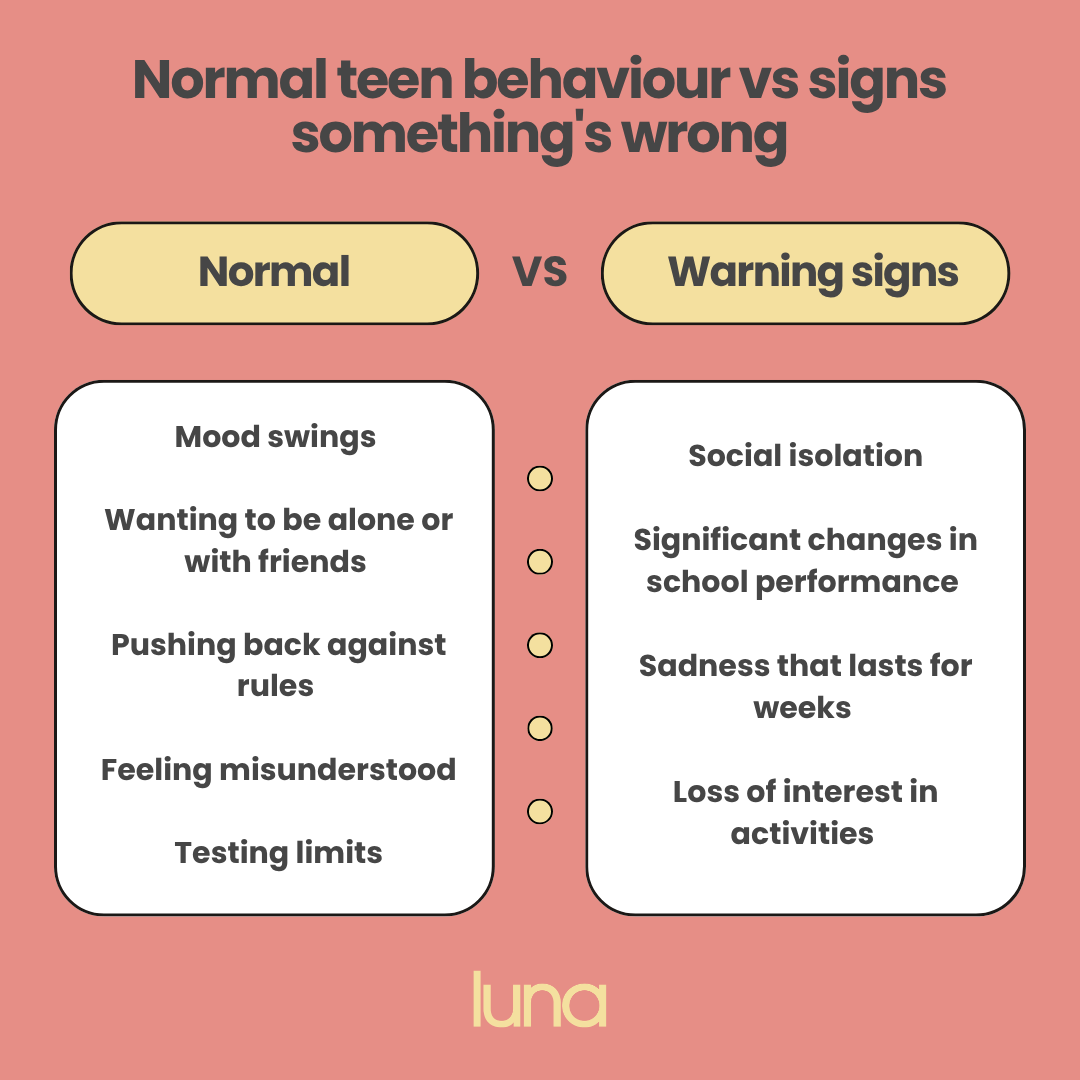
Typical teenage behaviours that, while often challenging for parents, are developmentally normal include:
- Mood swings and emotional intensity
- Wanting more time alone or with friends
- Pushing back against rules and authority
- Periods of sullenness or seeming "checked out"
- Testing limits and arguing with decisions
- Feeling misunderstood
- Changing interests, friendships and sense of identity
These behaviours are a normal part of adolescence, driven by hormones, a still-developing brain and the enormous task of building an independent identity.
What are the signs that something more serious might be happening?
The NHS outlines specific warning signs that go beyond typical teenage development.
Seek professional advice if you notice:
Signs of depression:
- Continuous low mood or sadness lasting more than two weeks
- Frequent unexplained tearfulness
- Expressed hopelessness or helplessness
- Loss of interest in activities she used to enjoy
- Social isolation (pulling away from friends as well as family)
- Disturbed sleep over a sustained period
Signs of an eating disorder:
- Thinking she’s fat when she isn't
- Being secretive or deceptive about food
- Becoming anxious or upset when asked to eat
- Vomiting or other purging behaviour
- Counting calories
Signs of self-harm:
- Unexplained cuts or bruises, particularly on arms, wrists or thighs
- Keeping herself fully covered even in hot weather
General red flags:
- Sudden dramatic change in behaviour or personality
- Dropping friends and becoming socially isolated
- Significant changes in school performance
- Dramatic changes in appetite or sleep
How do I tell the difference between a bad patch and a real problem?
Two factors matter most: duration and impact. A bad week, even a bad month, is different from a sustained pattern.
Ask yourself:
- Has this been going on for more than two to three weeks?
- Is it getting worse, not better?
- Is it significantly affecting her daily life, such as school, friendships, eating, sleep?
- Has she stopped doing things that used to bring her joy?
A "yes" to most of these shifts the picture from "teenage rough patch" to something worth professional attention.
What should I do if I'm worried?
Start with a conversation, not a confrontation. The NHS advises being honest: "I've noticed you seem to be going through something difficult, and I'm worried about you."
You don't need to have the answers when talking to your teen about mental health; you just need to open the door.
If she won't talk, try a different route: a note, a text, asking if she'd prefer to talk to someone else she trusts.
Raise your concerns during side-by-side activities such as walking, cooking, driving somewhere, rather than face-to-face sit-downs, which can feel like an interrogation.
You may also wish to explore free mental health resources for teens.
If you're seriously concerned about her mental health, see a doctor. You can attend alone to discuss your concerns if she's reluctant to go.
What helplines and services can help?
If you need guidance quickly:
- YoungMinds Parents Helpline: 0808 802 5544 (weekdays)
- Childline (for her): 0800 11 11 (24/7)
- Her school's pastoral team or SENCO is often a useful early point of contact
FAQ
My daughter says she's fine but I don't believe her. What do I do?
Trust the instinct. You know your daughter. Teenagers often say they're fine because they don't have words for what's happening, or because they don't want to worry you.
Keep the door open ("I'm here whenever you want to talk"), maintain your usual routines, and stay in contact with her school.
If your concern deepens, see a doctor alone to discuss what you're observing.
How is normal teenage moodiness different from depression?
Typical teen moodiness tends to be reactive. She's upset about something specific, recovers within hours or days, and still has periods of being her usual self.
Depression is more pervasive: it doesn't lift much, it applies broadly, and the enjoyment of things is reduced across the board.
Persistent low mood over two or more weeks, especially with withdrawal and loss of interest, is the key distinguishing pattern.
When should I consider therapy or counselling for my daughter?
If her distress is persistent, if she's struggling to function at school or socially, if she's showing signs of self-harm or disordered eating, or if you simply feel out of your depth.
Those are all valid reasons to pursue counselling. A doctor can make a referral to CAMHS or other services. Many schools also have counsellors available.
If you'd like more guidance on supporting her wellbeing, luna's how to help your teen's mental health is a good next step, as is teenage anxiety: spotting the signs.
How we created this article:
luna's team of experts comprises GPs, Dermatologists, Safeguarding Leads and Junior Doctors as well as Medical Students with specialised interests in paediatric care, mental health and gynaecology. All articles are created by experts, and reviewed by a member of luna's senior review team.
Sources:
NHS "Worried about your teenager?" | 02.06.2026
https://www.nhs.uk/mental-health/children-and-young-adults/advice-for-parents/worried-about-your-teenager/NHS "Coping with your teenager" | 02.06.2026
https://www.nhs.uk/mental-health/children-and-young-adults/advice-for-parents/cope-with-your-teenager/YoungMinds "Challenging behaviour parents guide" | 02.06.2026
https://www.youngminds.org.uk/parent/parents-a-z-mental-health-guide/challenging-behaviour/YoungMinds "Self-esteem and mental health guide for parents" | 02.06.2026
https://www.youngminds.org.uk/parent/parents-a-z-mental-health-guide/self-esteem/We'd love to keep in touch!
Sign up to our parent newsletter for emails on the latest teen trends, insights into our luna community and to keep up to date
By signing up, you are agreeing that we can use your email address to market to you. You can unsubscribe from marketing emails at any time by using the link in our emails. For more information, please review our privacy statement.