Should you let your daughter homeschool?
The pros, cons, and key questions
Updated July 7, 2026 • Medically reviewed by Dr. Emma Dickie
Medically reviewed by Dr. Emma DickieIn this article
In short
Homeschooling, also called elective home education (EHE), is legal in England and chosen by more than 100,000 families.
It can work well when it's a genuine fit, but it comes with real practical and financial responsibilities.
Whether it's right depends on your daughter's needs, your resources, and how much structure you can realistically provide.
If your daughter has been asking to leave school, or you've been watching her struggle and wondering whether there's another way, this can feel like a much bigger decision than it looks on paper.
There's no right or wrong answer here, only the answer that fits your family.
What might make homeschooling the right choice for my daughter?
The number of home-educated children in England has more than doubled since 2017.
Mental health was the most commonly cited reason in a 2023 Department for Education survey, with parents saying their daughter's wellbeing wasn't being supported in a mainstream school environment.
Other common reasons include bullying, unmet special educational needs (SEN), dissatisfaction with the school system, and philosophical or religious values.
Some families use it as a short-term intervention; others commit long-term.
What are the benefits of homeschooling my daughter?
The biggest potential advantage is flexibility.
Home education doesn't have to mirror a school day, and it doesn't need to follow the National Curriculum.
You can build around your daughter's pace, her strengths, and any specific needs she has.
For girls with autism, anxiety, ADHD, or sensory differences, removing the daily pressures of a mainstream school environment can make a significant difference.
The Department for Education's guidance notes that home-educated children often benefit from "almost continuous one-to-one contact" with their educator, which can make learning more efficient, not less.
If school anxiety is part of what's driving this question, it's worth looking at what changes schools can put in place first.
Some families find those changes are enough.
What are the downsides of homeschooling my daughter?
Social connection is the biggest practical risk.
The Department for Education's official guidance states that home education "may not be suitable if it leads to excessive isolation from the child's peers, and thus impedes social development."
Homeschooling doesn't automatically cause isolation, but social contact needs to be actively planned for.
Homeschooling doesn't automatically cause isolation, but social contact needs to be actively planned for.
There are financial realities too.
You'd be responsible for the full cost of your daughter's education, including GCSE entry fees.
Exams have to be taken at an external examination centre at your own expense, and those centres can be limited in some areas.
The 16 to 19 Bursary Fund is not available to young people home educated after the age of 16.
It's also worth knowing that if you withdraw your daughter from school and later change your mind, there's no guaranteed right to return to the same school.
An application would go through standard in-year admissions and her old place would not be held.
What questions should I ask myself before deciding?
The Department for Education's guidance for parents sets out several considerations worth sitting with honestly.
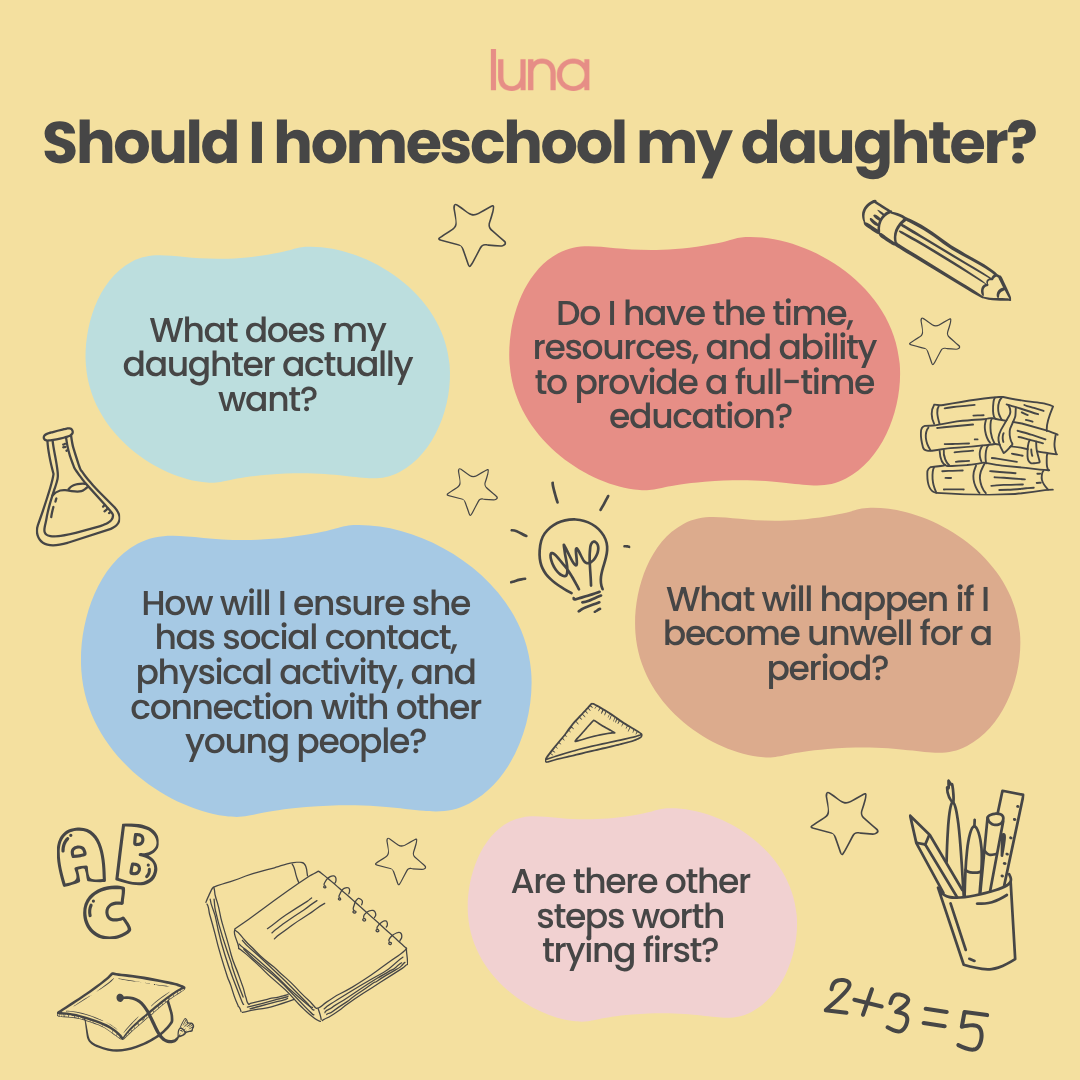
Why are you considering this now, and is homeschooling the answer to the underlying problem, or are there other steps worth trying first?
YoungMinds' guidance on school anxiety recommends working with schools to put changes in place before removing a daughter entirely.
You should also consider what your daughter actually wants and if she has thought it through.
Furthermore, do you have the time, resources, and ability to provide a genuinely full-time education?
It's worth thinking about what happens if you become unwell for a period, or if your circumstances change.
How will you make sure she has regular social contact, physical activity, and connection with other young people?
If you're thinking of bringing in a tutor, luna's guide to finding a safe tutor for your teen covers what to look for and how to check credentials.
What does the law say about homeschooling my daughter?
In England, parents are legally responsible for ensuring their child of compulsory school age receives an "efficient, full-time education suitable to their age, ability and aptitude."
That education doesn't have to happen in a school, but it does have to happen.
You don't need to be a qualified teacher, follow a set timetable, or teach formal lessons.
But the local authority can make enquiries to check that your daughter is receiving a suitable education.
If you've withdrawn her from a registered school, the school is required to notify the local authority.
There are no legal requirements to follow the National Curriculum, use specific materials, or arrange formal assessments.
But you should be able to demonstrate that full-time learning is taking place if asked.
luna gives teen girls a private, expert-reviewed space to ask questions about health and wellbeing.
If your daughter is finding it hard to talk, it can be a helpful place for her to start making sense of what she's going through.
FAQs
Is homeschooling better for my daughter's mental health?
Research findings are mixed.
Mental health is the most common reason families move to home education, and many find that removing a daughter from a stressful environment does help.
But research shows outcomes depend significantly on how structured the home education is, and how well social connection is maintained.
For daughters with significant mental health difficulties, professional support alongside any educational arrangement is worth exploring.
Can I homeschool my daughter if I'm not a teacher?
Yes.
There's no legal requirement to hold teaching qualifications, and many home-educating parents have none.
You can use private tutors, online learning platforms, co-operative arrangements with other home-educating families, and specialist resources.
Government guidance recommends that any outside tutor you bring in should hold a current DBS (Disclosure and Barring Service) certificate.
What happens if I change my mind about homeschooling?
There's no automatic right to return to your daughter's previous school.
If you withdraw her and later want her to re-enroll, you'd apply through the standard in-year admissions process.
A place at her former school is not guaranteed, but the local authority is required to find a suitable school place if you request one.
Will my daughter still be able to do her GCSEs?
Yes, but you'd need to organise and fund it yourself.
Homeschooled students aren't automatically entered for exams.
You'd register her with an external examination centre, choose an exam board and syllabus, and pay the entry fees.
Some local authorities offer discretionary financial support, but it's not guaranteed.
If she's already in Years 10 or 11, this timing is something to factor in carefully before withdrawing from school.
How do I make sure my daughter isn't isolated?
Social contact needs to be actively built in from the start.
Home education groups, sports clubs, volunteering, youth organisations, and part-time attendance at an FE college (available from age 14 to 16) are all options families use.
The government's guidance for parents notes that excessive isolation from peers makes education legally "unsuitable," so planning for social experiences is part of getting this right.
If the question underneath all of this is really "is my daughter okay?", luna's guide to spotting the signs of teenage anxiety is worth reading alongside this one.
How we created this article:
luna's team of experts comprises GPs, Dermatologists, Safeguarding Leads and Junior Doctors as well as Medical Students with specialised interests in paediatric care, mental health and gynaecology. All articles are created by experts, and reviewed by a member of luna's senior review team.
Sources:
Department for Education "Elective home education: guidance for parents" | Accessed 23.06.26
https://assets.publishing.service.gov.uk/media/5ca21e22e5274a77d9d26feb/EHE_guidance_for_parentsafterconsultationv2.2.pdfYoungMinds "School anxiety and refusal" | Accessed 23.06.26
https://www.youngminds.org.uk/parent/parents-a-z-mental-health-guide/school-anxiety-and-refusal/Green-Hennessy S. "Homeschooled adolescents in the United States: developmental outcomes" | Accessed 23.06.26
https://pubmed.ncbi.nlm.nih.gov/24793392/We'd love to keep in touch!
Sign up to our parent newsletter for emails on the latest teen trends, insights into our luna community and to keep up to date
By signing up, you are agreeing that we can use your email address to market to you. You can unsubscribe from marketing emails at any time by using the link in our emails. For more information, please review our privacy statement.