What should I do if my daughter wants to quit sport?
When the joy in sport disappears
Updated May 11, 2026
In this article
In short
Teen girls are dropping out of sport at record rates, even if they don’t really want to.
The drivers are real: confidence, body image, periods, kit, and time. Before accepting her quit, check what's actually changed for her, and whether keeping her moving in any form matters more than keeping her in this sport.
Why are so many teen girls quitting sport?
It's a system-level problem, not a personal failing. In Women in Sport's 2026 Let Her Dream report, only 23% of girls aged 13 to 24 now dream of reaching the top in sport, down from 38% in 2024.
That's the lowest level since the charity began tracking in 2020, and the gender dream gap is now at its widest in five years.
Most striking: the sharpest drop is among girls who say they love sport, with their dream rates falling 35%. The girls most invested are quitting fastest.
The drivers cluster around a few familiar themes:
- Body image and self-consciousness during puberty
- Periods that interrupt training, affect performance, or make the kit feel exposing
- Lack of visible female role models, especially in some sports
- PE kit that doesn't fit or feel comfortable
- Time pressure and stress as schoolwork ramps up
- Coaches and culture that haven't caught up with how teen girls' bodies and minds actually work
Knowing this isn't just her can take some of the guilt out of the conversation, both for her and for you.
Why might my daughter specifically be wanting to quit?
Underneath the system-level drivers, there's almost always something specific. Working out which one is the unlock.
According to luna polls of teens:
- 34% said confidence issues were the main reason they stopped enjoying sport they used to love
- 22% feel self-conscious about their physical abilities during sport
- 21% feel self-conscious about their body
- 55% say their PE kit makes them feel less motivated
- 69% have skipped or wanted to skip sport because of their period
- 65% have noticed their period affects their sporting ability.
If you don't know which driver it is yet, that's the question to start with, not "are you sure you want to quit?"
What can I do before accepting the quit?
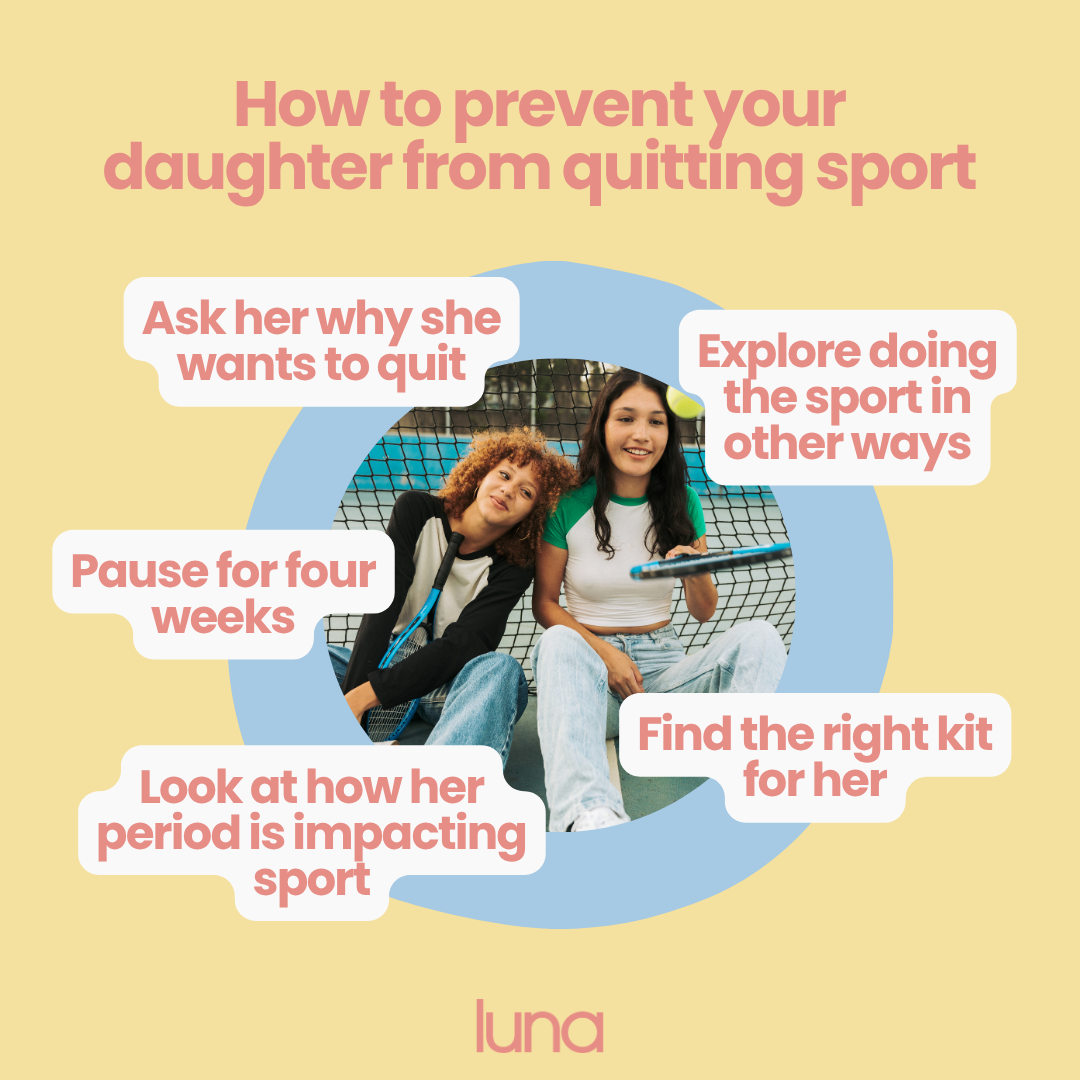
Most of the time, the answer to "should I let her quit" is yes, but not yet. A short pause, with the right questions inside it, often reframes the choice.
A useful sequence:
- Get curious before negotiating, with something like "what's it been like recently?" rather than "but you've done it for years"
- Separate the sport from the context by asking whether she'd love it with a different coach, group, time, or schedule
- Check the period angle, because a girl who's been miserable in PE for two years because of leaks or pain may not want to quit sport, just this version of it
- Look at the kit, because the right shorts, swimwear, sports bra, or period-friendly options can change how it feels in her body
- Try a four-week pause, where she keeps her place but doesn't have to perform, then revisits at the end
- Ask what she'd lose, including friendships, identity, and structure (if "nothing" comes back fast, that's information)
If confidence is an issue, you may want to check out luna’s article on body image issues.
How can she stay active without this sport?
This is the conversation worth having even if she does quit. Movement is the goal, not this specific sport.
Girls who quit one sport often quit movement altogether, and that's the bigger problem.
In a luna poll of 1,214 girls, over 2 in 3 (68%) said they don't get the recommended 60 minutes of exercise a day. Quitting one sport doesn't have to land her there.
Alternatives worth offering:
- Non-competitive options like climbing, dance, yoga, swimming, or hiking
- Strength training, which has strong links to body confidence and self-esteem
- Solo or small-group activities like running, cycling, padel, or tennis
- Movement that doesn't feel like sport, like walking with a podcast, gardening, or trampolining
- Activity with a social hook, like parkrun or a hiking group
- Period-friendly options if her cycle is part of why she dropped the original sport
Frame the alternatives as adding, not replacing. The aim isn't to fill the slot. It's to keep her relationship with her own body intact through the bit of adolescence where it most needs the wins.
When could quitting be a sign of something more?
Most quitting is normal. Sometimes it's the visible edge of something heavier.
Worth a closer look if she also has:
- Quitting other things at once, including social and academic activities she used to enjoy
- Persistent low mood, hopelessness, or harsh self-criticism
- Sleep, appetite, or energy changes
- Avoidance of mirrors, photos, or anything where her body is on show
- Restrictive eating or compulsive exercise patterns
- Self-harm, or talk of not wanting to be here
These can be signs of depression, anxiety, body dysmorphia, or an eating disorder.
If you're seeing several of the above, talk to your GP. Earlier support is better.
FAQ
My daughter has been training for years. Is it really okay for her to quit?
Yes, even after years. Sunk cost is real for parents but rarely useful for teens. The more useful question is whether the sport still works for who she is now, not who she was at 9.
Should I let her quit even if she's good at it?
Being good at it isn't a reason to stay if she's miserable. Being talented in a sport she's stopped enjoying tends to lead to burnout, injury, and resentment, not eventual love.
Could her period really be the reason?
Yes, more often than parents realise. If her quit lines up with worsening periods, painful cramps, or starting them recently, treat the period part directly through period pain relief.
What if she quits and then regrets it?
She might. Most teens who quit a sport don't return to that one, but many find another way to move their body in their late teens or twenties.
Letting her own the choice is more important than locking her in.
Should I let her drop the team but keep her in school PE?
That's often a sensible middle ground if school PE works for her. If PE is the worst bit, drop it from the question and find movement elsewhere.
The aim is keeping her active, not keeping her doing PE.
If she's also showing a wider drop in motivation alongside this, how to motivate a teenager is a useful next read.
How we created this article:
luna's team of experts comprises GPs, Dermatologists, Safeguarding Leads and Junior Doctors as well as Medical Students with specialised interests in paediatric care, mental health and gynaecology. All articles are created by experts, and reviewed by a member of luna's senior review team.
Sources:
Women in Sport "Let Her Dream / Dream Deficit 2026" report | Accessed 11 May 2026
https://womeninsport.org/wp-content/uploads/2025/12/Dream-Deficit-2026.pdfWomen in Sport "Reframing sport for teenage girls" | Accessed 11 May 2026
https://womeninsport.org/wp-content/uploads/2022/03/2022-Reframing-Sport-for-Teenage-Girls-Tackling-Teenage-Disengagement.pdfSport England "Active Lives Children and Young People Survey" | Accessed 11 May 2026
https://www.sportengland.org/research-and-data/data/active-livesNHS "Physical activity guidelines for children and young people (5 to 18 years)" | Accessed 11 May 2026
https://www.nhs.uk/live-well/exercise/physical-activity-guidelines-children-and-young-people/We'd love to keep in touch!
Sign up to our parent newsletter for emails on the latest teen trends, insights into our luna community and to keep up to date
By signing up, you are agreeing that we can use your email address to market to you. You can unsubscribe from marketing emails at any time by using the link in our emails. For more information, please review our privacy statement.