Should my teenage daughter take protein powder?
What's safe, what's hype
Updated May 22, 2026
In this article
- In short
- Why does my teen want protein powder?
- How much protein does my daughter actually need?
- Is protein powder safe for teenage girls?
- What's the difference between whey, plant protein, and creatine?
- When might protein powder actually make sense for my daughter?
- When should I worry about my daughter taking protein powder?
- What should I look for if I do buy her protein powder?
- How do I talk to my daughter about protein powder?
- FAQ
- A gentle next step
In short
Most teen girls don't need protein powder. Girls aged 11 to 18 need around 41g to 45g of protein a day, which is easy to get from food: eggs, yogurt, chicken, beans, and nuts.
Powders are generally safe for healthy teens in small amounts, but quality varies, and the industry is loosely regulated. The bigger question is usually why she wants it, not whether it's harmful.
Why does my teen want protein powder?
Usually it's TikTok, a friend at the gym, or sports performance. The protein-shake aesthetic has gone mainstream, especially with girls who lift, run, or play team sports.
Take a moment before reacting. Asking "why protein powder?" tells you more than saying yes or no. Her answer might be about strength, feeling full, fitting in, or how she sees her body.
In a luna poll of 2,718 teen girls, more than 4 in 5 (84%) said they'd felt pressure to have a back-to-school glow up, so it's worth quietly checking whether the protein interest is about performance or appearance.
How much protein does my daughter actually need?
Girls aged 11 to 14 need around 41g of protein a day, and girls aged 15 to 18 need around 45g a day. Most teens easily hit this through normal meals and healthy eating.
Here's what 45g of protein looks like across a single day:
- 1 boiled egg (around 6g)
- 100g Greek yogurt (around 10g)
- 1 chicken breast (around 25g)
- 1 slice of wholegrain bread (around 4g)
That's only four items, and she'd still have room for snacks. If your daughter eats three balanced meals with some protein in each, she's almost certainly getting enough without a powder.
Is protein powder safe for teenage girls?
For most healthy teens, a moderate amount of protein powder is safe. The bigger issues are quality, dose, and what it's replacing.
Things to keep in mind:
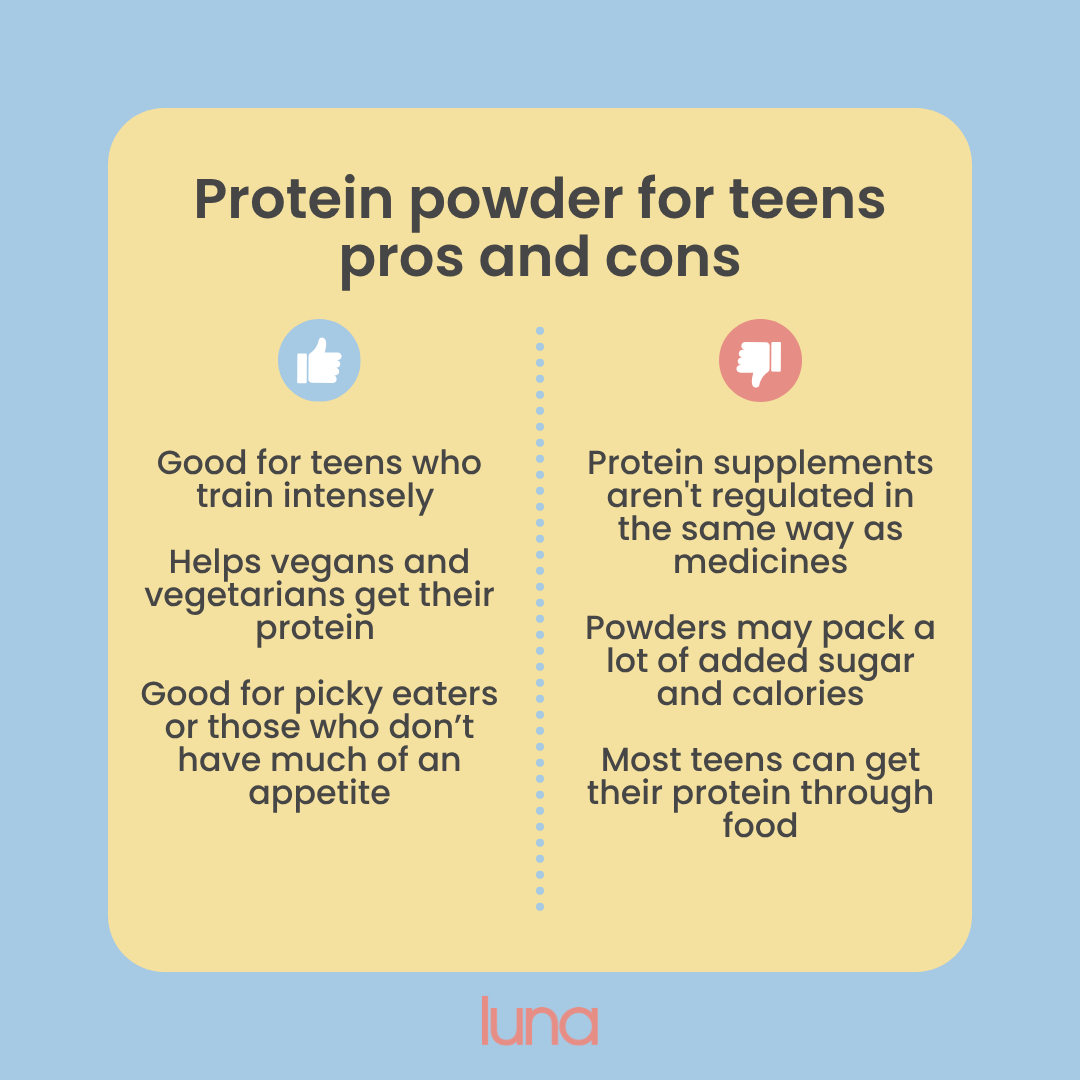
- Protein supplements aren't regulated in the same way as medicines, so quality varies a lot
- Independent testing has found some powders contain heavy metals or banned substances
- "Mass gainer" or "bulk" powders often pack a lot of added sugar and calories
- Powder calories can crowd out whole foods that carry vitamins, minerals, and fibre
If she's already eating well and growing well, she most likely doesn't need a powder.
If she's training hard, vegetarian, or struggling with appetite, it can be a useful add-on rather than a replacement.
What's the difference between whey, plant protein, and creatine?
They aren't the same thing, even though they often sit side by side on the supplement shelf.
- Whey protein: comes from dairy, absorbs quickly, and is the most studied. Not suitable if she's lactose intolerant or dairy-free
- Casein protein: also dairy-based, but digests slowly
- Plant protein: made from pea, soy, hemp, or rice. A good option for vegan or vegetarian teens
- Creatine: not a protein at all. It's a separate supplement used for short bursts of strength and power. Research in teen girls is limited, so most paediatric dietitians don't recommend it under 18 without a clear sports reason and supervision
If she's specifically asking for creatine, that's worth a separate conversation with your GP or a registered sports dietitian.
When might protein powder actually make sense for my daughter?
There are a few situations where a protein shake can genuinely help:
- She trains intensely, more than once a day, or does two-a-day sport
- She's vegetarian or vegan and finding it hard to hit her protein target
- She's a picky eater who often skips meals, for example, if she isn’t eating lunch at school
- She's recovering from illness, injury, or surgery, and her appetite is low
- She has braces, wisdom teeth out, or another reason chewing is hard
In these cases, treat the powder like a tool, not a replacement. One scoop blended into a smoothie with milk and fruit is very different to using shakes instead of meals.
When should I worry about my daughter taking protein powder?
The product matters less than her relationship with it. Watch for patterns rather than the powder itself.
Signs worth paying attention to:
- She's skipping meals and using shakes instead
- She's counting protein grams obsessively
- She's cutting out food groups or labelling foods "good" or "bad"
- She's training more, eating less, and her period has become irregular or stopped
- She’s counting calories
- She's hiding what she eats, or how much she trains
- She thinks she’s fat when she’s not
These are signs to gently open a conversation, and to consider speaking to your GP.
Disordered eating in teen girls doesn't always look like restriction. It can hide inside "clean eating", "hitting macros", or fitness-coded language.
What should I look for if I do buy her protein powder?
If you've decided to buy one, the label tells you most of what you need to know.
A reasonable choice usually has:
- A third-party testing logo (Informed Sport or NSF Certified for Sport are the most trusted)
- A short ingredients list you can actually read
- Around 20 to 25g of protein per scoop
- Low added sugar (under 5g per scoop is a good rule)
- No "proprietary blend", which hides exact ingredients
Avoid anything sold as a "fat burner", "mass gainer", "test booster", or with added stimulants like caffeine. These aren't suitable for under-18s.
How do I talk to my daughter about protein powder?
Lead with curiosity, not a verdict. Teen girls shut down quickly when a question feels like a test.
A few openers that tend to land:
- "What made you want to try it?"
- "Where did you hear about it?"
- "What are you hoping it'll do?"
If her reasons are sports-based, you can look at a powder together, read the label, and agree how she'll use it. If her reasons are about her body, that's worth more time, not less.
In a luna poll of 2,156 teen girls, 1 in 5 (22%) said body image is their top worry going into summer. The protein powder is rarely really about the protein powder.
You know your daughter best. The aim is to keep the door open, not to deliver a final answer.
FAQ
Can teenage girls take whey protein safely?
Yes, in moderate amounts a healthy teen can have whey protein. Stick to no more than one scoop a day, choose a third-party tested brand, and treat it as an add-on to food rather than a meal replacement.
Will protein powder make my daughter "bulky"?
No. Teen girls don't have the hormone profile to gain large amounts of muscle from a protein shake.
Strength training and protein together help her build lean muscle, which supports bone health and energy, not a bodybuilder look.
Is creatine safe for teen girls?
Most paediatric dietitians don't recommend creatine for under-18s unless there's a clear sport reason and adult supervision.
If she's asking for it specifically, speak to her GP or a registered sports dietitian first.
Can protein powder affect my daughter's period?
Protein powder on its own won't disrupt her cycle. But if she's using shakes to under-eat, training hard, and losing weight, her period can become irregular or stop.
A missed period in a previously regular teen always needs a GP check.
What's the best protein powder for teenage girls?
The best one is the one she doesn't need, because she's eating enough through food.
If you do buy one, look for a plain whey or plant protein with Informed Sport or NSF Sport certification, around 20g of protein per scoop, and minimal added sugar.
A gentle next step
If your daughter is asking about protein, it's almost always opening a bigger conversation about her body, food, and how she sees herself.
Stay curious, eat together when you can, and pay closer attention to how she talks about food than which powder she picks. If anything you've noticed feels off, your GP is a good first call.
How we created this article:
luna's team of experts comprises GPs, Dermatologists, Safeguarding Leads and Junior Doctors as well as Medical Students with specialised interests in paediatric care, mental health and gynaecology. All articles are created by experts, and reviewed by a member of luna's senior review team.
Sources:
NHS Foundation Trust "Eating for energy: A guide to nutrition for adolescents and teens" | Accessed 22 May 2026
https://www.nelft.nhs.uk/eating-for-energy-a-guide-to-nutrition-for-adolescents-and-teens/British Dietetic Association "Sport and exercise nutrition food fact sheet" | Accessed 22 May 2026
https://www.bda.uk.com/resource/sport-exercise-nutrition.htmlNHS "Vitamins and minerals" | Accessed 22 May 2026
https://www.nhs.uk/conditions/vitamins-and-minerals/Rady Children's Health "Protein powders and teens: Are they safe? Are they necessary?" | Accessed 22 May 2026
https://health.choc.org/protein-powders-and-teens-are-they-safe/Michigan Medicine "Should teens use protein supplements?" | Accessed 22 May 2026
https://www.michiganmedicine.org/health-lab/should-teens-use-protein-supplementsHarvard Health Publishing "The hidden dangers of protein powders" | Accessed 22 May 2026
https://www.health.harvard.edu/diet-and-nutrition/the-hidden-dangers-of-protein-powdersWe'd love to keep in touch!
Sign up to our parent newsletter for emails on the latest teen trends, insights into our luna community and to keep up to date
By signing up, you are agreeing that we can use your email address to market to you. You can unsubscribe from marketing emails at any time by using the link in our emails. For more information, please review our privacy statement.