My daughter has her first crush: how do I act?
Stay close without making it weird

Updated May 15, 2026
In this article
In short
Your daughter's first crush is usually a healthy sign of social and emotional development, not something to worry about. Stay calm, don't tease, ask open questions, and listen more than you speak.
Most early crushes fade quickly, but how you respond now shapes whether she'll talk to you about relationships later.
Why does my daughter suddenly have a crush?
First crushes are a normal stage of puberty, often starting between the ages of 8 and 13. They're driven by a mix of hormones, social development, and the urge to work out her own identity through who she finds interesting.
A crush isn't really about the other person; it's about her. She's figuring out what she likes, who she wants to be, and how it feels to have big feelings about someone outside the family.
It can be the first time she's felt that fluttery, distracted, slightly obsessive emotion, and it can hit hard.
Crushes can be on anyone:
- A classmate or someone in the year above
- A celebrity, singer, or actor
- A TikTok or YouTube creator
- A teacher or coach
- A close friend
They don't always reflect her future identity or who she'll date later. They're practice for emotional intimacy, not a forecast.
Some girls have a string of crushes through their teens, some have very few, and both are normal.
How should I react when my daughter tells me about her crush?
Stay calm and curious. If you react with too much excitement, teasing, or alarm, she'll likely shut down and not tell you again.
A few things that tend to land well:
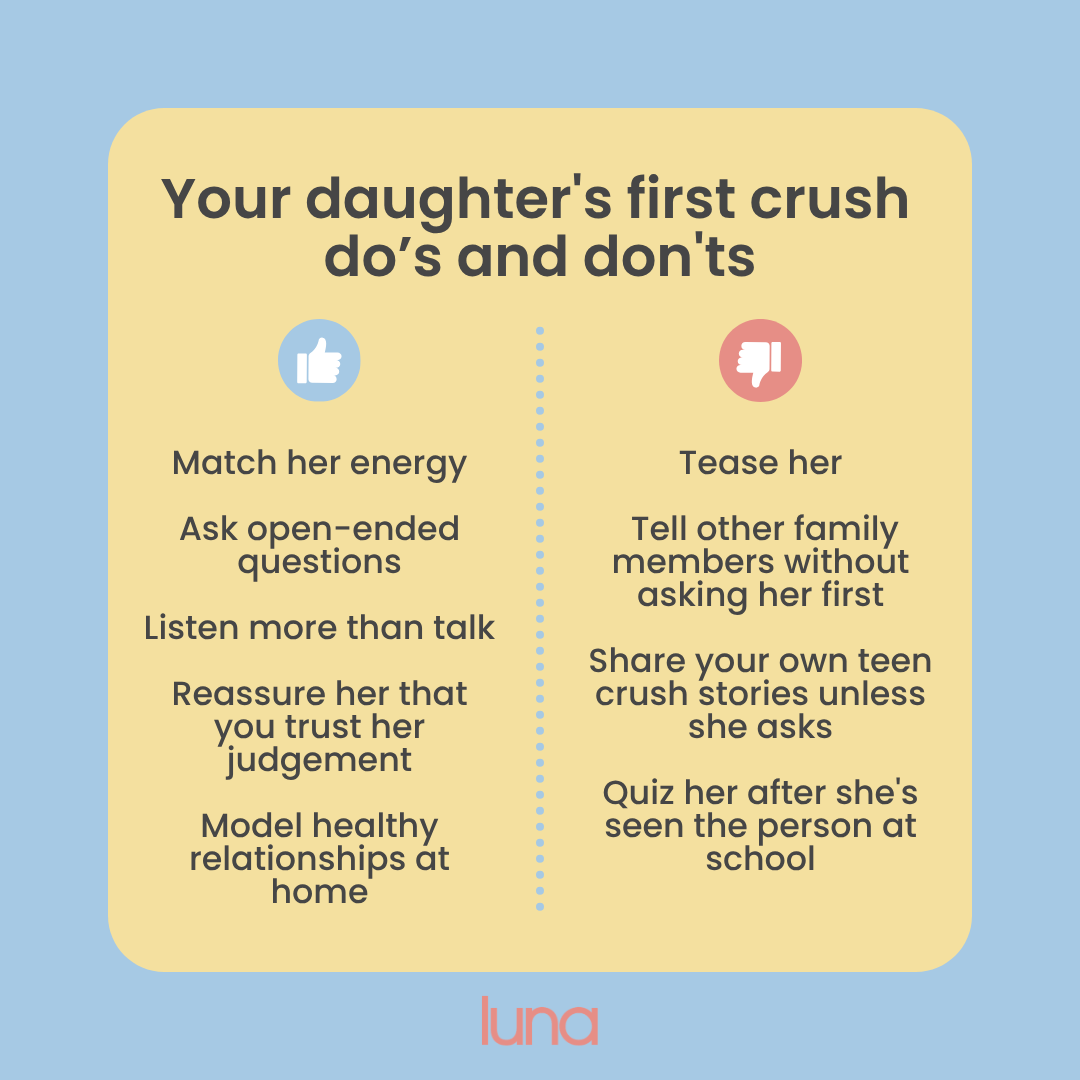
- Match her energy, not your own. If she's playing it casual, play it casual back
- Don't tease, even gently. What feels like banter to you can feel humiliating to her
- Don't tell other family members without asking her first
- Ask open questions like "what's she like?", "how did you meet?", "what do you like about him?"
- Listen more than you talk. You don't need to give advice unless she asks for it
It also helps to drop the spotlight. Conversations like this often go better in the car, on a dog walk, or while you're cooking together: anywhere you're not face-to-face.
What if she doesn't want to talk to me about it?
That's normal, and it's not a sign she doesn't trust you. Teen girls often process big feelings with friends first, and that's developmentally healthy.
In a luna poll of 1,873 teen girls, 1 in 4 (24%) said nothing would make them open up to a parent, and 1 in 5 (21%) said reassurance they won't be judged would help most.
So your job isn't to be told everything. It's to make sure she knows the door is open, without pressure.
What tends to work better than asking direct questions:
- Mention it lightly once, then leave it: "if you ever want to talk, I'm here"
- Treat the small things she does share as if they matter
- Don't quiz her after she's seen the person at school
- Avoid asking in front of siblings or other adults
- Model that you can hear something without panicking
If she is pulling away generally, you may want to check out luna’s article on what to do if you’ve stopped talking to your teenage daughter.
How do I support her without taking over?
Be a steady, low-key presence rather than a fixer. She doesn't need you to solve the crush, decode the texts, or plan her next move.
What she does need:
- Someone to vent to without judgement
- A sense that her feelings are normal and not silly
- Quiet modelling of what healthy relationships look like at home
- Reassurance that you trust her judgement, even when she's unsure of it
- The space to feel it without it becoming family news
If she asks for advice, give it gently and briefly, then stop. Long lectures rarely land.
And resist the urge to share your own teen crush stories unless she asks: what felt relatable to you can feel cringe to her now.
When should I worry about my daughter's crush?
Most first crushes are harmless. But there are a few situations worth gently paying attention to.
Things worth a closer look:
- The crush is on a much older person, especially an adult
- She's changing her behaviour, appearance, or friendships in ways that feel unlike her
- She's hiding her phone, lying about where she's going, or seems anxious about the other person
- She's giving up things she loves to please them
- The other person is pressuring, controlling, or making her feel bad about herself
- She seems sad, withdrawn, or anxious more often than not
If any of that's coming up, you don't need to confront it head-on. Stay close, keep the conversation going, and speak to a doctor or school counsellor if you're worried.
Trust your gut: you know your daughter best.
You may also want to check out luna’s article on how to help your daughter leave a controlling relationship if it is an issue.
FAQ
Is my daughter too young to have a crush?
Probably not. Crushes commonly start anywhere from age 8 to 13, and even younger children can have them.
Age alone isn't a concern: what matters more is whether her behaviour and feelings still feel age-appropriate for her.
What if my daughter has a crush on a girl?
Treat it exactly the same way you'd treat a crush on a boy: calmly, kindly, and without making it a big thing.
Crushes during puberty are often part of working out identity, and your reaction now shapes how safe she feels coming to you later.
Should I tell her dad or my partner about her crush?
Ask her first. If she's told you in confidence, sharing it without permission can feel like a betrayal and make her less likely to open up again. Try: "would you mind if I told your dad?"
How do I talk to her about crushes without being awkward?
Keep it short, casual, and side-by-side rather than face-to-face. Don't try to cover everything in one chat. Lots of small conversations work better than one big one.
What if her crush doesn't like her back?
Take her feelings seriously. A first crush rejection can feel huge, even if it looks small from the outside.
Acknowledge how hard it is before offering perspective, and don't rush her to "get over it."
Should I let her meet up with her crush?
It depends on her age, who the crush is, and your family rules. For younger teens, group meet-ups in public places (like the cinema or a café) tend to work better than one-on-one.
Keep the bar at "I want to know roughly where you are and who you're with," not "tell me everything."
A gentle next step
First crushes are a milestone, not a crisis. You're already doing the hard part by paying attention and being someone she can come to. The trick is to stay curious without prying, and warm without being intense.
For more advice on navigating teen relationships, have a read of luna’s teen dating advice for parents.
If the crush turns into something more, learning how to handle your daughter’s first boyfriend or girlfriend may be useful.
How we created this article:
luna's team of experts comprises GPs, Dermatologists, Safeguarding Leads and Junior Doctors as well as Medical Students with specialised interests in paediatric care, mental health and gynaecology. All articles are created by experts, and reviewed by a member of luna's senior review team.
Sources:
Healthy Children "Your Child’s First Crush" | Accessed 15 May 2026
https://www.healthychildren.org/English/healthy-living/emotional-wellness/Pages/Your-Childs-First-Crush.aspxChildline "Top Facts About Puberty" | Accessed 15 May 2026
https://www.childline.org.uk/info-advice/you-your-body/puberty/puberty-facts/We'd love to keep in touch!
Sign up to our parent newsletter for emails on the latest teen trends, insights into our luna community and to keep up to date
By signing up, you are agreeing that we can use your email address to market to you. You can unsubscribe from marketing emails at any time by using the link in our emails. For more information, please review our privacy statement.