How to talk to your daughter about her first relationship
The first relationship talk, made easier

Updated September 8, 2026 • Medically reviewed by Dr. Emma Dickie
Medically reviewed by Dr. Emma DickieIn this article
In short
A first boyfriend, girlfriend, or partner is a normal part of growing up, and how you react shapes how much your daughter shares with you.
Keep conversations short, curious, and judgement free, ask open questions, and talk about consent and healthy relationships early.
Research shows that a warm parent relationship predicts healthier teen romantic relationships later on.
My daughter has her first boyfriend: what do I say?
Less than you might think.
The goal of the first conversation isn't to deliver a speech; it's to show her she can keep talking to you.
Whether it's a boyfriend, girlfriend, or partner, the same things hold true, so this article uses "partner" from here on.
If your stomach dropped when you found out, you're in good company.
It can feel like she's grown up overnight, especially if this follows hot on the heels of her first crush.
The NHS suggests leading with open questions rather than assumptions.
"How are things going?" lands better than "Are you being careful?", and showing curiosity about her choices works better than pre-judging them.
And here's the reassuring bit. A 2025 study that followed teenagers over two years found that a warm, supportive relationship with parents predicted closer and more committed romantic relationships in late adolescence.
The connection you've already built is doing more work than any single conversation will.
How do I start the conversation without making it awkward?
Side by side beats face to face.
The NSPCC recommends picking a moment when she's relaxed and unlikely to be interrupted.
Four low-pressure ways in:
- Chat in the car or on a walk, where she doesn't have to make eye contact
- Use a couple in a show you watch together as a prompt: "Do you think their relationship is healthy?"
- Aim for a few short chats over time rather than one big talk
- Ask open questions like "What do your friends think about dating?" and let her take it from there
One thing worth knowing about language: sexual health charity Brook suggests open phrases like "is there someone you're thinking about?" rather than assuming a label.
Some parents also swap "boyfriend" for "partner", which quietly signals she can tell you anything, whoever the person is.
What should I avoid saying?
Anything that makes the relationship feel like a problem to be managed.
Judgement tends to close the door, while curiosity keeps it open.
Things that tend to backfire:
- Teasing her about it, even gently, in front of family
- Firing off rapid questions, which feels like an interrogation rather than a chat
- Criticising her partner before you've met them
- Banning the relationship outright, which usually drives it underground
- Dismissing it as puppy love that doesn't matter
The NHS also suggests picking your battles.
If every chat turns into a lecture, she'll stop having them with you.
How do I talk to my daughter about consent and boundaries?
Earlier and more casually than you might expect.
Consent isn't one scary conversation, it's a value that can run through everyday chat.
The NSPCC suggests explaining that consent means actively checking the other person is happy, and that anyone can change their mind at any time, even if they've said yes before.
It's worth knowing that in the UK, the age of consent is 16, and the law exists to protect young people rather than prosecute them.
Brook recommends covering digital boundaries too: flirting and texting should never come with pressure to share images.
Once a photo is sent, she loses control of where it ends up.
If this opens the door to bigger questions, there's a full guide on talking to your teen about sex.
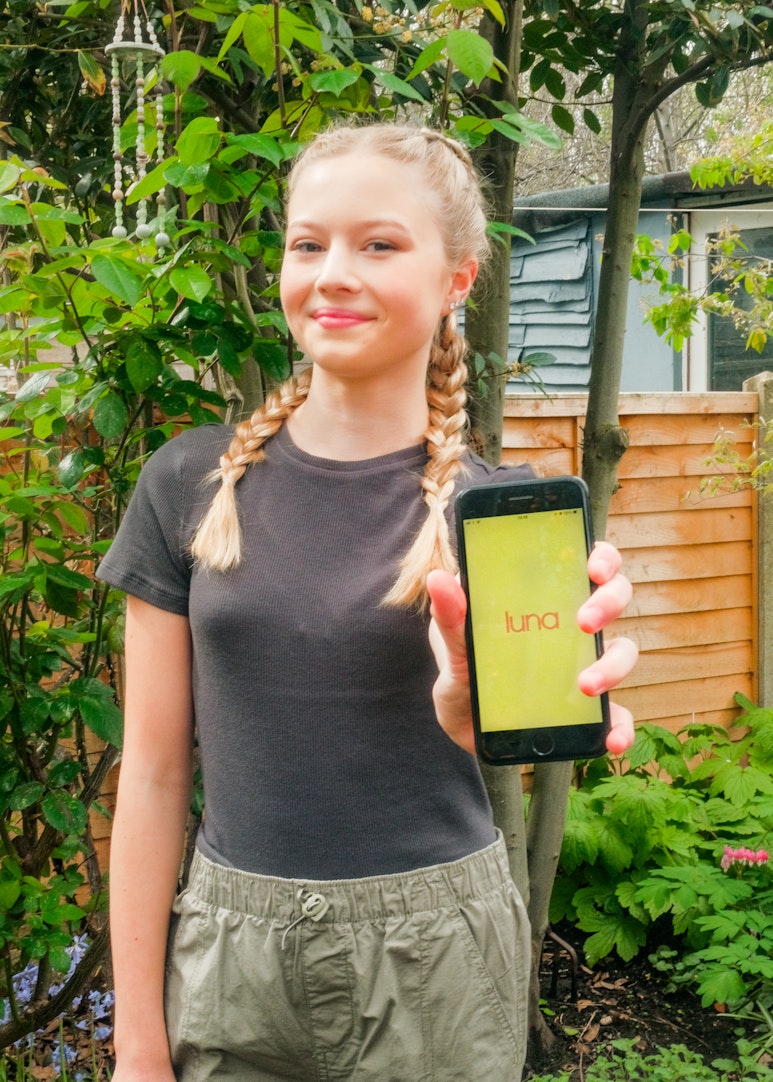
luna also gives teen girls a space to explore questions about relationships, consent, and growing up at her own pace, with content reviewed by medical experts.
How do I know if my daughter's relationship is healthy?
A healthy relationship should leave her more herself, not less.
The NSPCC describes it as one where she feels safe, respected, trusted, and able to be honest.
Signs worth keeping an eye on:
- She's spending little time with friends or family
- She's told what to wear, or always has to report where she is
- Her social media is being monitored by her partner
- She seems pressured into anything she's uncomfortable with
- Her mood or behaviour has persistently changed
- She’s choosing her partner over her family
One of these alone isn't proof of a problem.
A pattern is worth acting on gently, and there's guidance on helping your daughter leave a controlling relationship if your instincts are telling you something's wrong.
If you're worried about her safety, the NSPCC helpline (0808 800 5000) can talk things through with you.
FAQs
Should I let my daughter and her partner hang out in her bedroom?
There's no single right answer; it depends on her age and your family's values.
Brook notes that saying no to privacy doesn't stop a determined teen, it just moves things elsewhere, so some families set boundaries and ground rules for their daughter’s partner together, like doors staying open or agreed visiting times.
What age should my daughter be allowed a boyfriend or girlfriend?
There's no official age, and early teen relationships are often more about friendship groups and fitting in than real romance.
Her maturity, and how openly she talks to you, matter more than the number.
What if I don't like her partner?
Holding back criticism until you've genuinely got to know them tends to work best, as open disapproval often pushes young couples closer together.
If you hate your daughter's partner because of safety concerns rather than personality clashes, that's the time to act.
What if she won't talk to me about it at all?
Some privacy is healthy and normal at this age, and it isn't the same as secrecy.
Keep the door open with low-pressure check-ins, and make sure she has trusted places for accurate information, like luna, where she can ask questions without judgement.
First relationships are big, for her and for you. You don't need perfect words, just an open door and a calm face when she walks through it.
And if it ends in tears, here's how to help your daughter through her first breakup.
How we created this article:
luna's team of experts comprises GPs, Dermatologists, Safeguarding Leads and Junior Doctors as well as Medical Students with specialised interests in paediatric care, mental health and gynaecology. All articles are created by experts, and reviewed by a member of luna's senior review team.
Sources:
NHS "Talking to your teenager" | Accessed 29.06.26
https://www.nhs.uk/mental-health/children-and-young-adults/advice-for-parents/talk-to-your-teenager/NSPCC "Healthy relationships" | Accessed 29.06.26
https://www.nspcc.org.uk/advice-for-families/healthy-relationships/Brook "Teen dating: tips for parents" | Accessed 29.06.26
https://www.brook.org.uk/blog/teen-dating-tips-for-parents/van Rijn-van Gelderen L et al. "Children will love like you do: how adolescents' relationships with parents predict the quality of best friendships and romantic relations" | Accessed 29.06.26
https://pmc.ncbi.nlm.nih.gov/articles/PMC12420711/We'd love to keep in touch!
Sign up to our parent newsletter for emails on the latest teen trends, insights into our luna community and to keep up to date
By signing up, you are agreeing that we can use your email address to market to you. You can unsubscribe from marketing emails at any time by using the link in our emails. For more information, please review our privacy statement.