What do I do if my daughter is being cyberbullied?
Steady steps when she's hurting online
Updated May 18, 2026
In this article
- In short
- How do I know if my daughter is being cyberbullied?
- What should I do first if I find out she's being cyberbullied?
- How do I talk to my daughter about cyberbullying without making it worse?
- Should I take her phone away if my daughter is being cyberbullied?
- How do I report cyberbullying?
- When should I call the police about cyberbullying?
- How can I help my daughter recover from cyberbullying?
- FAQ
- Where to go next
In short
If your daughter is being cyberbullied, stay calm and listen before you fix anything. Don't take her phone away as your first move: that often makes her shut down.
Together, save screenshots, block and report the accounts, and tell her school in writing.
Involve the police if there are threats, sexual content, or repeated harassment. Recovery takes time, so keep checking in.
How do I know if my daughter is being cyberbullied?
Cyberbullying is hard to spot because it usually happens on her phone, in private chats, late at night. The signs of bullying online are often behavioural rather than obvious.
You might notice she's suddenly anxious about her phone, jumpy when notifications come in, or hiding her screen when you walk past.
Other common signs include:
- Going quiet or withdrawn, especially after using her phone
- Avoiding school, clubs, or friends she used to like
- Trouble sleeping or eating, or new stomach aches and headaches
- Mood swings, tearfulness, or anger that comes out of nowhere
- Deleting her social accounts or making new secret ones
- A drop in grades or focus
- Talking about feeling worthless, hopeless, or "everyone hates me"
These overlap with normal teen ups and downs, so trust your gut.
luna's poll of 1,522 teen girls found that nearly 1 in 2 (46%) feel drained and unproductive after scrolling social media, and 1 in 5 feel insecure.
If your daughter's reaction to her phone has gone from one of those everyday lows to something heavier, it's worth a gentle conversation.
What should I do first if I find out she's being cyberbullied?
Before anything else, take a breath. Your first reaction sets the tone for whether she keeps talking to you, so try to lead with calm rather than panic.
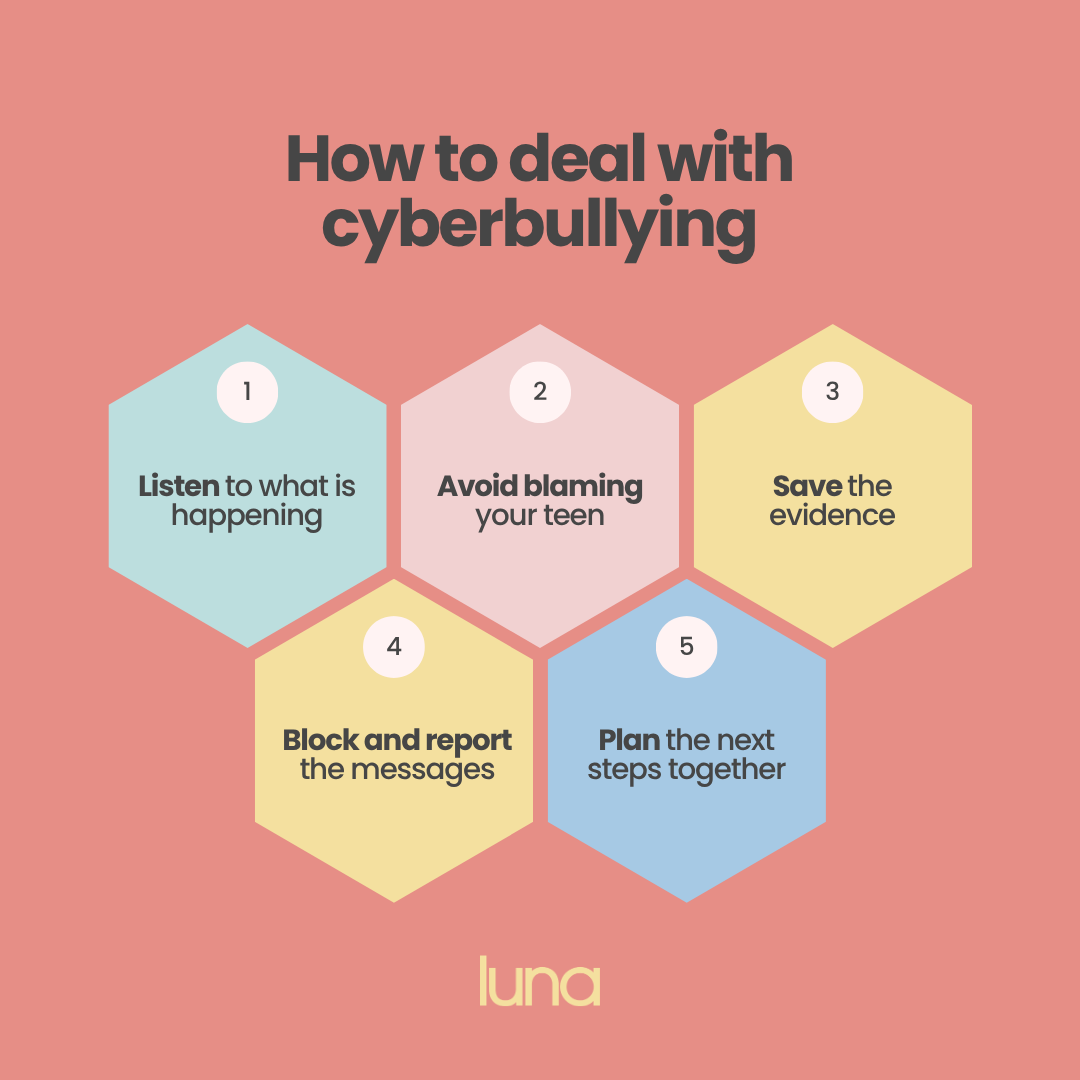
The first 24 hours matter most. Work through these steps in order:
- Listen first: let her tell you what's happening without interrupting or jumping to solutions. Thank her for telling you.
- Don't blame her: avoid "why were you on that app?" or "what did you say to them?" She didn't cause this.
- Save the evidence: screenshot every message, post, comment, and username. Note dates and times. Don't delete anything yet.
- Block and report: on the platform itself (Instagram, TikTok, Snapchat, and WhatsApp all have report tools).
- Reassure her: tell her she's not in trouble and you'll work it out together.
- Plan next steps with her: school, parents, police: decide together what feels right, and when.
Acting alongside her, not over her, protects the trust you'll need for the harder conversations later.
How do I talk to my daughter about cyberbullying without making it worse?
Open the conversation gently and at a low-pressure moment, like in the car or on a walk, where she doesn't have to make eye contact. Then mostly listen.
Some openers that work better than "we need to talk":
- "I noticed you've seemed a bit off after being on your phone. Is everything okay?"
- "If something was going on online, you can tell me. I won't take your phone away."
- "I'm not here to judge anyone, I just want to help."
luna's poll of 1,873 teen girls found that 1 in 4 (24%) say nothing would help them open up to a parent, and another 1 in 5 say what they need most is reassurance they won't be judged.
So lead with that reassurance, and accept that she might not tell you everything in one go.
If she shuts down, don't push. Let her know the door is open, and try again in a day or two.
For more on this, luna has a guide on talking to your teen about mental health.
Should I take her phone away if my daughter is being cyberbullied?
In most cases, no, at least not as your first move. Taking the phone away often feels like punishment to her, even though you're trying to protect her.
Her phone is also where her friends, support, and sense of normality live. Removing it can leave her more isolated and less likely to tell you when something else goes wrong.
The bullying may also continue: people will still talk about her, and she just won't know what's being said.
A better approach:
- Keep the phone, but mute or block the accounts involved
- Turn off notifications from the apps where it's happening
- Agree together on a phone-free wind-down hour before bed
- Make a deal that you'll check in weekly without reading her messages
If the abuse is severe, sexual, or involves images, you may need to step in more firmly. But default to working with her, not against her.
How do I report cyberbullying?
You can report cyberbullying in three places: the platform, the school, and (if it's serious) the police. Most parents need to do at least the first two.
On the platform: every major app has a report and block function. Use both. Reporting flags the content for removal; blocking stops the account from contacting her.
- Instagram: tap the three dots on the message or post and choose Report
- TikTok: hold the video or comment and tap Report
- Snapchat: press and hold the Snap or chat and tap Report
- WhatsApp: open the chat, tap the contact's name, scroll down to Report Contact
- Roblox / online games: use the in-game report tool and screenshot before you leave the chat
To the school: even if the bullying happens out of school hours, schools in the UK have a legal duty to act if it affects a pupil's wellbeing at school.
Email rather than only phoning: you want a paper trail. Include screenshots, names, and what you'd like the school to do.
To Report Harmful Content (UK): if a platform won't remove something, you can escalate via reportharmfulcontent.com, run by the UK Safer Internet Centre.
When should I call the police about cyberbullying?
Call the police, or report online via your local force, if the cyberbullying involves any of the following:
- Threats of violence, rape, or death
- Sharing or threatening to share nude or sexual images of your daughter (this is illegal regardless of who took or sent the image)
- Blackmail or "sextortion" (someone demanding money, images, or favours)
- Stalking or relentless harassment
- Hate crime based on race, religion, sexuality, gender, or disability
- Incitement to self-harm or suicide
These can be criminal offences under UK law, including the Malicious Communications Act 1988 and the Communications Act 2003.
If she's in immediate danger, call 999. For non-emergency reports, call 101 or report online.
The NSPCC (0808 800 5000) can help you decide if you're not sure.
How can I help my daughter recover from cyberbullying?
Recovery isn't a single conversation: it's weeks or months of small, steady reassurance. Most girls bounce back well with the right support, but the emotional impact can linger.
Things that help:
- Keep talking: short, frequent check-ins beat one big "are you okay?" chat
- Rebuild her offline world: sport, art, family time, hobbies, anything that reminds her she's more than what was said online
- Watch her sleep, appetite, and mood: these are the early indicators if things are getting worse
- Get professional help if she's struggling: your doctor can refer to CAMHS (Child and Adolescent Mental Health Services), or you can go private. Charities like YoungMinds and Childline are free
- Let her decide what to share with friends: she may not want everyone to know, and that's her call
Watch out for signs of anxiety, depression, or self-harm. If she's talking about not wanting to be here, or you're worried about her safety, contact your doctor or go to A&E the same day. Don't wait.
FAQ
What if my daughter begs me not to tell the school?
Take her fear seriously: she may worry about retaliation or being labelled a snitch. Explain why telling the school protects her, and ask how she'd like it handled (named complaint, anonymous, a specific teacher only).
Schools can usually act discreetly, and most have an anti-bullying lead.
What if my daughter is being cyberbullied by her own friends?
This is one of the most common and most painful versions. Don't pressure her to cut them off straight away: she may need to figure that out herself.
Help her see the difference between a friend having an off day and a pattern of cruelty. luna has a guide on helping your teen make friends that's useful here.
What if my daughter has done something embarrassing online that's now being shared?
She still isn't to blame for being bullied. Save evidence, report on the platform, and if it's a sexual image of a child (anyone under 18) you can request removal via Take It Down (run by NCMEC) or Report Remove (run by NSPCC and IWF). Both are free and confidential.
How long should I expect this to take to resolve?
Platform reports can take 24 to 72 hours. School investigations usually take one to two weeks.
The emotional recovery is longer: a few months is normal, and that's not a sign you're doing it wrong. Keep checking in, even when she says she's fine.
Should I monitor her accounts going forward?
Light, agreed monitoring is more effective than secret surveillance. Talk openly about which apps she uses, who she follows, and what to do if something feels off.
Parental controls have a place, but trust and conversation are what actually keep her safe.
Where to go next
You don't have to handle this alone. If you'd like more support on the wellbeing side of things, luna has guides on supporting your teen's mental health.
And if she's open to it, the luna app is built to give her age-appropriate, doctor-reviewed answers to the questions she might not yet want to ask you.
How we created this article:
luna's team of experts comprises GPs, Dermatologists, Safeguarding Leads and Junior Doctors as well as Medical Students with specialised interests in paediatric care, mental health and gynaecology. All articles are created by experts, and reviewed by a member of luna's senior review team.
Sources:
Childline "Bullying and Cyberbullying" | Accessed 18 May 2026
https://www.childline.org.uk/info-advice/bullying-abuse-safety/types-bullying/bullying-cyberbullying/NSPCC "Bullying and Cyberbullying" | Accessed 18 May 2026
https://www.nspcc.org.uk/keeping-children-safe/types-of-abuse/bullying-and-cyberbullying/Internet Matters "Cyberbullying: Facts & advice" | Accessed 18 May 2026
https://www.internetmatters.org/issues/cyberbullying/NSPCC "Report Remove" | Accessed 18 May 2026
https://www.childline.org.uk/info-advice/bullying-abuse-safety/online-mobile-safety/report-remove/NCMEC "Take It Down" | Accessed 18 May 2026
https://takeitdown.ncmec.org/Kids Health "Cyberbullying" | Accessed 18 May 2026
https://kidshealth.org/en/parents/cyberbullying.htmlReport Harmful Content "When should you go to the Police?" | Accessed 18 May 2026
https://reportharmfulcontent.com/when-should-you-go-to-the-police/We'd love to keep in touch!
Sign up to our parent newsletter for emails on the latest teen trends, insights into our luna community and to keep up to date
By signing up, you are agreeing that we can use your email address to market to you. You can unsubscribe from marketing emails at any time by using the link in our emails. For more information, please review our privacy statement.