When should I let my daughter have sleepovers?
What's normal, safe, and right for her

Updated May 19, 2026
In this article
In short
There's no single right age. Some family experts suggest age 7 to 10 is a typical window for a first sleepover, but readiness matters more than age.
Check that your daughter feels confident asking for help, vet the host family, and agree on a "come get me" plan. For teens, the focus shifts to communication, phones, and which homes feel safe.
What age is right for my daughter's first sleepover?
Many child psychologists and family therapists say around age 7 to 10 is when many girls are ready for a first sleepover, but readiness varies hugely.
Some 8 year olds are excited to go, some 13 year olds still aren't, and both are completely normal.
A few signs she might be ready:
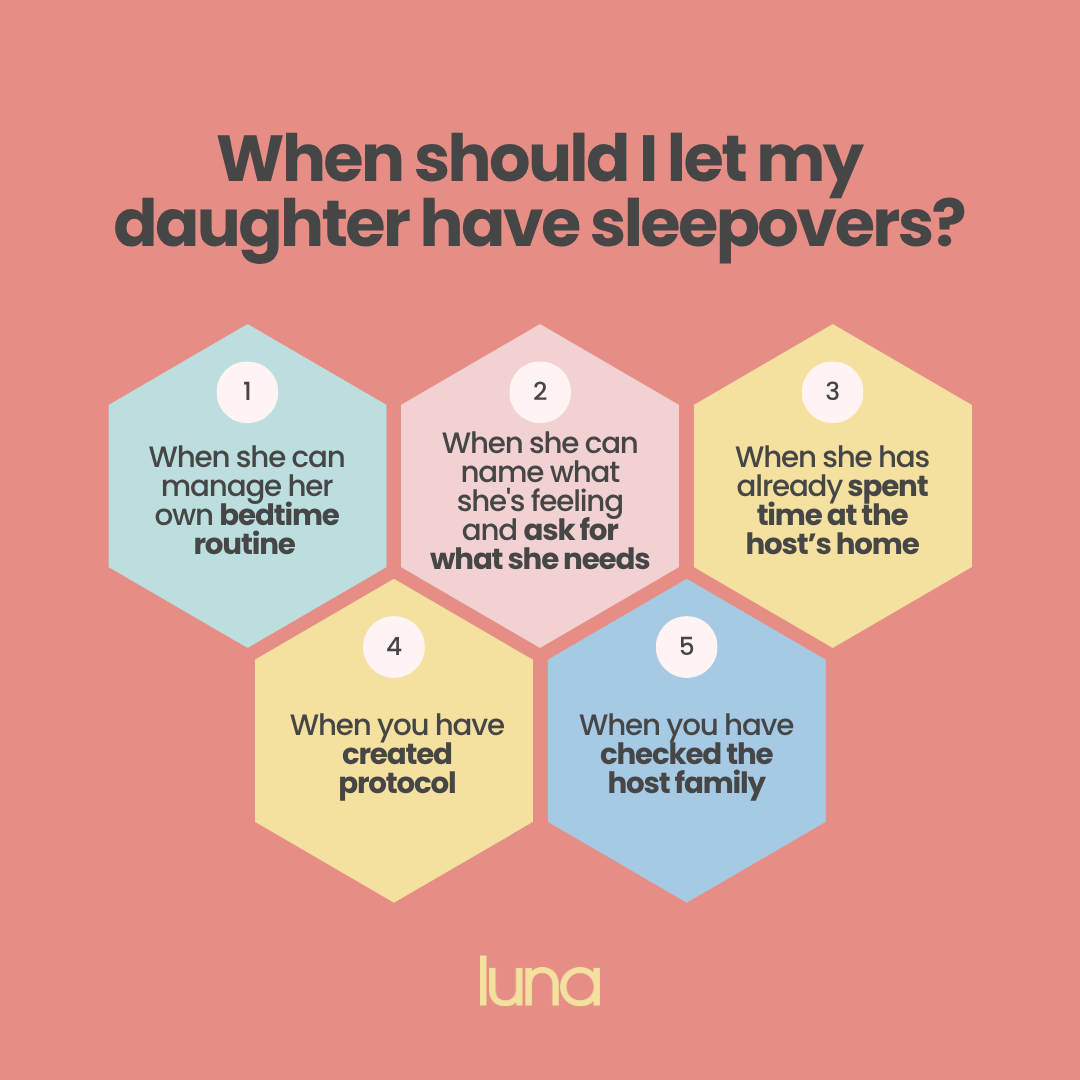
- She can manage her own bedtime routine away from home
- She'd feel okay telling another adult she's not feeling well, scared, or wants to go home
- She can name what she's feeling and ask for what she needs
- She's spent comfortable time at the host family's home in the daytime first
There's no rush. If she's not ready at 9, she'll likely be ready at 10 or 11. Pushing it too early often ends in a panicked midnight phone call, which can make the next attempt harder.
Are sleepovers safe for my daughter?
Sleepovers are a normal, valuable part of growing up for many girls, but the safety question is a real one and worth taking seriously.
There's been more conversation in recent years about whether to allow sleepovers at all, with some parents choosing "lateovers" instead (where she goes home before bed).
Both positions have something behind them. The NSPCC notes that most harm to children is carried out by someone the child already knows, which is exactly why vetting the household matters.
On the other side, sleepovers help girls build independence, friendships, and confidence away from home.
You know your daughter and the families around you best. The aim isn't to say yes or no to sleepovers as a rule. It's to make a thoughtful call household by household.
How do I check the other family before saying yes?
You don't need to interview anyone, but a friendly conversation with the host parent goes a long way. Most parents expect this and welcome it.
Things worth knowing before you say yes:
- Who else will be in the house, including older siblings, partners, or relatives staying over
- Where the girls will sleep, and where the adults will be
- What the supervision looks like around screens, films, and bedtime
- How you'd be contacted if your daughter wanted to come home
- Whether your daughter can call you any time without it being a big deal
- How well you know the family and home
A short text the day before to confirm pickup time, allergies, and any worries opens the door without making it weird.
What if my daughter doesn't want to go?
If she's hesitant, listen carefully and don't push. Sometimes "I don't want to go" means "I'm a bit nervous," sometimes it means "something feels off." Both are worth respecting.
Try open questions:
- "What part doesn't feel right?"
- "Is it about being away from home, or about that house in particular?"
- "What would help you feel okay about it?"
In a luna poll of 1,873 teen girls, 1 in 5 (21%) said the thing that would help them open up to parents most was reassurance they won't be judged. The aim is to make it easy for her to say no without losing face.
A middle option often helps: she goes for the evening, and you pick her up at 9 or 10. A lateover is a brilliant stepping stone for younger girls and anxious teens.
What if I'm the anxious one?
It's normal to feel anxious, especially the first time. Your daughter staying somewhere overnight is a real shift, and worry doesn't mean you're being unreasonable.
A few things that often help:
- Be honest with yourself about what's driving the worry: is it her readiness, the specific household, or you adjusting to her growing up
- Agree a "phone home any time, no fuss" rule between the two of you
- Make a plan with the host parent for worst case scenarios so you're not improvising at 11pm
- Try not to telegraph your worry to her, she'll pick it up and start worrying too
- Once she's there, leave them to it: constant checking can actually unsettle her
What about phones and sleepovers?
Phones are now part of the sleepover question. In a luna poll of 3,901 teen girls, over 7 in 10 (71%) said they got their first phone aged 11 or younger, which means most sleepovers now happen with phones in the room, and phones can affect sleep.
Worth thinking through before she goes:
- Whether phones go on charge in the kitchen overnight (a great rule if both families agree)
- Whether the host family's screen rules match yours, and if they don't, what you're comfortable with
- Whether the girls might watch films or social media together that you'd rather she didn't see at this age
- What she should do if something online during the sleepover worries her
A short conversation rather than a lecture sets her up well: "If anything tonight feels weird, online or in the house, you can call me."
What about teen sleepovers?
By the teen years, sleepovers usually shift from "first time away" to a normal part of friendships. The focus moves to communication, trust, and which households feel right, rather than age.
A few useful habits at this stage:
- Keep meeting her friends and their parents, even briefly at pickup
- Agree she'll text when she's arrived, and that you'll always come get her if she changes her mind
- Talk through alcohol, vaping, and older siblings before they come up, not in the moment
- Be willing to host sometimes: it's the easiest way to know what her friendships actually look like
FAQ
What's a "lateover" and is it a good middle step?
A lateover is when your daughter goes for the evening: dinner, a film, hanging out, then home before bed.
It's a brilliant option for younger girls, anxious sleepers, or households you don't know well yet. Many families now use lateovers as the default for primary-school age, and move to full sleepovers later.
Should I let her sleep over on a school night?
Most parents save sleepovers for weekends, mostly because sleepovers usually mean very little actual sleep.
Teen girls already tend to get less sleep than they need: in a luna poll of 1,684 teen girls, 39% said they get less than the recommended 8 hours. School nights are a fair line to hold.
Are mixed-gender sleepovers okay in the teen years?
This is a personal call and varies hugely by family. Some parents are comfortable with mixed-gender sleepovers in established friendship groups; others aren't.
There's no medically right answer. What matters is that the rule is consistent, explained honestly, and applied across all her friends, not just selectively.
What if I don't know the host family at all?
Suggest a smaller step first: a coffee at pickup, a playdate at your house, or a lateover before committing to a full overnight.
It isn't over-the-top, it's normal, and most parents will respect you for asking.
What if my daughter wants to host and I'm not sure?
Hosting can actually be easier for nervous girls because she's on her own turf. Start with one friend rather than a big group, agree clear lights-out expectations with the other parents, and have a plan for what happens if anyone gets homesick at 1am.
A gentle next step
Sleepovers can be a lovely part of growing up, but they're not a rite of passage you have to tick off at a set age. The best timing is the one that fits your daughter, your family, and the specific household she'd be staying in.
If anxiety is part of what's coming up for her right now, luna's guide on spotting the signs of teenage anxiety is a good next read.
How we created this article:
luna's team of experts comprises GPs, Dermatologists, Safeguarding Leads and Junior Doctors as well as Medical Students with specialised interests in paediatric care, mental health and gynaecology. All articles are created by experts, and reviewed by a member of luna's senior review team.
Sources:
NSPCC "Child abuse and neglect" | Accessed 19 May 2026
https://learning.nspcc.org.uk/child-abuse-and-neglectCAPS "Sleepover Safety" | Accessed 19 May 2026
https://www.caps.org.au/our-newsletter/sleepover-safetyUnderstood "Checklist: Is your child ready for a sleepover?" | Accessed 19 May 2026
https://www.understood.org/en/articles/checklist-is-your-child-ready-for-a-sleepoverWe'd love to keep in touch!
Sign up to our parent newsletter for emails on the latest teen trends, insights into our luna community and to keep up to date
By signing up, you are agreeing that we can use your email address to market to you. You can unsubscribe from marketing emails at any time by using the link in our emails. For more information, please review our privacy statement.