SPF for teens: why sunscreen matters more than you think
Sun protection starts young
Updated July 1, 2026 • Medically reviewed by Dr. Simon Tso
Medically reviewed by Dr. Simon TsoIn this article
In short
Sunburn increases your risk of skin cancer, and there is no safe way to get a tan.
For teenagers, the stakes are higher than many parents realise.
The damage that leads to skin cancer in later life often accumulates during childhood and adolescence, making the teen years arguably the most important time to establish sun protection as a habit.
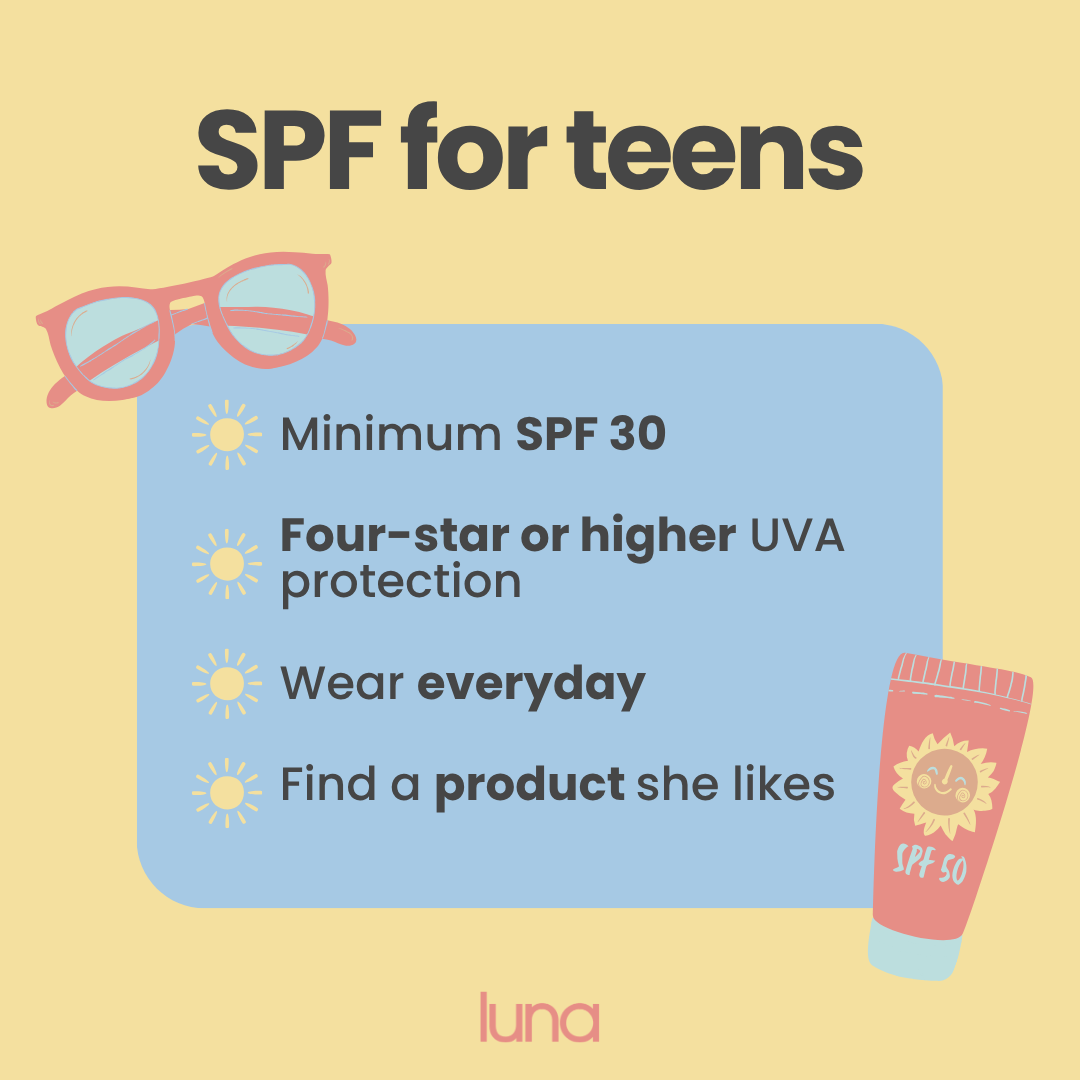
The NHS recommends a minimum of SPF 30 with four-star or higher UVA protection, worn every day, not just on holiday or in obvious sunshine.
Why does sun protection matter more for teenagers specifically?
Teenage skin is biologically different from adult skin as it is thinner, more sensitive, and more vulnerable to UV damage.
The NHS highlights that repeated UV exposure in childhood and adolescence significantly raises the long-term risk of skin cancer.
This is not about the occasional beach holiday; it is about the cumulative effect of years of unprotected exposure, including the everyday kind, such as the walk to school, the lunch break outside, the sports match.
Making SPF a part of your teen's skincare routine means that they can be protected long term.
What SPF should my daughter actually use?
The NHS recommends at least SPF 30 with four or five star UVA protection for everyday use in the UK.
For prolonged outdoor exposure, such as sport, summer holidays, SPF 50 is a better choice.
UVA protection is often indicated by stars on the packaging (four or five stars) or the letters "UVA" in a circle, indicating it meets the EU standard.
A product that only shows SPF without UVA protection offers incomplete coverage.
Does she need it even on cloudy days?
Yes, as you can burn in the UK even when it is cloudy.
UV rays pass through cloud cover, and the risk is not limited to sunshine or summer.
The NHS recommends being particularly attentive between March and October, and when the UV index is three or higher, which can be checked on any weather app.
The sun is strongest between 11am - 3pm so this is the important time frame to protect the skin
Also consider broad rim hats and long sleeve clothes as sun protection strategies.
Why isn't she using it, and how do I change that?
Teenagers resist SPF for a few consistent reasons:
- It leaves a white cast or greasy feeling
- It breaks up makeup or makes skin look shiny
- It feels like an unnecessary extra step
- Many teen girls tan because they think it is a desirable look
The formulation matters enormously here.
Lightweight, invisible fluid SPFs, tinted mineral sunscreens, and skincare-primer hybrids are far more likely to become daily habits than thick, white, heavily fragranced beach creams.
If applying sunscreens leads to acne, then think about the technique of applying.
This is because if you apply sunscreen in a circular motion, this can occlude/block hair follicles contributing to acne formation.
Instead, apply sun screen (also apply to emollients) in a single smooth direction as this is less likely to occlude/block hair follicle, and less likely to cause acne.
Finding a product she actually likes wearing and the right techniques is more productive than persuading her to wear one she hates.
Our resident dermatologist Dr. Simon Tso explains:
"The current most ideal sunscreens are tinted (coloured) sunscreens consisting of a blend of iron oxide (Fe2O3) and TiO2 that function as an visible light and UV blocker."
What about sunscreen and acne?
This is a common concern, and a valid one.
The NHS notes that some acne treatments, including benzoyl peroxide and certain antibiotics, actually increase photosensitivity, making sun protection even more important, not less.
Non-comedogenic, oil-free SPF formulations are widely available and do not block pores.
If her current SPF is contributing to her teen acne, the product rather than the habit is the problem.
FAQ
Are sunbeds an option for vitamin D or a "base tan"?
No.
The NHS advises that sunbeds can be more dangerous than natural sunlight, using a concentrated source of UV radiation.
It is also illegal for under-18s to use sunbeds in the UK.
There is no evidence that a "base tan" provides meaningful protection against further sun damage.
Does she need to reapply SPF throughout the day?
The NHS recommends reapplying every two hours in active sun exposure, and immediately after swimming or sweating, even with water-resistant products.
For a typical school day, applying in the morning and reapplying at lunchtime if she is outside is a reasonable routine.
Can she get enough vitamin D if she is always wearing SPF?
The NHS recommends SPF alongside sensible sun exposure rather than as a total block.
Most people in the UK get adequate vitamin D from modest sun exposure without needing to skip SPF.
In winter months, the NHS suggests a vitamin D supplement for most people in the UK regardless of skin tone.
How we created this article:
luna's team of experts comprises GPs, Dermatologists, Safeguarding Leads and Junior Doctors as well as Medical Students with specialised interests in paediatric care, mental health and gynaecology. All articles are created by experts, and reviewed by a member of luna's senior review team.
Sources:
NHS "Sunscreen and sun safety" | Accessed 08.06.26
https://www.nhs.uk/live-well/seasonal-health/sunscreen-and-sun-safety/NHS "Acne - Treatment" | Accessed 08.06.26
https://www.nhs.uk/conditions/acne/treatment/American Academy of Pediatrics "Trendy skin care for tweens and teens: is it safe?" | Accessed 08.06.26
https://www.healthychildren.org/English/ages-stages/teen/Pages/trendy-skin-care-for-tweens-and-teens-is-it-safe.aspxWe'd love to keep in touch!
Sign up to our parent newsletter for emails on the latest teen trends, insights into our luna community and to keep up to date
By signing up, you are agreeing that we can use your email address to market to you. You can unsubscribe from marketing emails at any time by using the link in our emails. For more information, please review our privacy statement.