What to do if your teen won’t revise for exams?
How you can help

Updated April 6, 2026 • Medically reviewed by Dr. Alex Ho
Medically reviewed by Dr. Alex HoIn this article
What to do if your teen won’t revise for exams?
If your teen won’t revise, it’s usually not about laziness, it’s often overwhelm, stress, or lack of motivation. Start by understanding why they’re struggling, then focus on gentle ways to motivate them and make revision feel more manageable.
Exams can be an extremely stressful time for teens, and they may be finding it difficult to balance the different subjects and any other responsibilities they have. Instead of simply telling them to revise, it can be beneficial to explore methods that break down tasks and help to manage stress.

How to encourage a teenager to revise?
You can encourage your teen to revise by exploring different methods for revision and offering incentives and rewards. It is also helpful to have a chat with them about why they are refusing to revise and the struggles they are dealing with.
Teens are more likely to revise when they feel understood, confident, and relaxed. Think about ways you can promote these feelings in your teen and make revision a more positive task.
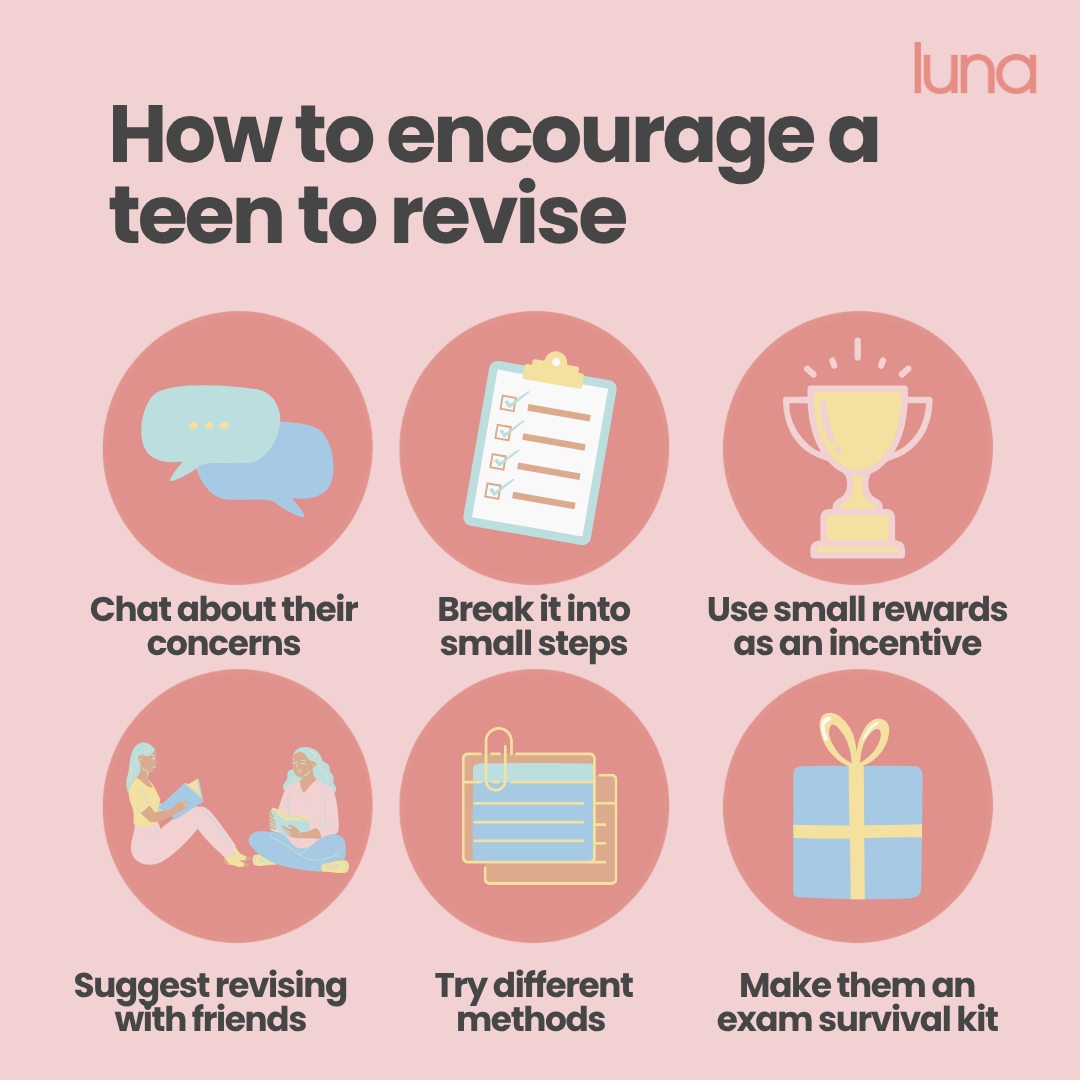
To encourage your teen to revise, you may want to:
- Start with understanding: have a calm chat to figure out what’s behind the resistance - exam stress, overwhelm, or lack of confidence are common reasons
- Break it into small steps: suggest starting with just 10–15 minutes or one topic to make it feel less daunting
- Use motivation that works for them: small rewards (like snacks, screen time, or a treat) can make revision feel more positive
- Make it social: revising with friends or sharing practice questions can make it feel less isolating
- Try different methods: practice papers, flashcards, or quizzes can feel more engaging than just reading notes
- Reframe the conversation: instead of focusing on pressure or results, ask what would make revision feel easier or less stressful
In a recent luna poll, over 1 in 3 teens (34%) said rewards were their top motivator for completing tasks. Offering small, meaningful incentives – like a favourite snack, extra screen time, or a weekend treat – can turn revision into a more positive experience. An exam survival kit can also be a great way to motivate your teen.
What methods help teens revise?
Methods like spaced repetition and the Pomodoro technique are especially helpful, as these are all about improving memory without overwhelm. Other things that help teens revise include having a dedicated study space and a balanced routine.
It is a good idea to explore different methods with your teen to discover what works for them.
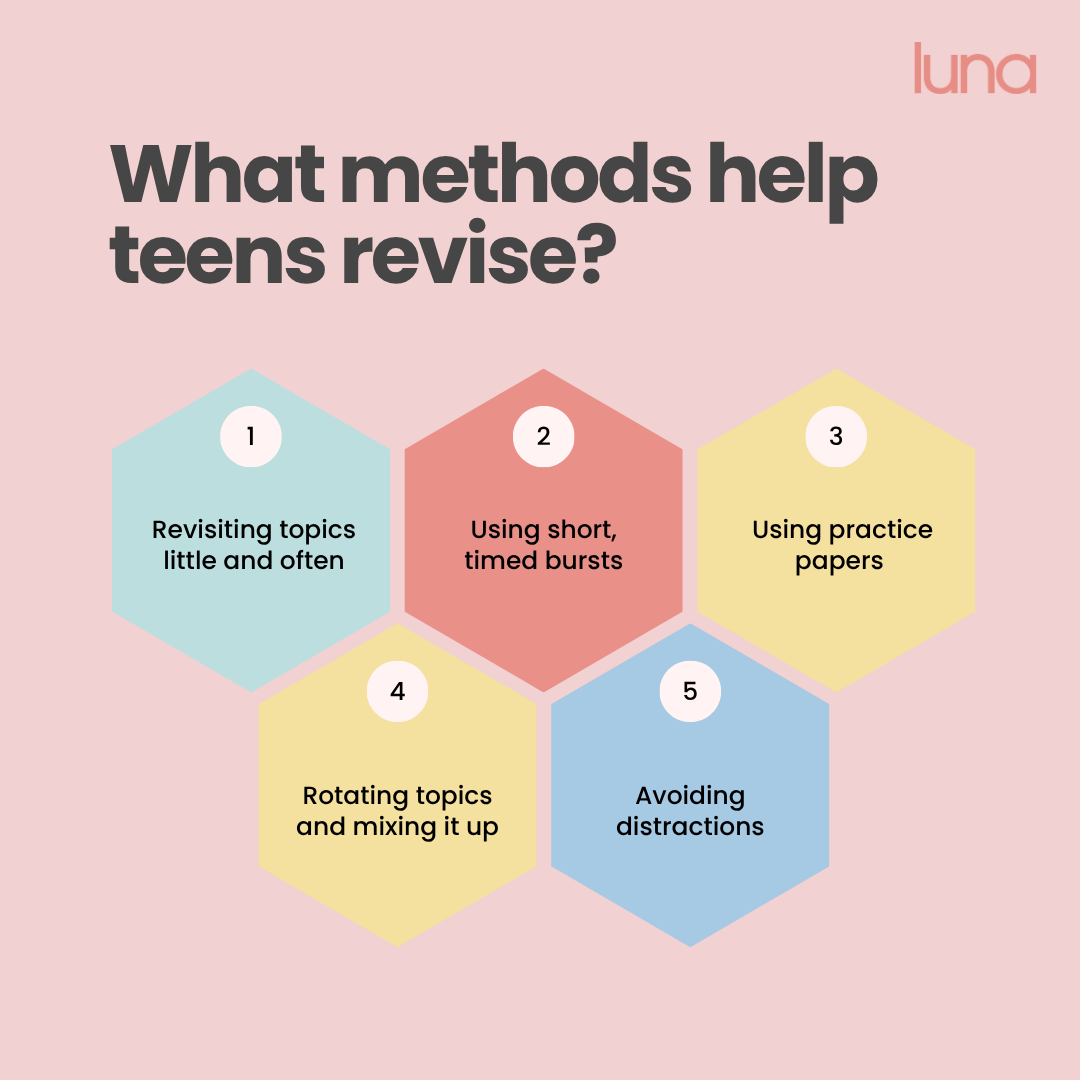
Here are some methods that can be useful:
- Spaced repetition: revisiting topics little and often over time helps information stick
- Pomodoro technique: focuses on short bursts of revision
- Practice papers: one of the most effective ways to prepare for exams and build confidence
- Active recall: testing themselves (rather than re-reading notes) improves memory
- Mixing subjects: rotating topics can keep revision more engaging and reduce boredom
Do teens with ADHD struggle with revision?
Yes, teens with ADHD can find revision harder because of challenges with focus, organisation, and getting started. They can also find it difficult to focus on one thing for too long, meaning they may get distracted or sidetracked when revising.
With the right support, though, they can absolutely succeed.
You can help your teen start revising by:
- Breaking tasks down clearly: give very specific, small steps instead of one big task
- Using timers: short, timed sessions (like 10–15 minutes) can help maintain focus.
- Creating a distraction-free space: reduce noise and interruptions where possible
- Using visual aids: checklists, colour-coding, or sticky notes can help with organisation
- Building in movement breaks: regular breaks can improve concentration and reduce frustration
- Keeping routines consistent: revising at the same time each day can help build habit
What to remember if your teen is refusing to revise
It can be really frustrating when your teen won’t revise - especially when you know how important exams are and want them to be happy on results day. But in most cases, it’s not about them not caring. It’s about feeling overwhelmed, stuck, or unsure where to start.
By focusing on understanding, breaking things into small steps, and finding what motivates your teen, you can help them build confidence and get going, without it turning into a daily battle.
If your teen needs extra support, introduce them to luna - a supportive space where they can find motivation, revision tips, and advice to help them feel more in control during exam season.
How we created this article:
luna's team of experts comprises GPs, Dermatologists, Safeguarding Leads and Junior Doctors as well as Medical Students with specialised interests in paediatric care, mental health and gynaecology. All articles are created by experts, and reviewed by a member of luna's senior review team.
Sources:
Birmingham City University "Spaced repetition and the 2357 method" | Accessed 06.04.2026
https://www.bcu.ac.uk/exams-and-revision/best-ways-to-revise/spaced-repetitionBirmingham City University "How to help your child revise for their GCSEs" | Accessed 06.04.2026
https://www.bcu.ac.uk/parents-and-carers/exams-and-revision/gcsesBirmingham City University "The Pomodoro technique for focus" | Accessed 06.04.2026
https://www.bcu.ac.uk/exams-and-revision/time-management-tips/pomodoro-techniqueADDA "How to Study Efficiently with ADHD" | Accessed 06.04.2026
https://add.org/tips-for-studying-with-adhd/We'd love to keep in touch!
Sign up to our parent newsletter for emails on the latest teen trends, insights into our luna community and to keep up to date
By signing up, you are agreeing that we can use your email address to market to you. You can unsubscribe from marketing emails at any time by using the link in our emails. For more information, please review our privacy statement.