What do I do if my teen daughter is a perfectionist?
When 'good enough' isn't an option

Updated May 12, 2026
In this article
In short
Perfectionism in teen girls isn't just high standards. It's a pattern where her sense of self gets tied to never falling short, and the cost shows up in stress, sleep, mood, and sometimes physical health.
The most useful thing parents can do is separate the drive from the self-criticism, which means staying curious about how she's actually doing rather than how well she's performing.

What does perfectionism actually look like in teen girls?
It often doesn't look like what people expect. Many perfectionist teen girls present as easy, capable, and "fine on paper." The cost is usually internal.
Common signs include:
- Setting standards she'd never expect of anyone else, then beating herself up for not meeting them
- Difficulty with anything she's not immediately good at, leading to avoidance
- Procrastination disguised as preparation, where research replaces starting
- Repeatedly editing, redoing, or starting over, even on small things
- Harsh self-talk about her work, body, intelligence, or character
- Defensive or tearful responses to even mild feedback
- Discomfort with asking for help, because needing help means falling short
- Looking calm in public, falling apart in private, often in front of you
In a luna poll of 1,777 girls, 7 in 10 (70%) said school pressures negatively affect their mental health multiple times a week or more, and 2 in 5 (40%) say it's every day.
The "high-achiever who is fine" is often the one carrying the heaviest internal load.
When is perfectionism healthy and when is it a problem?
Not all perfectionism is bad. The shift between healthy striving and self-harming standards is what matters.
A useful frame, drawn from clinical research:
- Healthy striving sets ambitious goals, allows mistakes, and recovers quickly from them
- Adaptive perfectionism sets high standards but keeps self-worth separate from outcomes
- Maladaptive perfectionism ties self-worth to outcomes, treats normal errors as failures, and is followed by harsh self-criticism
- Clinical perfectionism is a recognised driver of anxiety, depression, and eating disorders, and is linked to long-term mental health problems
The flag is rarely the standard; it's the response to falling short of it.
A teen who sets a high target and is gentle with herself when she misses is in a different place from one who sets the same target and turns on herself.
Research from Curran and Hill (2019) found that perfectionism in young people has been steadily rising since the late 1980s, particularly the form linked to social pressure to be perfect.
Your daughter is part of a generation under more measurable perfectionism pressure than any before her.
Furthermore, social media can add more pressure, with many teens comparing themselves to everyone online.
What's it costing her, even when she's winning?
The hardest part of helping a perfectionist daughter is that the surface often looks fine. The cost is usually under the line.
Common hidden costs:
- Sleep, because of late-night re-doing, overthinking, or worrying about the next day
- Mental health, with anxiety, low mood, and self-criticism running in the background
- Friendships, if she's pulling out of social situations she can't perform in
- Physical health, including stress headaches, gut issues, or appetite changes
- Risk of disordered eating, because perfectionism is a psychological risk factors for eating disorders in teen girls
- Joy, because the bar keeps moving and the win never quite arrives
In a luna poll of 3,032 girls, 9 in 10 (88%) said they're stressed at least half the time, and over 1 in 3 (37%) say they're always stressed.
A perfectionist teen running at that level is often quietly exhausted.
How can I help her without making her feel attacked?
The aim isn't to lower her standards. It's to lower the self-cost of having them.
Things that tend to help:
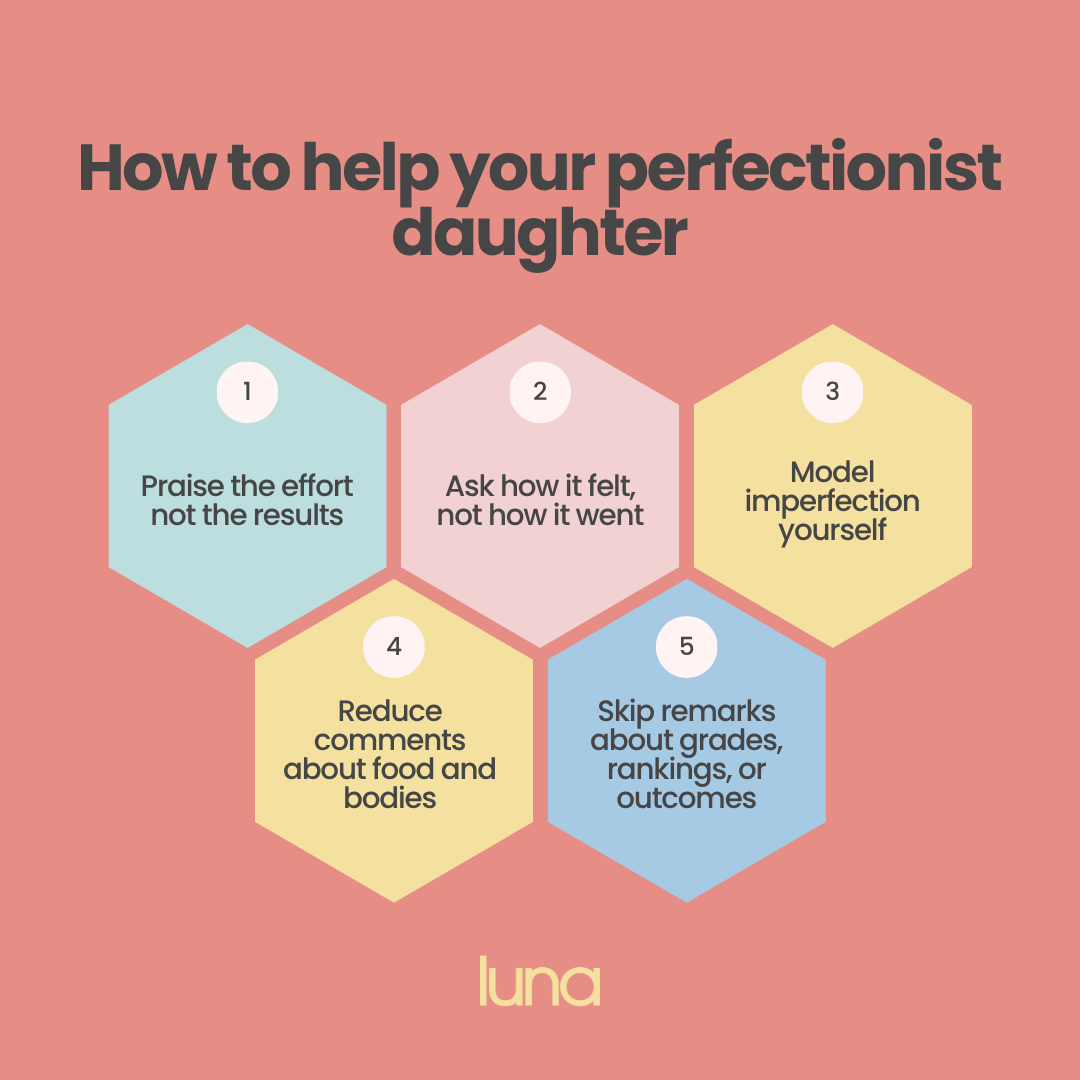
- Praise the trying and the recovery, more loudly than the result
- Ask how it felt, not how it went, with something like "what was the bit you enjoyed?" rather than "how did you do?"
- Separate her self-worth from her output, by reacting with the same warmth on the days she nails it and the days she doesn't
- Model imperfection yourself, by talking about your own current flops in front of her
- Lower the stakes of small comments, by skipping casual remarks about grades, rankings, or outcomes
- Get curious about the cost, with something like "you finished the project, but how did the week feel?"
- Reduce comments about food and bodies in front of her, because perfectionism and disordered eating often travel together
In a luna poll of 2,053 girls, 32% said being listened to without judgement is what they want most from a parent when they're stressed.
A perfectionist teen often doesn't want a strategy session; she wants someone to acknowledge that the standard she's set is heavy.
When could perfectionism be a sign of something more?
Most perfectionism in teens is a mix of personality and culture. Sometimes it's the visible edge of something heavier.
Worth a closer look if she also has:
- Persistent low mood, anxiety, or harsh self-criticism
- Sleep disruption that's not just exam-related
- Avoidance of school, friends, or activities she used to enjoy
- Restrictive eating, compulsive exercise, or body checking
- Stress-related physical symptoms like headaches, gut issues, or panic attacks
- A drop in her wider engagement with things she used to love
- Self-harm, or talk of not wanting to be here
Perfectionism is well-documented as a risk factor for adolescent anxiety, depression, eating disorders, and burnout. If you're seeing several of the signs above, talk to your GP.
For more on the wider picture, see how to help your teen's mental health.
FAQ
Is perfectionism inherited or learned?
Both. There's a genetic component, but a lot of it is learned from family patterns, school culture, and social media.
The good news is the learned part is more malleable than people think, especially before her early twenties.
My daughter is high-achieving and seems happy. Should I worry?
Not necessarily. The flag is whether her self-worth survives a setback.
If she handles a missed result, a failed audition, or a bad day with reasonable resilience, she's probably in a healthy place. If a small miss spirals her, that's worth attention.
Should I tell her she doesn't need to be perfect?
She'll have heard it. The more useful version is showing her that you'd think the same of her on her worst day. Words rarely move perfectionists. Behaviour does.
Could her perfectionism be linked to something I'm doing?
Possibly, in the sense that family patterns matter. The most useful thing is to audit your own talk about your achievements, your body, and your work in front of her, rather than blaming yourself for what's already there.
How long does this stage usually last?
Perfectionism that ties self-worth to outcomes can persist into adulthood, especially in high-achievers, which is why working on it now matters.
Many teens become more compassionate with themselves through their late teens and twenties as they accumulate experience of being wrong without disaster.
If she's also showing signs of stress or low mood alongside the perfectionism, tips for helping a stressed-out teen is a useful next read.
How we created this article:
luna's team of experts comprises GPs, Dermatologists, Safeguarding Leads and Junior Doctors as well as Medical Students with specialised interests in paediatric care, mental health and gynaecology. All articles are created by experts, and reviewed by a member of luna's senior review team.
Sources:
NHS "Anxiety disorders in children" | Accessed 12 May 2026
https://www.nhs.uk/mental-health/children-and-young-adults/advice-for-parents/anxiety-disorders-in-children/Curran, T. and Hill, A. P. "Perfectionism is increasing over time: a meta-analysis of birth cohort differences from 1989 to 2016" (Psychological Bulletin, 2019) | Accessed 12 May 2026
https://psycnet.apa.org/doiLanding?doi=10.1037%2Fbul0000138Society for the Advancement of Psychotherapy "Anorexia Nervosa and Perfectionism" | Accessed 12 May 2026
https://societyforpsychotherapy.org/anorexia-nervosa-and-perfectionism/York St John University "Perfectionism is Adaptive and Maladaptive, But What’s the Combined Effect?" | Accessed 12 May 2026
https://ray.yorksj.ac.uk/id/eprint/4339/Science Direct "Genetic and environmental contributions to perfectionism and its common factors" | Accessed 12 May 2026
https://www.sciencedirect.com/science/article/abs/pii/S0165178115306752We'd love to keep in touch!
Sign up to our parent newsletter for emails on the latest teen trends, insights into our luna community and to keep up to date
By signing up, you are agreeing that we can use your email address to market to you. You can unsubscribe from marketing emails at any time by using the link in our emails. For more information, please review our privacy statement.