Could your daughter's eczema be getting worse in puberty?
Why puberty affects eczema and what to do

Updated July 1, 2026 • Medically reviewed by Dr. Simon Tso
Medically reviewed by Dr. Simon TsoIn this article
In short
Eczema often changes during puberty.
Hormonal shifts and stress can trigger new flares or worsen existing eczema, particularly on the face, neck and hands.
Skin that also produces more oil during puberty can create a complicated picture, especially if your daughter is using acne products that dry the skin.
The core management remains the same: regular emollient use, avoiding known triggers and seeking medical help if the eczema is infected or uncontrolled.

Why does puberty affect eczema?
Hormonal changes are a known eczema trigger.
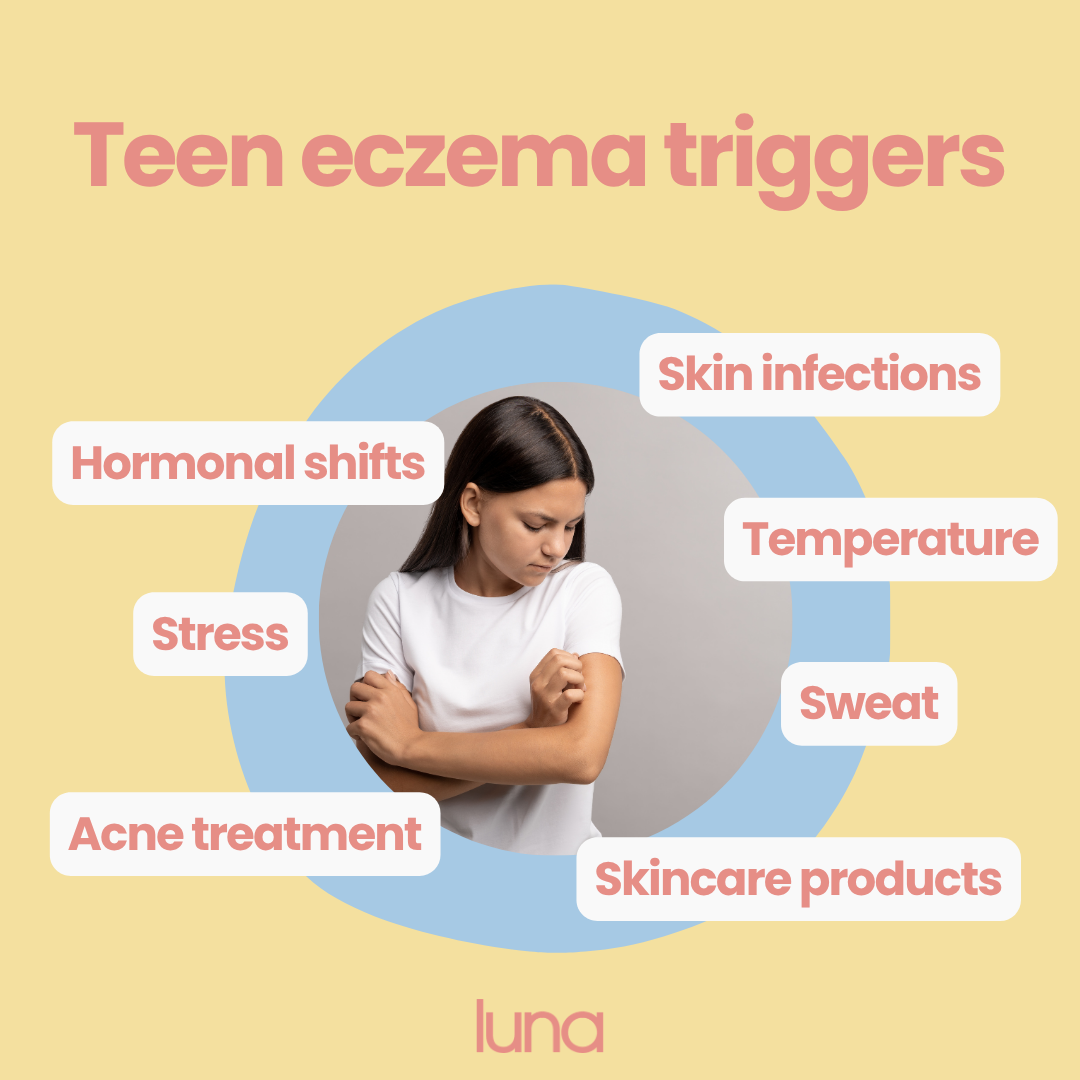
The NHS lists hormonal changes alongside stress, skin infections, and temperature changes as things that can cause atopic eczema to flare up.
During puberty, these hormonal shifts are persistent and significant, which is why some girls find their eczema becomes harder to manage in their early teens.
The stages of puberty also increase oil production and sweat gland activity, which changes the skin environment.
For girls managing acne alongside ezcema, which can co-exist, this creates a real challenge, since many acne treatments (especially benzoyl peroxide and retinoids) are drying and can worsen eczema on the same skin.
Where does teen eczema tend to appear?
The location of eczema often shifts as children get older.
In teenagers, it's most commonly found on:
- Inside of the elbows and back of the knees
- Wrists and hands
- Neck and face
- Around the eyes
Hand eczema is particularly common in teenage girls, partly because hands are washed frequently and exposed to products like hand sanitiser, soaps and cosmetics.
Does eczema get better or worse through puberty?
It varies, but there's reason for hope.
According to the Primary Care Dermatology Society, about 60% of children with atopic eczema will see it clear or significantly improve by the time they reach their teens.
For others, puberty temporarily worsens symptoms before things settle.
A small number of people continue to have eczema into adulthood, though it often becomes more manageable with age and treatment.
If your daughter's eczema was mild in childhood and has worsened recently, puberty is a likely factor, but it's still worth seeing a doctor to review her treatment plan.
How should her eczema routine change during puberty?
The fundamentals stay the same, but puberty introduces some new considerations:
- Emollients should be applied at least twice a day, even when skin looks clear
- Use emollient as a soap substitute rather than regular soap or shower gel, which strips the skin barrier
- Wash the vulva and intimate areas with plain water only, never scented products
- If she wears makeup, she should remove it carefully with a fragrance-free product and check that any makeup is non-comedogenic
- Hair dyes contain chemicals that can trigger contact reactions on the scalp and face, and this is worth knowing before she experiments with colour
- Ensure she is using a teen skincare routine that is appropriate for eczema
Sweat can also trigger flares, so showering after exercise with a mild emollient wash is worth building into her routine.
When should I take my daughter to the doctor about her eczema?
See a doctor if:
- Her eczema is not responding to her usual treatment
- Her skin looks blistered, weeping, crusty or has spots filled with pus
- The affected area is swollen, warm or painful
- She has a raised temperature alongside a flare
- Her eczema is significantly affecting her sleep, school or confidence
These can signal an infection, which needs antibiotic treatment and shouldn't wait. Call 111 if you're unsure.
FAQ
Can eczema be confused with acne during puberty?
Yes, it can, particularly on the face.
Eczema tends to be itchy and dry, while acne produces blocked pores and pustules.
Some teenagers have both.
If you're not sure what you're looking at, a doctor or pharmacist can help differentiate the two and advise on how to manage them without one treatment making the other worse.
Are topical steroids safe to use long-term on teenage skin?
Topical steroids (steroid creams) are an effective eczema treatment and, when used as prescribed, are safe for most people.
Your doctor will prescribe the right strength for the area being treated and guide you on frequency.
Using them sparingly and only when needed is the standard advice. They shouldn't be used continuously without medical guidance.
It’s important to note that occasionally the use of topical steroids may induce acne especially on facial areas.
If this is the case, discuss with your doctor about a switch from topical steroid to a steroid sparing group of treatment called topical calcineurin inhibitors to manage facial eczema as this is less likely to trigger acne.
My daughter says her eczema makes her self-conscious. How do I help?
Visible eczema, especially on the hands or face, can affect confidence at an already sensitive age.
Taking the condition seriously, getting effective treatment, and having conversations about it without shame all make a difference.
If it's significantly affecting her wellbeing, it's worth mentioning to the doctor.
They can refer for additional support.
For more on skin and puberty, luna's article on teen hormones affecting periods, skin and mood explains how hormonal changes play out across different systems.
How we created this article:
luna's team of experts comprises GPs, Dermatologists, Safeguarding Leads and Junior Doctors as well as Medical Students with specialised interests in paediatric care, mental health and gynaecology. All articles are created by experts, and reviewed by a member of luna's senior review team.
Sources:
NHS "Atopic eczema" | Accessed 05.06.26
https://www.nhs.uk/conditions/atopic-eczema/NHS "Hygiene for young people and teenagers" | Accessed 05.06.26
https://cambspborochildrenshealth.nhs.uk/child-development-and-growing-up/hygiene/hygiene-for-young-people-and-teenagers/NHS "A guide for teenagers with eczema" | Accessed 05.06.26
https://wyhealthiertogether.nhs.uk/application/files/5917/1535/0983/A-Guide-for-Teenagers-with-Eczema-booklet-2019.pdfNational Eczema Association "Eczema in your teen years" | Accessed 05.06.26
https://nationaleczema.org/blog/eczema-teen-hormones/Primary Care Dermatology Society "Eczema - atopic eczema" | Accessed 05.06.26
https://www.pcds.org.uk/patient-info-leaflets/atopic-eczemaWe'd love to keep in touch!
Sign up to our parent newsletter for emails on the latest teen trends, insights into our luna community and to keep up to date
By signing up, you are agreeing that we can use your email address to market to you. You can unsubscribe from marketing emails at any time by using the link in our emails. For more information, please review our privacy statement.