Tanner stages of puberty: a guide for parents
What each stage means for her

Updated June 1, 2026
In this article
In short
The Tanner stages are a five-stage framework used by clinicians to describe the physical changes of puberty. For girls, they track breast development, pubic hair, and overall growth from the prepubertal body to full physical maturity.
Stages begin any time between the ages of 8 and 14, and the whole process typically takes between two and five years.
No two girls move through the stages of puberty at exactly the same pace, which is normal.

What are the Tanner stages?
The Tanner stages, developed by paediatrician James Tanner in the 1960s, give clinicians and parents a shared language for puberty.
They describe development in a predictable sequence, even though the timing varies widely between individuals.
For girls, two separate tracks are scored: breast development (B1 to B5) and pubic hair development (PH1 to PH5). These do not always progress in lockstep.
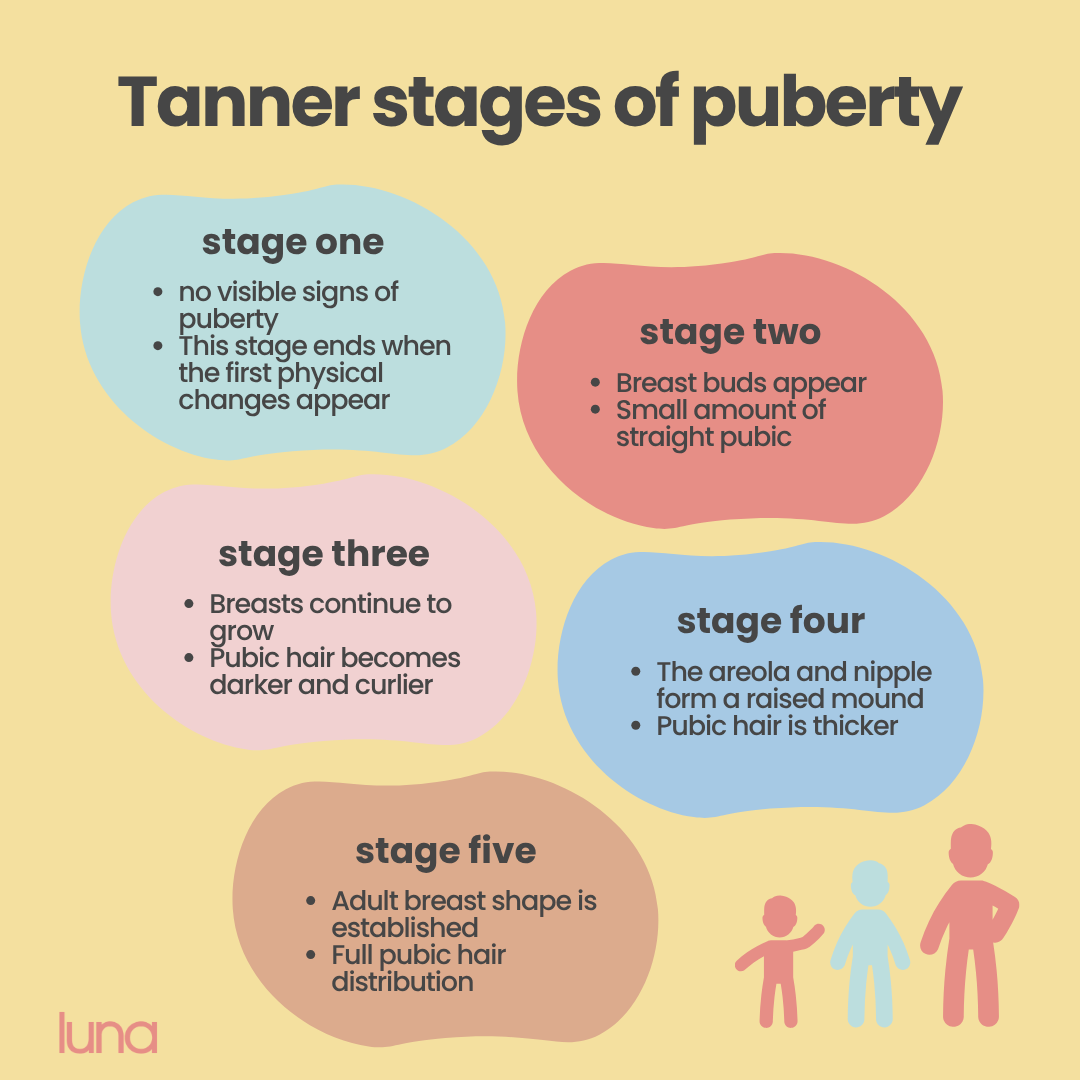
What happens at each stage?
Here is a summary of each stage for girls:
- Stage 1 (prepubertal): no visible signs of puberty. The body is in a childhood state. This stage ends when the first physical changes appear
- Stage 2 (onset, usually ages 8 to 13): breast buds appear, with slight elevation of the nipple and enlargement of the areola. A small amount of straight pubic hair may appear. This marks the official start of puberty
- Stage 3 (usually ages 9 to 14): breasts continue to enlarge. Pubic hair becomes darker and curlier. A growth spurt is typically underway. Underarm body hair begins. Vaginal discharge may start
- Stage 4 (usually ages 10 to 15): the areola and nipple form a raised secondary mound above the rest of the breast. Pubic hair is thicker. Periods often start during this stage
- Stage 5 (mature, usually ages 14 to 17): the adult breast shape is established, with the areola returning to the same level as the breast. Full pubic hair distribution. Physical growth slows and puberty ends
When should puberty start and finish?
The NHS states that it is normal for puberty to start any time between 8 and 14. Signs before age 8 may warrant a conversation with a doctor, as might no signs at all by age 15.
Periods typically arrive around two years after breast buds first appear, usually between ages 10 and 16. Most girls have completed puberty by around age 16 to 17.
What if her development seems faster or slower than her peers?
Tanner staging is a guide, not a rulebook. Girls within the same school year can be two or three stages apart, and all be completely healthy.
Delayed or early puberty is usually nothing to worry about, but tests can find out if a condition is causing it. If her development starts before age 8, or has not started at all by age 15, talking to a doctor is the right step.
How do I use this knowledge to support her?
Understanding the stages of female puberty helps you have conversations at the right time rather than after the fact.
Knowing that breast buds precede periods by roughly two years, for example, means you can introduce period products and preparation in Stage 2 rather than scrambling in Stage 4.
It also helps if your daughter is self-conscious about her breasts, periods, or being ahead of or behind her friends.
Being able to say "bodies go through this in a specific sequence, everyone gets there" is more grounding than vague reassurance.
FAQ
Do all the changes happen in order?
The sequence is consistent but the timing is not. Breast development, pubic hair, and the growth spurt may run at slightly different rates, and that is normal.
Is it normal for one breast to develop before the other?
Yes, this is very common in Stages 2 and 3. Asymmetry usually evens out, though some variation between breasts is entirely normal in adulthood, too.
My daughter is 13 and still in Stage 1. Should I be worried?
The NHS advises that puberty not having started by age 15 is when investigations are typically considered. At 13 with no signs at all, it is worth mentioning at a routine health check, but it is not usually urgent.
Does going through stages faster mean she will stop growing sooner?
Generally, yes. Girls who enter puberty earlier tend to have growth spurts earlier and stop growing earlier. Overall, adult height is not dramatically affected in most cases.
Understanding where your daughter is in her journey can make conversations calmer and more practical for both of you.
How we created this article:
luna's team of experts comprises GPs, Dermatologists, Safeguarding Leads and Junior Doctors as well as Medical Students with specialised interests in paediatric care, mental health and gynaecology. All articles are created by experts, and reviewed by a member of luna's senior review team.
Sources:
NHS "Early or delayed puberty" | 01.06.26
https://www.nhs.uk/conditions/early-or-delayed-puberty/NHS "Starting your periods" | 01.06.26
https://www.nhs.uk/conditions/periods/starting-periods/PubMed "Normal and disordered timing of pubertal development" via NCBI Bookshelf | 01.06.26
https://www.ncbi.nlm.nih.gov/books/NBK279024/Cleveland Clinic "Puberty: Tanner stages for boys and girls" | 01.06.26
https://my.clevelandclinic.org/health/body/pubertyWe'd love to keep in touch!
Sign up to our parent newsletter for emails on the latest teen trends, insights into our luna community and to keep up to date
By signing up, you are agreeing that we can use your email address to market to you. You can unsubscribe from marketing emails at any time by using the link in our emails. For more information, please review our privacy statement.