How to help your socially awkward daughter
What to do and when to seek help

Updated July 9, 2026
In this article
In short
Social awkwardness in teen girls is common, and it's often distinct from clinical social anxiety disorder.
Research shows girls are significantly more likely to experience social fears during adolescence than boys.
The most effective support combines listening without fixing, gradual exposure to social situations, and CBT (cognitive behavioural therapy) if the anxiety starts to affect daily life.
Watching your daughter hang back while others chat easily can be one of the harder things about this age.
But before you do anything else, it helps to understand whether what you're seeing is part of her personality or something that needs more support.
Social anxiety disorder (sometimes called social phobia) is a clinical condition where fear of social situations is persistent, overwhelming, and interfering with daily life.
The NHS describes it as more than shyness: a persistent fear that doesn't go away and affects everyday activities, self-confidence, relationships, and school.
Your daughter might have social anxiety if:
- She's actively dreading situations
- She’s avoiding school events
- She’s feeling physically sick before social interactions
- She finds it hard to do things when others are watching
- She worries about doing something embarrassing
Social awkwardness, on the other hand, is a much broader term.
It can describe a girl who is naturally introverted, neurodivergent, or simply still finding her social footing.
If you're wondering where the line is, teenage anxiety: spotting the signs is worth reading alongside this.
There's rarely one reason, and understanding the cause matters because the support that helps depends on it.
Some daughters are naturally more introverted or sensitive to social environments.
Others develop anxiety after a specific trigger: being left out, changing schools, bullying, or sustained family stress.
The NHS also notes that girls can pick up anxious behaviours from adults around them, particularly if a parent or carer is themselves anxious.
It's also worth knowing that teens with ADHD or autism are significantly more likely to experience social anxiety.
Not because something is "wrong", but because navigating social norms that weren't designed with their brain in mind can be genuinely exhausting.
How do I help my daughter without making it worse?
This is where most parents get stuck.
The instinct is either to push ("just go, you'll be fine once you're there") or protect ("don't worry, we'll cancel it").
Both can backfire over time.
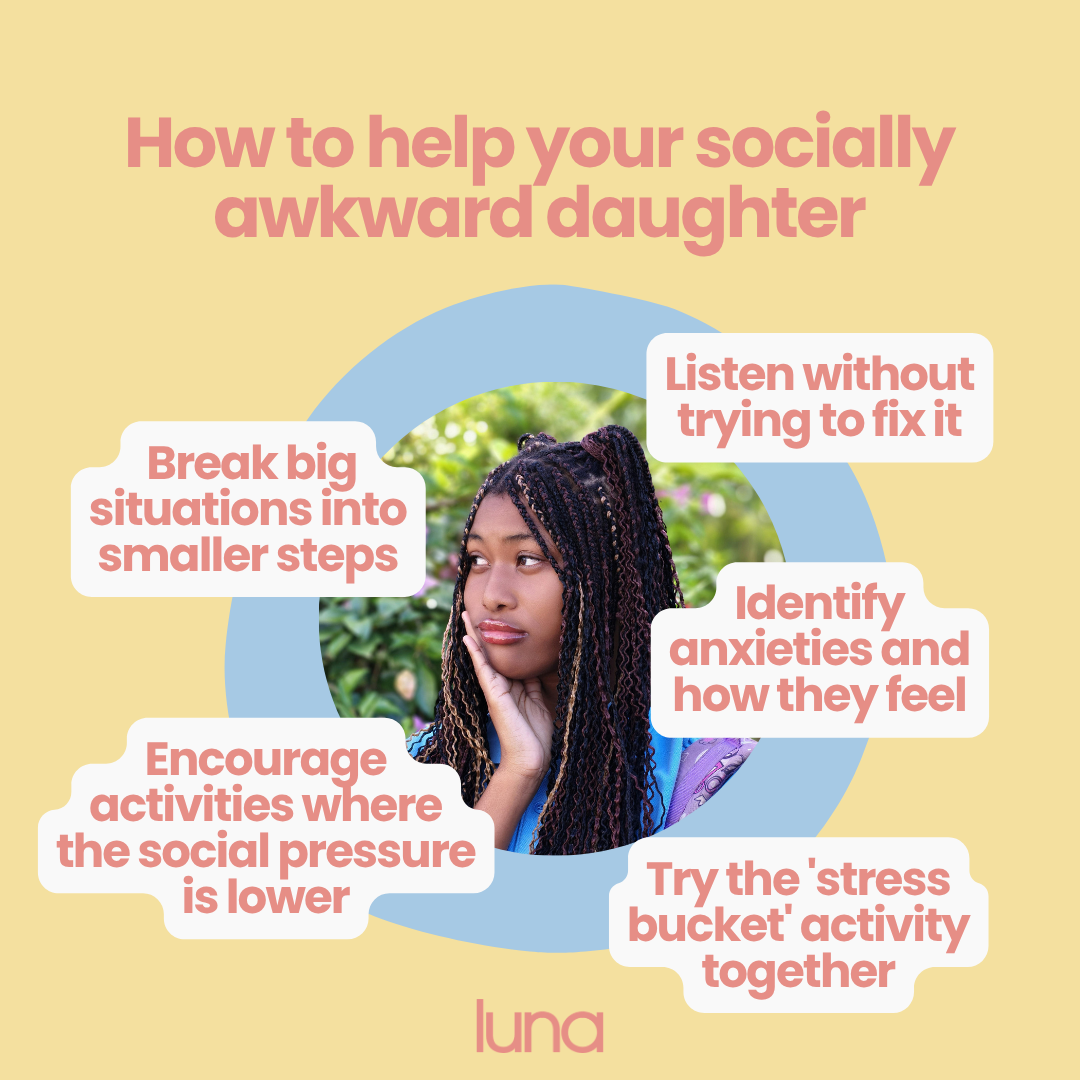
A helpful approach is to listen without trying to fix it.
Ask her what the anxiety feels like in her body and mind, and let her answer.
Simply saying "that sounds really hard" before you offer any suggestions can go further than any amount of reassurance.
Practical steps that can help over time:
- Help her break big situations into smaller steps: arriving for just the first 30 minutes of something, rather than committing to the whole event
- Help her recognise the physical signs of anxiety (tight chest, nausea, racing heart) so she can use grounding techniques before they escalate
- Encourage activities where the social pressure is lower: a one-to-one hangout, a structured class, or a hobby with a small group
- Try the 'stress bucket' activity together: writing down what fills her with anxiety, and what helps let it out
luna gives teen girls a space to explore mental health and wellbeing topics at their own pace, with all content reviewed by medical experts.
Sometimes knowing the information is there, without pressure, is enough of a first step.
For more on the social side, how to help your teen make friends has some useful starting points.
Should I tell my daughter's school she's struggling?
Yes, and it can make more of a difference than you might expect.
Most schools have pastoral support, mentoring, or peer-buddy schemes that your daughter may not know exist.
Some have counsellors who can work with her in a familiar environment.
You don't have to frame it as a mental health issue.
Saying "she finds large social situations hard and I'd love to understand what support is available" is a reasonable starting point.
If the social anxiety and school are more closely linked for your daughter, how to help with school anxiety covers what to do when the school environment itself has become part of the problem.
If her anxiety is affecting her daily life and she's avoiding school, friends, or activities she used to enjoy, it's worth speaking to a doctor.
A doctor can refer her to CAMHS (Child and Adolescent Mental Health Services) for a full assessment.
The NHS recommends CBT (cognitive behavioural therapy) as the main treatment for teenage social anxiety.
CBT helps her identify the thought patterns driving the fear and develop practical strategies for managing them.
Medication (SSRIs) is not normally used in young people and would only be considered if CBT hasn't helped.
There are things you can do while your daughter waits for CAMHS to get her support in the meantime, such as exploring free mental health resources for teens.
FAQs
Is my daughter just shy, or is it something more?
Shyness is a personality trait: feeling reserved around new people is normal and doesn't need to be "fixed."
Social anxiety is different.
It's a persistent fear that doesn't ease off and starts to limit what she feels able to do in everyday life.
If avoidance is escalating or she's distressed before most social situations, it's worth exploring further.
My daughter is socially awkward but seems happy. Should I do anything?
If she's content in herself and has at least one close connection, that's a reassuring sign.
Not every girl is wired to thrive in large social groups, and that's completely okay.
Social awkwardness only needs active support when it's causing her distress, affecting her day-to-day life, or getting progressively worse.
Can social anxiety get worse if left alone?
For some girls it does ease with age, but the NHS notes that for many it doesn't resolve without support.
Avoidance can also compound the problem: the less she practises social situations, the harder they tend to feel.
What should I avoid saying to my daughter about this?
"Just be yourself", "stop worrying", and "everyone feels nervous sometimes" can backfire, even when well-meant.
Let her know her feelings are understandable before you offer any practical suggestions.
Feeling dismissed is one of the main reasons teens stop talking to parents about anxiety.
What if my daughter won't talk to me about it?
That's common and completely normal.
luna is built for exactly this: a space where she can explore health and mental wellbeing topics privately, ask questions without judgement, and find expert-reviewed information.
If you're seeing the signs and wondering how to open the conversation, talking to your daughter about mental health is a practical next step.
If the social anxiety is getting in the way of school or daily life, speaking to a doctor is always the right move.
How we created this article:
luna's team of experts comprises GPs, Dermatologists, Safeguarding Leads and Junior Doctors as well as Medical Students with specialised interests in paediatric care, mental health and gynaecology. All articles are created by experts, and reviewed by a member of luna's senior review team.
Sources:
NHS "Social anxiety (social phobia)" | Accessed 12.06.26
https://www.nhs.uk/mental-health/conditions/social-anxiety/NHS "Anxiety disorders in children" | Accessed 12.06.26
https://www.nhs.uk/mental-health/children-and-young-adults/advice-for-parents/anxiety-disorders-in-children/Young Minds "Anxiety" | Accessed 12.06.26
https://www.youngminds.org.uk/parent/parents-a-z-mental-health-guide/anxiety/Alves F et al. "The prevalence of adolescent social fears and social anxiety disorder in school contexts" | Accessed 12.06.26
https://pmc.ncbi.nlm.nih.gov/articles/PMC9566153/We'd love to keep in touch!
Sign up to our parent newsletter for emails on the latest teen trends, insights into our luna community and to keep up to date
By signing up, you are agreeing that we can use your email address to market to you. You can unsubscribe from marketing emails at any time by using the link in our emails. For more information, please review our privacy statement.