How to help a withdrawn daughter
When she shuts down, here's what to do
Updated July 22, 2026 • Medically reviewed by Dr. Emma Dickie
Medically reviewed by Dr. Emma DickieIn this article
- In short
- How do I know if my daughter is just being a teenager or if something is really wrong?
- What signs might suggest my withdrawn daughter is depressed?
- How do I get my withdrawn daughter to open up?
- What if my daughter just won't talk to me at all?
- When should I take my daughter to see a doctor?
- FAQs
In short
If your daughter has become quieter, more distant, or withdrawn over recent weeks, it's understandable to worry.
Some withdrawal is a normal part of teenage development.
But if low mood has lasted two weeks or more and is affecting school, friendships, or things she used to enjoy, it is worth speaking to a doctor.
How do I know if my daughter is just being a teenager or if something is really wrong?
Teenagers naturally pull back from family; it is part of how they develop their own identity.
The challenge is telling the difference between typical teenage behaviour and something that needs attention.
Normal teenage behaviour includes wanting more privacy, spending more time alone, and being less talkative at home.
This can feel abrupt if it wasn't how she was before, but on its own, it doesn't always signal a problem.
The shift worth looking for is when the withdrawal is persistent and wide-ranging: not just quieter at home, but pulling away from friends, dropping activities she used to love, or seeming flat and joyless over a sustained period.
luna's guide to normal teen behaviour vs signs something's wrong covers where the line sits.
What signs might suggest my withdrawn daughter is depressed?
Depression in teenagers doesn't always look like visible sadness.
Withdrawal, flatness, and a loss of interest in things she used to enjoy are among the most common ways it shows up.
The NHS and NICE both list social withdrawal as a key symptom of depression in young people.
Other signs that can appear alongside it include:
- Continuous low mood or a flat, numb feeling lasting most of the day
- Losing interest in things she used to enjoy
- Tiredness and low energy even after sleep
- Poor concentration or difficulty making decisions
- Changes in sleep: struggling to sleep, or sleeping much more than usual
- Changes in appetite: eating noticeably less or more
- Physical symptoms like headaches or stomach aches with no clear cause
- Expressing feelings of worthlessness, guilt, or hopelessness
According to NICE clinical guidelines (NG134), for depression to be clinically identified, at least four of these symptoms need to be present for most of the day and for a minimum of two weeks.
A single difficult week is different from a sustained pattern.
If you are seeing several of these signs in your daughter over weeks, rather than days, it is worth taking seriously.
Withdrawal can also be a sign of anxiety, and the two conditions often overlap in adolescent girls.
luna's guide to teenage anxiety: spotting the signs covers the patterns that can help you tell them apart.
How do I get my withdrawn daughter to open up?
When she is pulling away, the instinct can be to try harder: more direct questions, longer conversations.
YoungMinds and the NHS both suggest a gentler, more indirect approach tends to work better.
Side-by-side situations work best: the car, a walk, cooking together.
No eye contact takes the pressure off, and silences feel less loaded.
She is more likely to open up when talking is incidental to something else.
Some approaches parents find useful:
- Use an "I" opener rather than a direct question: "I've noticed you seem a bit flat lately and I just want you to know I'm here"
- Start the conversation during an activity, not sitting face to face
- Keep it brief: one conversation doesn't have to cover everything
- Try not to jump in with solutions: being heard usually matters more than being advised
YoungMinds also recommends letting her know she can come to you whenever she is ready, and reassuring her that what she tells you will not change how you feel about her.
luna's guide on talking to your teen about mental health has more practical conversation starters if you are not sure how to begin.
What if my daughter just won't talk to me at all?
If she isn't ready to open up to you, that doesn't mean she won't talk to anyone.
Encouraging her to find another trusted adult can be just as valuable as talking to you directly.
That person might be a family member, a school counsellor, her doctor, or someone else she feels safe with.
If she is not ready for face-to-face conversations at all, YoungMinds suggests trying text or messaging as a lower-pressure alternative.
Some teens find it easier to put something in writing first.
It is also worth staying visible: being around in shared spaces, offering to watch something together, keeping the door open without pressure.
The invitation needs to be there before she is ready to take it.
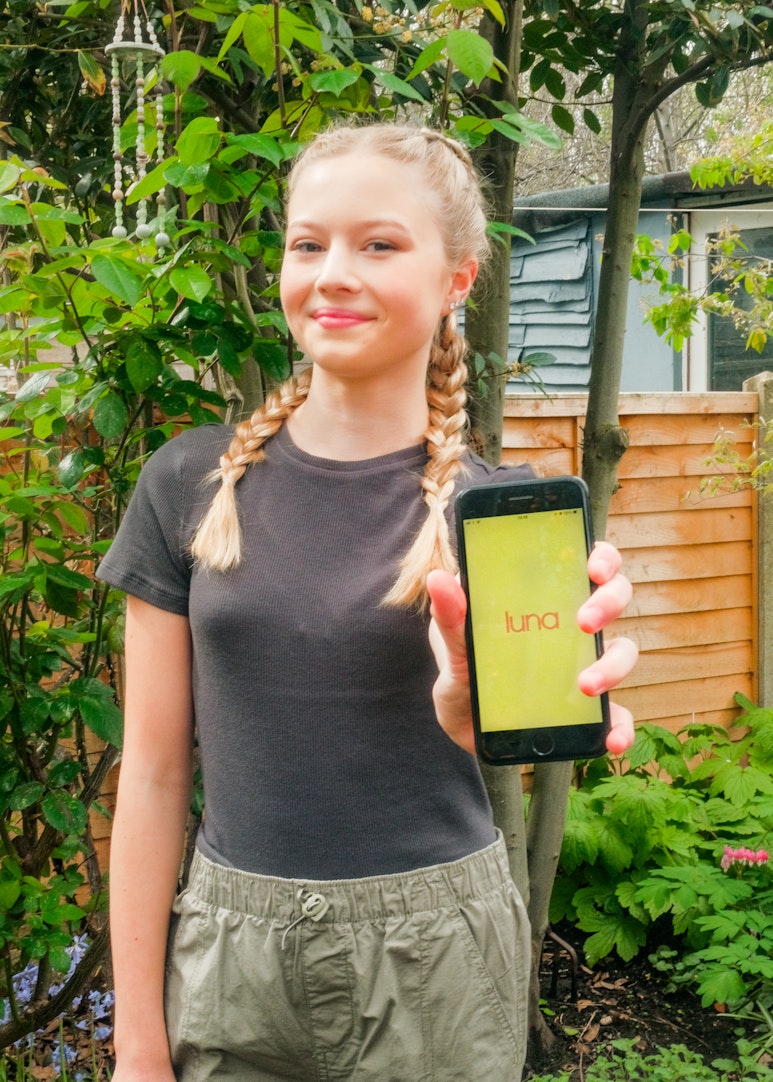
luna gives teen girls a private space to explore mental health topics and ask questions without judgement.
For some daughters, reading about what they are feeling in their own time is the first step toward being able to talk about it.
When should I take my daughter to see a doctor?
If you have tried to open conversation and she remains shut down, or if you are noticing several of the depression symptoms above over a period of two weeks or more, a visit to her doctor is the right next step.
The NHS is clear that early support matters: the longer depression goes without help, the more likely it is to have a longer-term impact.
You do not need to be certain she is depressed to make an appointment.
A worry is enough.
At the appointment, the doctor can talk through what your daughter has been experiencing and, if appropriate, refer her to local children and young people's mental health services (CAMHS), suggest counselling, or recommend self-help and free mental health resources.
If getting her there feels like a hurdle, YoungMinds suggests framing it as a general check-in rather than a crisis.
Her school may also have a counsellor she can see independently.
For some teenagers, knowing they can seek help without involving their parents makes it easier to take that first step.
luna has expert-reviewed content on mental health, growing up, and wellbeing, all designed for teen girls without ads or influencer pressure.
It can be a useful starting point for a daughter who is not ready to talk but might be willing to read.
FAQs
Could my daughter's withdrawal be linked to her period?
It is possible.
Some girls experience significant mood changes in the days before their period, and this is known as PMS (premenstrual syndrome) and, in more severe cases, PMDD (premenstrual dysphoric disorder).
If you notice the withdrawal follows a monthly pattern, it is worth tracking roughly where it falls in her cycle.
A doctor can help assess whether hormonal factors are contributing.
Should I contact her school?
It is worth considering, particularly if the withdrawal has lasted several weeks or if something may have happened there.
Bullying, a friendship fallout, and exam stress are all common triggers for teenage withdrawal.
Most schools have a pastoral lead you can speak to in confidence.
Many also have a counsellor your daughter can access directly, without needing to go through you first.
Could she be withdrawing because of something I've done?
It is one of the first places parents' minds go, and it is almost never the whole answer.
Teenagers sometimes pull away from the parent relationship precisely because it feels too close and too exposing when they are struggling.
Something at school, with friends, or online is just as likely to be affecting her.
Not knowing is not a failure.
Is withdrawal in teen girls more common than in boys?
Research suggests girls experience depression at higher rates than boys from adolescence.
Furthermore, girls also tend to internalise distress, such as going quiet and withdrawing, whereas boys more often externalise it through behaviour.
This means withdrawal in girls can go unnoticed for longer than it should.
If you are sitting with this worry right now, the fact that you noticed matters.
Staying present, keeping conversations low-pressure, and knowing when to involve a doctor are the most useful things you can do.
For small, practical ways to support your daughter while you work out what is happening, luna's guide to everyday things you can do to support your daughter's mental health is a good place to start.
How we created this article:
luna's team of experts comprises GPs, Dermatologists, Safeguarding Leads and Junior Doctors as well as Medical Students with specialised interests in paediatric care, mental health and gynaecology. All articles are created by experts, and reviewed by a member of luna's senior review team.
Sources:
NHS "Depression in children and young people" | Accessed 29.06.26
https://www.nhs.uk/mental-health/children-and-young-adults/advice-for-parents/children-depressed-signs/NHS "Worried about your teenager?" | Accessed 29.06.26
https://www.nhs.uk/mental-health/children-and-young-adults/advice-for-parents/worried-about-your-teenager/YoungMinds "Depression and low mood" | Accessed 29.06.26
https://www.youngminds.org.uk/parent/parents-a-z-mental-health-guide/depression-and-low-mood/YoungMinds "How to talk to your child about mental health" | Accessed 29.06.26
https://www.youngminds.org.uk/parent/how-to-talk-to-your-child-about-mental-health/NICE "Depression in children and young people: identification and management" | Accessed 29.06.26
https://www.nice.org.uk/guidance/ng134We'd love to keep in touch!
Sign up to our parent newsletter for emails on the latest teen trends, insights into our luna community and to keep up to date
By signing up, you are agreeing that we can use your email address to market to you. You can unsubscribe from marketing emails at any time by using the link in our emails. For more information, please review our privacy statement.