Explaining the menstrual cycle phases
Supporting your teen through them
Updated April 11, 2026 • Medically reviewed by Dr. Emma Dickie
Medically reviewed by Dr. Emma DickieIn this article
- What are the phases of my teen's menstrual cycle?
- What is my teen's menstrual cycle?
- Why is it helpful to know about my teen's menstrual cycle phases?
- What are the four phases of my teen's menstrual cycle?
- What happens to my teen during a period (menstruation phase)?
- How can I support my teen during the menstruation phase?
- What happens to my teen during the follicular phase?
- How can I support my teen during the follicular phase?
- What happens to my teen during ovulation?
- How can I support my teen during ovulation?
- What happens during my teen's luteal phase?
- How can I support my teen during the luteal phase?
- Does the menstrual cycle affect my teen’s mood?
- Why should my teen use a period tracker?
What are the phases of my teen's menstrual cycle?
The menstrual cycle has four phases: menstruation (your teen’s period), the follicular phase, ovulation, and the luteal phase. Each phase involves hormonal changes that affect your teen’s mood, energy, and body.
For example, your teen might feel low energy and crampy during their period, more focused and motivated in the follicular phase, more social around ovulation, and more emotional or tired in the days before their next period.
Understanding these phases can help your teen feel more in control of their body - and help you support them in the right way at the right time.
What is my teen's menstrual cycle?
The menstrual cycle is the natural monthly process your teen’s body goes through to prepare for a possible pregnancy. It includes their period, but also several hormonal phases before and after it.
A cycle starts on the first day of bleeding (their period) and ends the day before the next period begins.
While the “average” cycle is 28 days, it’s completely normal for teens to have cycles that are shorter (around 21 days) or longer (up to 35 days). Cycles can also be irregular in the first few years.
Across the cycle, hormones rise and fall - and this is what affects your teen’s mood, energy, sleep, and physical symptoms.
Why is it helpful to know about my teen's menstrual cycle phases?
When you understand the menstrual cycle, it becomes much easier to support your teen without second-guessing what’s going on.
Instead of thinking “why are they suddenly so emotional?”, you might recognise that they’re in the premenstrual phase - when mood changes are very common.
For example, your teen might:
- Feel more confident and social one week
- Then more sensitive or tired the next
Knowing this isn’t random - it’s hormonal - can help both of you respond with more patience and understanding.
It also helps your teen:
- Recognise patterns in how they feel
- Prepare for symptoms like PMS or cramps
- Feel more in control of their body
What are the four phases of my teen's menstrual cycle?
The menstrual cycle has four phases: menstruation, the follicular phase, ovulation, and the luteal phase. Each phase is driven by hormonal changes that affect your teen’s mood, energy, and body.
- Menstruation (the period): when bleeding occurs and hormone levels are lowest
- The follicular phase: energy and focus begin to rise as hormones increase
- Ovulation: an egg is released and confidence or sociability may peak
- The luteal phase: hormone levels shift again, often leading to PMS symptoms
You can remember this as follicular for first and luteal for last.
What happens to my teen during a period (menstruation phase)?
The menstruation phase is when your teen has their period. It usually lasts around 3–7 days and begins on day one of their cycle.
During this time, the body sheds the lining of the uterus, which causes bleeding.
Hormone levels are at their lowest in this phase, which is why many teens feel more tired, sensitive, or low in energy.
Common symptoms during a period include:
- Cramps (in the lower stomach, back, or thighs)
- Tiredness or low energy
- Mood swings or emotional sensitivity
- Bloating or digestive changes
- Headaches
- Acne or skin changes
Every teen is different - some may have only mild symptoms, while others find this phase more uncomfortable.
How can I support my teen during the menstruation phase?
This phase is often when your teen needs the most physical comfort and emotional reassurance. Making sure they know it is okay to rest when they need to, going easy on them, and offering them hot water bottles or warm baths is helpful
You may also want to:
- Support them with the right food: make sure they’re eating iron-rich foods to help replenish nutrients
- Encourage self-care: things like gentle exercise, journaling, or getting an early night can help
- Validate their emotions: they might not be feeling their best and might be a little sensitive
What happens to my teen during the follicular phase?
The follicular phase is the first half of the menstrual cycle, starting on the first day of a period and ending at ovulation. During this phase, oestrogen levels rise, which can increase your teen’s energy, focus, and mood.
As your teen moves out of their period, their body begins preparing to release an egg. This rise in hormones often brings a noticeable shift in how they feel - both physically and emotionally.
For example, your teen might go from feeling tired during their period to feeling more motivated, social, or productive as the days go on.
Other symptoms include:
- Improved concentration and focus
- More stable and positive mood
- Clearer skin due to rising oestrogen levels
How can I support my teen during the follicular phase?
This is often when your teen feels more like themselves again, so it’s a good time to gently support their independence and confidence. You may want to help them find ways to help them take advantage of this high-energy time, such as through schoolwork and sports.
You may also want to:
- Support balanced routines: even with higher energy, they still need rest, regular meals, and downtime
- Build confidence: if they’re feeling more positive, it’s a good time to reinforce self-esteem and encourage new challenges
- Avoid over-scheduling: energy can fluctuate, especially earlier in the phase, so flexibility still matters
What happens to my teen during ovulation?
Ovulation is when the ovary releases an egg, usually around the middle of the menstrual cycle. During this phase, oestrogen and other hormones peak, which can boost confidence, energy, and sociability.
This is often one of the shortest phases, but it can bring noticeable changes in how your teen feels.
For example, your teen might seem more outgoing, chatty, or confident than usual - or more interested in social plans and being around others.
Symptoms include:
- Increased confidence and sociability
- Higher energy levels
- Mild bloating or cramps
- A slight rise in body temperature
How can I support my teen during ovulation?
This phase often brings a natural boost in mood and confidence, so it can be a positive time for connection and activity. If they feel particularly outgoing or energetic, try to find ways to make the most of it with them through social plans or fun bonding activities together (as they may be in a great mood!)
You may also want to:
- Support their confidence: they may feel more self-assured, so reinforce this with encouragement
- Keep communication open: this can be a natural moment to talk about friendships, relationships, or body changes if needed
- Help them stay balanced: even during high-energy phases, rest and routine are still important
- Help ease pain: if they experience ovulation pain, suggest gentle stretching or a warm compress – all the same things you can do to help relieve period pain
What happens during my teen's luteal phase?
The luteal phase is the second half of the menstrual cycle, starting after ovulation and ending when the next period begins. During this phase, progesterone rises and then drops, which can lead to PMS symptoms.
This is often when teens notice the biggest emotional and physical shifts.
For example, your teen might feel more tired, irritable, or sensitive in the days before their period - even if everything seemed fine the week before.
Symptoms include:
- Increased tiredness and a desire to slow down
- Bloating and digestive changes
- Emotional sensitivity and mood swings
- Stronger food cravings, particularly for carbohydrates and sweets
- Oilier skin, spots, and acne – a good teen-friendly skincare routine can help with this
This phase isn’t talked about a lot, but can often be tougher even than a period phase for some menstruators.
Knowing about it can help to explain those feelings in the lead up to a period and can even help us to be more aware of when our period is on the way (alongside using a period tracker).
How can I support my teen during the luteal phase?
This phase often requires more emotional support, patience, and understanding. Let them know it’s okay to set boundaries and take more time for themselves if they feel irritable or overwhelmed.
You may also want to:
- Normalise what they’re feeling: remind them that mood changes and physical symptoms are common before a period
- Encourage rest and slower pacing: they may need more downtime or quiet time during this phase
- Help them prepare: stock up on period products, snacks, or comfort items ahead of time
- Support emotional regulation: be calm and reassuring if they feel more sensitive or overwhelmed
- Reduce pressure where possible: flexibility with expectations can help ease stress during this time
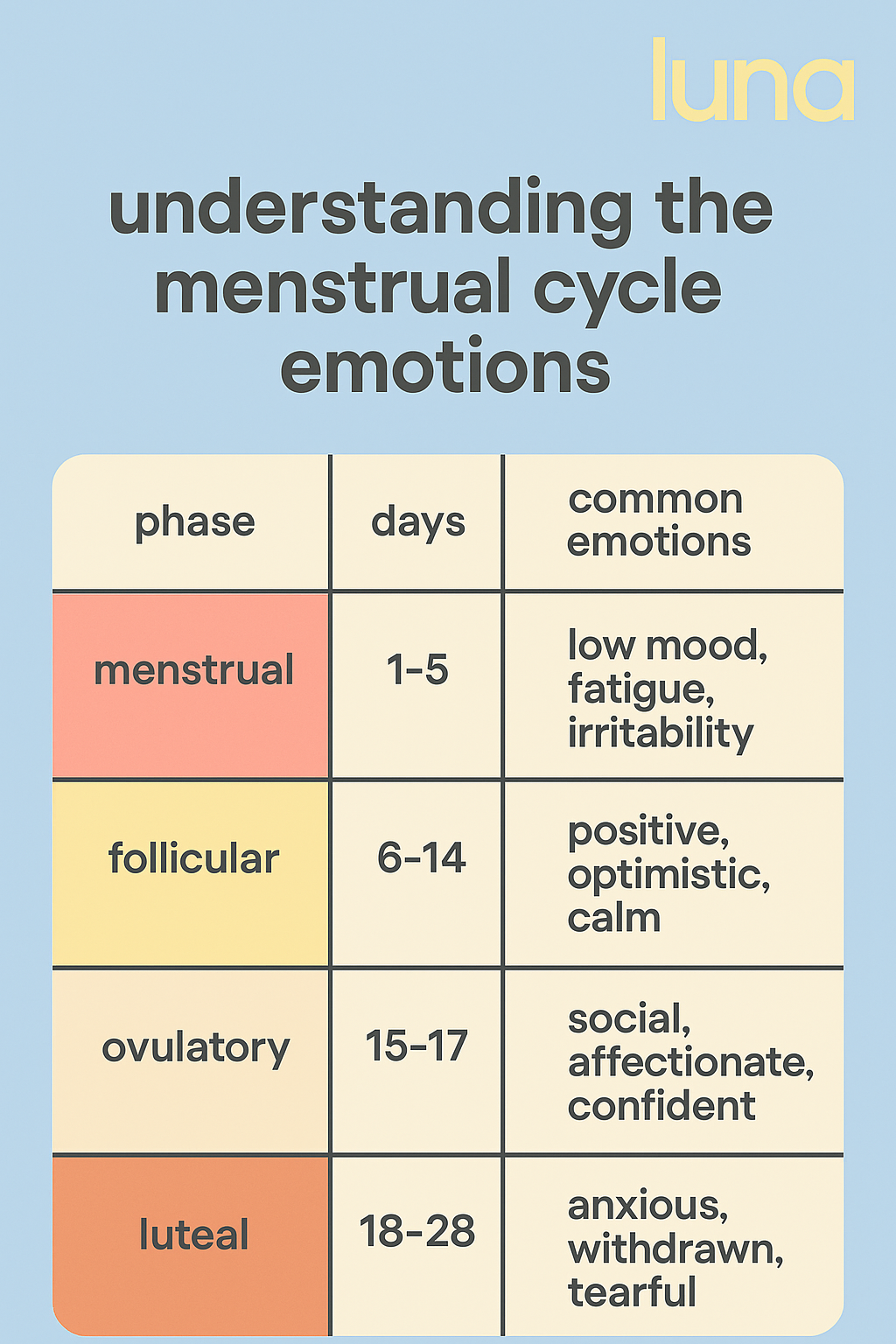
Does the menstrual cycle affect my teen’s mood?
Yes, the menstrual cycle can have a real impact on your teen’s mood. Hormonal changes throughout the cycle can influence how they feel emotionally, socially, and mentally from week to week.
Your teen might feel more confident and social at some points in their cycle, and more sensitive, tired, or irritable at others. These shifts can feel confusing, especially if they don’t yet recognise the pattern.
The infographic below breaks down how mood and emotions can change across each phase, so you can better support your teen depending on where they are in their cycle.
Why should my teen use a period tracker?
Tracking their cycle can help your teen turn something that feels unpredictable into something they understand and feel prepared for.
For example, instead of being caught off guard by mood changes or cramps, they can start to recognise “this usually happens a few days before my period.”
Using a period tracker can help your teen:
- Spot patterns in mood and symptoms
- Predict when their period is coming
- Feel more in control of their body
- Prepare for different phases of their cycle
It can also help you support them more easily, as you’ll both have a clearer picture of what’s happening and when.
You might want to encourage your teen to use luna’s period tracker to keep track of their cycle and learn more about how their body changes across the 4 phases of the menstrual cycle.
luna’s period tracker is designed specifically for teens to use, in collaboration with other teens and medical professionals, to make sure it’s age-appropriate, medically accurate and easy to use.
How we created this article:
luna's team of experts comprises GPs, Dermatologists, Safeguarding Leads and Junior Doctors as well as Medical Students with specialised interests in paediatric care, mental health and gynaecology. All articles are created by experts, and reviewed by a member of luna's senior review team.
Sources:
NHS “Periods” | Accessed 20.03.25
https://www.nhs.uk/conditions/periods/NHS “Irregular periods” | Accessed 20.03.25
https://www.nhs.uk/conditions/irregular-periods/Kids Health “Irregular periods” | Accessed 20.03.25
https://kidshealth.org/en/teens/irregular-periods.htmlNHS “Period pain” | Accessed 20.03.25
https://www.nhs.uk/conditions/period-pain/NHS “Periods and fertility in the menstrual cycle” | Accessed 20.03.25
https://www.nhs.uk/conditions/periods/fertility-in-the-menstrual-cycle/NHS "Ovulation pain" | Accessed 20.03.25
https://www.nhs.uk/conditions/ovulation-pain/Beverly G Reed, MD and Bruce R Carr, MD "The normal menstrual cycle and the control of ovulation" | Accessed 20.03.25
https://www.ncbi.nlm.nih.gov/books/NBK279054/Nathan R. Brott and Jacqueline K. Le. "Mittelschmerz" | Accessed 20.03.25
https://www.ncbi.nlm.nih.gov/books/NBK549822/Kids Health "Sex during period" | Accessed 20.03.25
https://kidshealth.org/en/teens/sex-during-period.htmlWe'd love to keep in touch!
Sign up to our parent newsletter for emails on the latest teen trends, insights into our luna community and to keep up to date
By signing up, you are agreeing that we can use your email address to market to you. You can unsubscribe from marketing emails at any time by using the link in our emails. For more information, please review our privacy statement.