Why is your daughter's girl friendship group so difficult?
The drama, the fallouts, the tears
Updated July 9, 2026
In this article
- In short
- Why are girls' friendship groups so intense compared to boys'?
- Why does my daughter's friendship group fall out so much?
- Why does my daughter's group feel so all-or-nothing at this age?
- What's the role of social media in my daughter's friendship drama?
- When should I be worried about my daughter's friendship group?
- How do I support my daughter without making it worse?
- FAQs
In short
Girl friendship groups are intense because they serve a developmental purpose: your daughter is using them to figure out who she is.
Girls' groups tend to be smaller and more emotionally close than boys', which means there's more at stake when things go wrong.
Conflict, shifting alliances, and social exclusion are common and usually normal, even when they hurt.
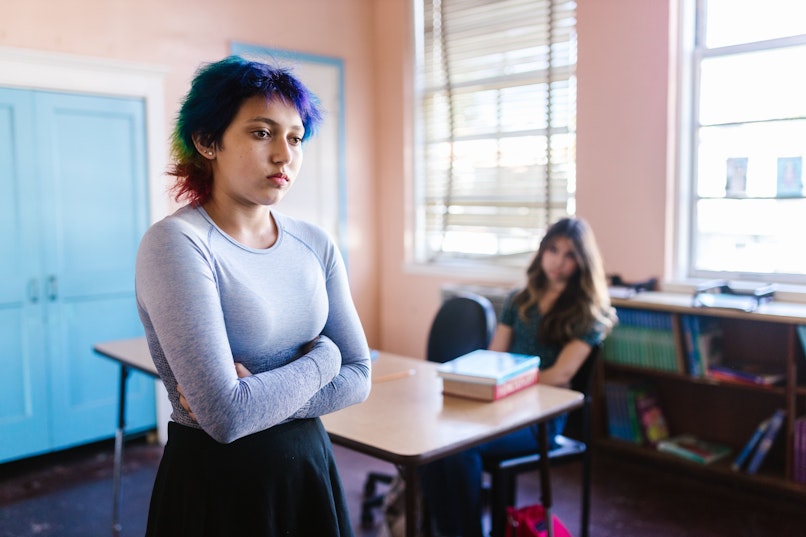
Why are girls' friendship groups so intense compared to boys'?
It's not your imagination.
Research shows that teenage girls tend to form smaller, more emotionally intimate friendship groups than boys, who typically move in larger, activity-based social clusters.
That closeness is meaningful, but it also means there's more at stake when things go wrong.
When your daughter shares everything with one or two close friends, any crack in that bond can feel catastrophic.
The intimacy that makes the friendship valuable is the same thing that makes conflict so much harder to weather.
Why does my daughter's friendship group fall out so much?
Adolescence is when young people are actively building their identity and working out where they fit in the world.
Friendship groups become the main arena for that work, which is why they can feel so high-stakes.
Psychologists have identified a pattern called relational aggression, which includes things like gossip, social exclusion, silent treatment, and shifting friendship dynamics.
These behaviours can sometimes emerge in close-knit friendship groups where belonging and social status feel especially important.
That doesn't make it okay.
But it does explain why the drama can feel relentless, even within an otherwise caring friendship.
If you suspect something has crossed into genuinely toxic territory, it's worth reading how to tell if your teen has a toxic friend.
Why does my daughter's group feel so all-or-nothing at this age?
Part of this comes down to mental development in adolescence.
The adolescent brain is still building the capacity for emotional regulation, managing big feelings, seeing other perspectives, and resolving conflict calmly.
This process continues well into the late teens.
At the same time, teens increasingly look to their peers rather than their parents for acceptance and a sense of identity.
A threat to her place in the group can feel, neurologically, like a threat to who she is.
luna gives teen girls a space to explore questions about friendship, identity, and belonging at their own pace, all content is reviewed by medical experts.
It adds fuel.
The features of social media, such as who's posting, who's been left out of a group chat, and the pressure to be always available, can contribute to digital stress and friendship conflict in teenagers.
What might once have blown over by Monday morning can now play out across multiple platforms over an entire weekend.
If your daughter has been kicked out of a group chat or left off an invite, the visibility of that exclusion is part of what makes it sting so much.
When should I be worried about my daughter's friendship group?
Most friendship drama, like the fallouts, the reshuffling, and the tears, is a normal if painful part of adolescence.
But there are signs of bullying or an unhealthy dynamic to watch out for:
- She's being deliberately excluded or isolated over a sustained period
- Rumours are being spread about her
- She's being pressured to behave in ways she's uncomfortable with to keep her place in the group
- She's becoming anxious, withdrawn, or reluctant to go to school
- She seems to have no safe relationships left in her peer group
If you're seeing several of these, it's worth talking to her school. Childline (0800 1111) is also available to young people directly.
How do I support my daughter without making it worse?
The instinct to fix it or take sides is natural, but stepping in too quickly can backfire.
It is a good idea to give young people space to sort things out where possible, because managing conflict is an important life skill they're actively building.
Your daughter may need you to listen more than she needs you to act.
Some parents find it useful to talk about what a good friendship feels like, not in the middle of a crisis, but as an ongoing, low-stakes conversation.
What does it feel like when a friend is kind to her?
What makes someone trustworthy?
Watching your daughter navigate the turbulence of a teenage friendship group is hard, especially when you can see what's happening and she won't let you in.
If she seems left out and lonely rather than just caught in normal drama, that's worth taking a closer look at.
And if she's consistently anxious or low, a conversation with her doctor is always a reasonable next step.
FAQs
Does my daughter have to go through this friendship group drama?
Not in the same way or to the same degree, but friendship difficulties are extremely common in adolescence.
That doesn't make it easier to watch, but it does mean your daughter isn't unusual, and you're not doing anything wrong.
My daughter's best friend has turned the whole group against her. What do I do?
This kind of targeted social exclusion is genuinely distressing and shouldn't be minimised.
Listen to what's happened without rushing to conclusions, and resist the urge to contact other parents unless things escalate significantly.
If it's ongoing, her school's pastoral team can often step in.
It might also help to read what to do when your daughter's been dumped by her best friend.
Should I get involved in my daughter's friendship problems?
The general advice from NHS and child development experts is to stay close but not intervene in every disagreement.
Working through conflict is part of how teens build social and emotional skills.
Save direct involvement for situations that have crossed into bullying, are affecting her mental health, or that she's explicitly asked you to help with.
Is it normal for my daughter's friendships to change so much at this age?
Yes, and it's developmentally expected.
Young people are changing rapidly.
Their values, interests, and sense of self are all shifting.
A friendship group that felt right at 12 might not fit at 15, and that's okay.
The skills she's building along the way, such as how to repair ruptures, recognise who she trusts, and navigate conflict, will stay with her long after school is over.
Could friendship group problems affect my daughter's mental health?
Persistent social exclusion and relational conflict can contribute to low self-esteem, anxiety, and low mood, and it's worth taking seriously if she seems persistently withdrawn or is avoiding school.
The NSPCC notes that a healthy friendship should feel safe, mutual, and respectful.
If what you're seeing sounds far from that, trust your instinct and speak to her doctor.
How we created this article:
luna's team of experts comprises GPs, Dermatologists, Safeguarding Leads and Junior Doctors as well as Medical Students with specialised interests in paediatric care, mental health and gynaecology. All articles are created by experts, and reviewed by a member of luna's senior review team.
Sources:
NHS "Friendships" | Accessed 12.06.26
https://family.kentcht.nhs.uk/support/emotional-health-and-wellbeing/supporting-your-childs-emotional-wellbeing/friendships/Young Minds "Friendships" | Accessed 12.06.26
https://www.youngminds.org.uk/young-person/coping-with-life/friends/NHS "Adolescence" | Accessed 12.06.26
https://londonwaitingroom.nhs.uk/adolescenceNSPCC "Healthy relationships" | Accessed 12.06.26
https://www.nspcc.org.uk/advice-for-families/healthy-relationships/PubMed "Emergence of mixed-sex friendship groups during adolescence: developmental associations with substance use & delinquency" | Accessed 12.06.26
https://pmc.ncbi.nlm.nih.gov/articles/PMC4315307/PubMed "Relational aggression, gender, and social-psychological adjustment" | Accessed 12.06.26
https://pubmed.ncbi.nlm.nih.gov/7789197/We'd love to keep in touch!
Sign up to our parent newsletter for emails on the latest teen trends, insights into our luna community and to keep up to date
By signing up, you are agreeing that we can use your email address to market to you. You can unsubscribe from marketing emails at any time by using the link in our emails. For more information, please review our privacy statement.