What is looksmaxxing and should you worry about your daughter?
The TikTok trend explained for parents
Updated July 7, 2026 • Medically reviewed by Dr. Katie Knight
Medically reviewed by Dr. Katie KnightIn this article
In short
Looksmaxxing is the practice of systematically trying to improve physical appearance, treating attractiveness like a score to maximise.
It started in male online communities but has spread to teen girls via TikTok trends.
Most of it is ordinary self-care.
The concern is when it becomes obsessive, involves extreme interventions, or affects how your daughter eats, socialises, or feels about herself.
What exactly is looksmaxxing?
If you've spotted the word on your daughter's phone or heard her use it, it can feel alarming without much context.
Looksmaxxing means deliberately and systematically working to improve physical appearance, with the idea that attractiveness can be treated like a score to maximise.
It ranges from beauty routines and lifestyle changes to, in more extreme cases, cosmetic procedures.
There are two broad ends of the spectrum:
- Softmaxxing covers lower-risk practices: skincare, haircare, fitness, posture, and style tweaks
- Hardmaxxing goes further and includes restrictive diets, devices marketed to reshape the jaw or face, and cosmetic procedures
Where did looksmaxxing come from?
Looksmaxxing has its roots in incel (involuntary celibate) communities and men's self-improvement forums online.
The core belief in those spaces is that a person's value is largely determined by how physically attractive they are.
That framing has since moved into mainstream social media.
Teen girls encounter it on TikTok and Instagram, usually with no awareness of where it originally came from.
You might recognise related terms your daughter uses: mewing (a tongue posture technique claimed to reshape the jaw) and facial harmony content about the symmetry and proportions of facial features.
Both are part of the same online ecosystem as looksmaxxing.
Is looksmaxxing bad for my daughter?
Not automatically. But it carries real risks worth understanding.
Research consistently links high social media use in adolescents with greater body dissatisfaction.
A 2024 review in Psychology Research and Behavior Management found that social media has negative effects on adolescent body image and disordered eating behaviours, and identified a strong need for strategies to reduce this harm.
The specific issue with looksmaxxing is how it frames your daughter's appearance: as a project to be fixed rather than a body to feel at home in.
That's a meaningfully different mindset from wanting to look nice or feel more confident.
What does looksmaxxing actually involve?
The range is wide.
On the lower-risk end, it's no different from ordinary teenage self-care: skincare routines, a new haircut, fitness, or experimenting with style.
More concerning practices include:
- Restrictive or regimented diets framed as improving facial features or "cutting body fat"
- Jaw exercises, tongue posture practices, or devices marketed as reshaping the face
- Using too much skincare designed for adult skin and at high concentrations
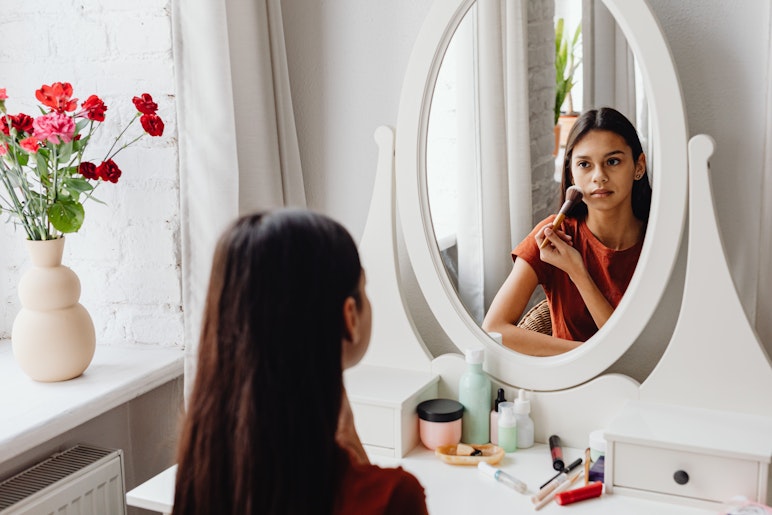
- Spending hours analysing specific features in the mirror or on camera, often comparing them to influencers
- Requesting cosmetic procedures such as lip fillers, buccal fat removal, or rhinoplasty, framed as routine enhancements
If your daughter is doing the first kind, there's probably not much to worry about. The second kind warrants more attention.
How do I know if my daughter's looksmaxxing has become a problem?
The NHS recognises body dysmorphic disorder (BDD) as a condition where a person spends a lot of time worrying about perceived flaws in their appearance, often flaws that are unnoticeable to others.
It is most common in teenagers and young adults, and it can lead to depression, self-harm, and thoughts of suicide if left untreated.
Signs that looksmaxxing may be crossing into BDD territory include:
- Spending hours each day comparing her appearance to others or analysing specific features
- Avoiding social situations, school, or activities because of how she looks
- Becoming very distressed or showing signs of anxiety if she can't complete a beauty routine or notices what she considers a flaw
- Repeatedly seeking reassurance about her appearance, or refusing all reassurance
- Pursuing increasingly extreme measures for features that look completely normal to you
If you're recognising these signs, speaking to a doctor is a reasonable next step.
BDD responds well to cognitive behavioural therapy (CBT), and the earlier support is sought, the easier it tends to be to treat.
It's also worth watching whether looksmaxxing is shaping what she eats.
If her diet is being restricted in the name of improving her looks, such as if she’s counting calories, that's a separate concern.
If she's spending a lot of time comparing herself to others online, that pattern is worth paying attention to, too.
How do I talk to my daughter about looksmaxxing?
If she's already deep into looksmaxxing content, a direct "I think this is harmful" conversation is likely to go nowhere.
Some parents find it helps to start with curiosity rather than concern.
Asking what she's watching, what she finds interesting about it, and what she makes of the claims being made can open things up without her feeling judged.
It's also worth being honest that some looksmaxxing content is genuinely useful (good skincare advice, healthy fitness habits) while other parts are built on pseudoscience or unrealistic standards.
Teenagers tend to engage better with that nuance than with a blanket dismissal.
If how your daughter feels about her appearance is starting to affect her eating, her friendships, or her willingness to leave the house, it's worth booking an appointment with your doctor.
luna's guide to what to do if your daughter has body image issues is a useful place to start in the meantime.
FAQs
Is looksmaxxing the same as self-care?
Not quite.
Self-care is about feeling good in your body.
Looksmaxxing, in its original form, is about optimising attractiveness as if it were a score.
Many teens use the term loosely to mean working on their appearance, which is entirely normal.
As a parent, it's worth knowing where the concept originally came from and what the more extreme end can look like.
Should I be worried if my daughter is using the word "looksmaxxing"?
Not necessarily.
Many teens use it the same way they'd say "glow up," a loose way of describing working on how they look.
The question is whether her behaviour has become obsessive, whether she's taking risks such as extreme diets or pursuing cosmetic procedures, or whether her appearance is significantly affecting her mood or daily life.
Can looksmaxxing lead to an eating disorder?
It can be a risk factor.
When looksmaxxing includes dietary restriction framed as improving "bone structure" or lowering body fat percentage, it can develop into disordered eating.
If your daughter is significantly restricting food in the name of looksmaxxing, that's worth raising with a doctor.
What age do girls start looksmaxxing?
Looksmaxxing content reaches girls as young as 11 or 12 via TikTok and Instagram.
The younger your daughter is, the more valuable open conversations about what she's seeing online tend to be, particularly around understanding what is evidence-based and what isn't.
Is mewing part of looksmaxxing?
Yes. Mewing is a tongue posture technique claimed to reshape the jaw over time and is one of the most widely shared looksmaxxing practices.
There is no clinical evidence it changes bone structure, and incorrect technique can cause jaw discomfort.
How we created this article:
luna's team of experts comprises GPs, Dermatologists, Safeguarding Leads and Junior Doctors as well as Medical Students with specialised interests in paediatric care, mental health and gynaecology. All articles are created by experts, and reviewed by a member of luna's senior review team.
Sources:
NHS "Body dysmorphic disorder (BDD)" | Accessed 30.06.26
https://www.nhs.uk/mental-health/conditions/body-dysmorphia/NSPCC "Helping children stay safe on social media" | Accessed 30.06.26
https://www.nspcc.org.uk/keeping-children-safe/online-safety/social-media/YoungMinds "Body image" | Accessed 30.06.26
https://www.youngminds.org.uk/young-person/coping-with-life/body-image/Mazzeo SE et al. "Mitigating harms of social media for adolescent body image and eating disorders: a review" | Accessed 30.06.26
https://pubmed.ncbi.nlm.nih.gov/38978847/Konig DJ et al. "Looksmaxxing: straddling the inflection between self-enhancement and self-harm" | Accessed 30.06.26
https://pubmed.ncbi.nlm.nih.gov/41460661/We'd love to keep in touch!
Sign up to our parent newsletter for emails on the latest teen trends, insights into our luna community and to keep up to date
By signing up, you are agreeing that we can use your email address to market to you. You can unsubscribe from marketing emails at any time by using the link in our emails. For more information, please review our privacy statement.