Breast buds and development: is uneven normal?
What to know and when to worry
Updated July 22, 2026 • Medically reviewed by Dr. Katie Knight
Medically reviewed by Dr. Katie KnightIn this article
- In short
- Why does my daughter only have one breast bud?
- How long before my daughter's second breast bud appears?
- Is it normal for my daughter to have one breast bigger than the other?
- What if my daughter has had only one breast bud for over a year?
- When should my daughter see a doctor about uneven breast development?
- FAQs
In short
One breast bud appearing before the other is one of the most common patterns in early puberty.
The NHS confirms it's normal for one side to start growing first, and any size difference tends to become less noticeable as development continues.
Most girls with a single starting bud go on to develop both breasts normally.
It rarely signals anything serious.
Why does my daughter only have one breast bud?
When you notice a small tender lump on one side with nothing on the other, it's natural to start searching at midnight wondering if something's wrong.
The short answer: it almost always isn't.
Breast buds, the small mounds of glandular tissue that appear under the areola (the darker area around the nipple), are typically the very first physical sign of puberty in girls.
One side starts first.
According to the Tanner stages of puberty, which doctors use to track pubertal development, a breast bud on one side marks the entry point into Stage 2 of breast development.
It's one of the most common patterns in early puberty, not a warning sign.
How long before my daughter's second breast bud appears?
There's no fixed timeline, and this is where a lot of worry builds.
For some girls the second bud appears within a few weeks.
For others it can be several months, or even close to a year.
The NHS doesn't set a strict cut-off point, and the research backs that up: asymmetry at the start of puberty is common, and the gap tends to close as development progresses.
The more useful thing to watch is whether the stages of puberty are moving forward in other ways.
Pubic hair usually follows the first breast bud by around one to one and a half years.
A growth spurt and underarm hair typically come around the same time.
First periods arrive, on average, around two to two and a half years after that first breast bud appears.
If your daughter is progressing through puberty in other ways and still has only one bud, that's usually reassurance enough.
Is it normal for my daughter to have one breast bigger than the other?
Yes, and most women carry some degree of breast asymmetry throughout their adult lives.
Research using the Tanner staging system confirms that noticeable size differences between the two breasts are commonly seen at Tanner stages 2 and 3, the early-to-mid point of puberty, and tend to become much less noticeable by stages 4 and 5 as development completes.
The difference that feels so visible at the breast bud stage often looks much smaller six months or a year later.
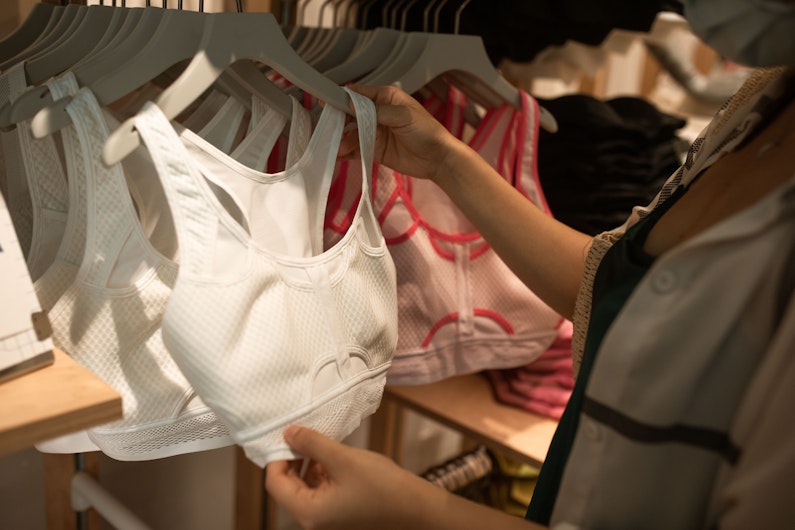
If your daughter is already becoming self-conscious about it, a well-fitted starter bra or soft crop top can make a real difference day-to-day.
Building confidence around a first bra fitting is something a lot of parents navigate around this time, and it doesn't have to be a big deal if you approach it lightly.
luna gives teen girls a space to explore puberty and body changes at their own pace, with content reviewed by medical experts rather than driven by trends.
What if my daughter has had only one breast bud for over a year?
A longer gap can feel alarming, especially if you've read that the second bud "should" appear within a few months.
The honest answer is that there is no hard deadline.
The most important thing is context: how old is your daughter, and is puberty progressing in any other way?
If she's 9 or 10, got her first bud in early puberty, and has no other signs of development yet, the second bud simply hasn't had its cue.
That's a different situation from a 13-year-old who has had one bud for 18 months with no other puberty signs at all.
One condition worth knowing about is Poland syndrome, a rare birth difference (affecting only 1 in 20,000 children, and more common in boys than girls) where the chest muscle on one side doesn't fully develop.
In girls, it can sometimes affect breast development on that side.
It's very uncommon, but if you're concerned that one side looks notably flat or underdeveloped compared to the other and there’s no change for over a year, a doctor can examine her properly and refer her to a specialist if needed.
When should my daughter see a doctor about uneven breast development?
For most girls, watchful waiting is all that's needed.
But it's worth booking an appointment if:
- Your daughter has had only one breast bud for over 12 months with no other signs of puberty
- She hasn't shown any signs of puberty at all by age 13
- One side looks notably absent or underdeveloped compared to the other
- You're worried enough that a doctor's reassurance would help
The NHS notes that if signs of puberty haven't started by 13, a doctor can check hormone levels and, if needed, refer to a paediatric specialist.
In the vast majority of cases, everything is progressing normally, and the appointment simply provides peace of mind.
FAQs
Will my daughter's uneven breasts even out over time?
For most girls, yes.
The asymmetry that's most noticeable at the breast bud stage tends to decrease as puberty progresses through the later Tanner stages.
A small degree of natural asymmetry is normal in adult women, but the gap that feels so significant early on usually closes considerably.
Can a breast bud on one side be a sign of cancer?
An adolescent breast lump is almost always a breast bud or benign (non-harmful) tissue.
Breast cancer in under-18s is extremely rare.
If a lump feels hard, fixed, or grows rapidly, it's worth getting it checked by a doctor.
A soft, tender bud is the expected sign of puberty beginning.
My daughter is worried about having only one breast bud, what do I say?
Naming it can help.
Letting her know that this is how puberty almost always begins, one side first, and that the second usually follows, takes some of the anxiety out of it.
If she's embarrassed, starting with a soft crop top or first bra can help her feel more comfortable day-to-day.
luna is built around exactly this kind of question, giving teen girls a safe space to explore what's happening to their bodies without having to ask an adult or wade through unreliable content online.
At what age do breast buds normally appear?
The NHS says it's normal for puberty to begin any time between ages 8 and 13.
Breast buds are almost always the first sign.
If your daughter gets a breast bud before age 8, it's worth mentioning to a doctor.
If there are no signs of puberty at all by 13, the same applies.
What is Poland syndrome and should I worry about it?
Poland syndrome is a rare birth difference where the chest muscle on one side doesn't fully develop, which can affect breast development on that side in girls.
It's more common in boys. It's usually identifiable by other physical features, and specialist options are available.
A doctor can assess properly if you have concerns, but it shouldn't be assumed from uneven breast buds alone.
If your daughter has started asking questions about why her body is developing the way it is, that's a good sign she feels safe raising it with you.
You might find it useful to read about what's normal in breast development during puberty for a broader picture of how this stage unfolds.
If she's becoming self-conscious about the difference, there's guidance on supporting a daughter who feels self-conscious about her breasts that you might find useful for framing that conversation.
How we created this article:
luna's team of experts comprises GPs, Dermatologists, Safeguarding Leads and Junior Doctors as well as Medical Students with specialised interests in paediatric care, mental health and gynaecology. All articles are created by experts, and reviewed by a member of luna's senior review team.
Sources:
NHS "Early or delayed puberty" | Accessed 23.06.26
https://www.nhs.uk/conditions/early-or-delayed-puberty/NHS "Puberty, periods and sexual health in girls with additional needs" | Accessed 23.06.26
https://www.chelwest.nhs.uk/services/childrens-services/community-services/cheyne/support-for-children-and-families/puberty-girlsNHS "Breast asymmetry" | Accessed 23.06.26
https://www.ruh.nhs.uk/patients/services/breast_unit/non_cancer_surgery/asymmetry.asp?menu_id=8Emmanuel M et al. "Tanner stages" | Accessed 23.06.26
https://www.ncbi.nlm.nih.gov/books/NBK470280/We'd love to keep in touch!
Sign up to our parent newsletter for emails on the latest teen trends, insights into our luna community and to keep up to date
By signing up, you are agreeing that we can use your email address to market to you. You can unsubscribe from marketing emails at any time by using the link in our emails. For more information, please review our privacy statement.