How much screen time is too much for your daughter?
What the evidence says for girls

Updated July 7, 2026 • Medically reviewed by Dr. Emma Dickie
Medically reviewed by Dr. Emma DickieIn this article
- In short
- What does the research say about screen time and my daughter's mental health?
- Is there a recommended screen time limit for my daughter?
- What are the warning signs that my daughter's screen use has become a problem?
- Does it matter what kind of screen time my daughter is having?
- How do I talk to my daughter about screen time without it turning into a battle?
- FAQs
In short
There's no magic number, but NHS guidance points to no more than one hour of recreational screen time a day for older children and teenagers, and all screens off at least an hour before bed.
Research consistently links heavy social media use in girls specifically with higher rates of anxiety and depression.
The bigger question isn't just how much, but what kind and when.
What does the research say about screen time and my daughter's mental health?
Watching your daughter disappear into her phone for hours and come out looking worse isn't your imagination.
The research backs up what you're seeing.
A 2023 systematic review of 50 studies published in BMC Psychology found that excessive screen time was associated with mental health problems in adolescents.
For girls specifically, social media use was linked to a higher risk of depression, and girls who used social media frequently were less likely to report good mental health, life satisfaction, or happiness.
The most-used device was the smartphone, and weekday use was associated with the biggest dip in mental wellbeing.
But not all phone use is unhelpful.
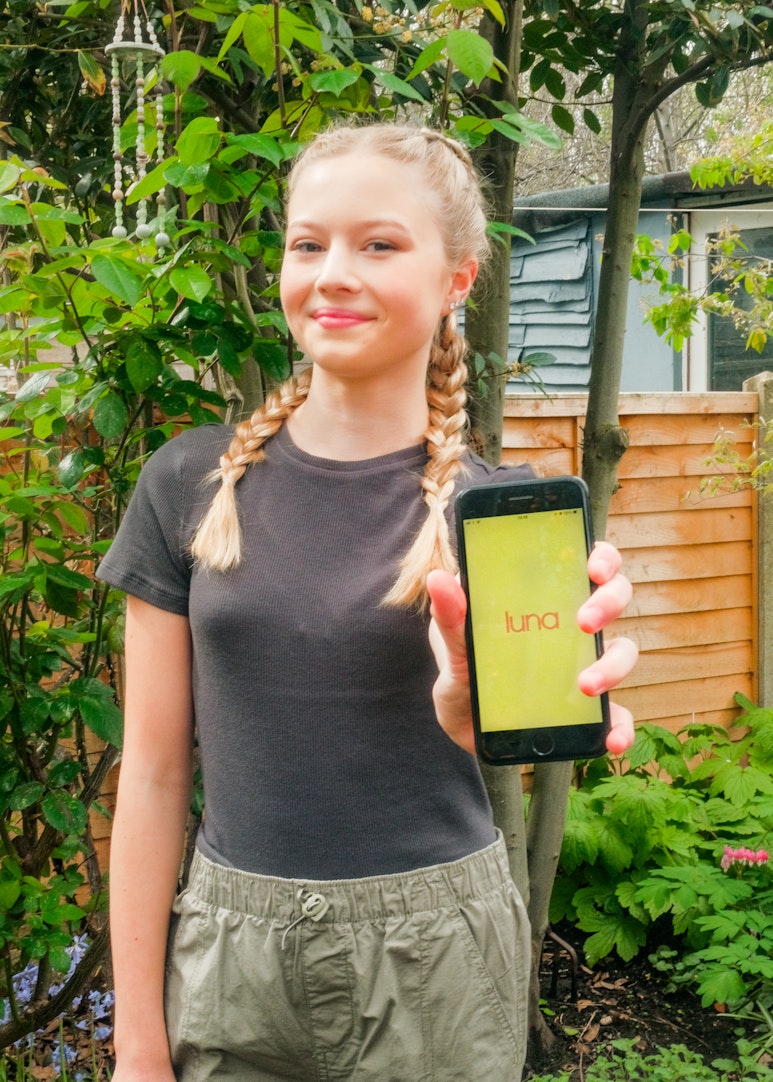
luna gives teen girls a space to explore topics like mood, sleep, and social media without the algorithm-driven noise. All content is reviewed by medical experts.
Is there a recommended screen time limit for my daughter?
The guidance from NHS sources suggests no more than one hour of recreational screen time per day for older children and teenagers, with all screens off at least one hour before bed.
In practice, most teenagers are well beyond this.
But rather than treating it as a hard rule to enforce (which rarely works), many clinicians suggest using it as a benchmark for a conversation: where does she think she's at?
It's also worth knowing that all screens emit blue light, which suppresses melatonin, the hormone that helps us fall asleep.
In a luna poll of 2,510 girls, phone use ranked in the top three things affecting their sleep quality, alongside overthinking and stress.
If you want to understand exactly how this works, luna's guide on how phones affect your daughter's sleep goes deeper.
This is why the bedtime boundary matters regardless of how many hours she's had during the day.
What are the warning signs that my daughter's screen use has become a problem?
YoungMinds, the UK's leading young people's mental health charity, lists signs to watch for:
- Difficulty sleeping, particularly if she's using her phone late at night
- Poor concentration at school or a noticeable drop in mood during the week
- Losing interest in offline hobbies, friends, or activities she used to enjoy
- Physical symptoms like headaches, eye strain, or less physical activity
- Irritability or signs of anxiety when her phone is taken away, or she can't get online
- Becoming secretive or anxious about messages or what she's looking at
One or two of these occasionally isn't a red flag.
But if several are happening consistently, it's worth having a conversation, not about the phone, but about how she's feeling.
Her self-esteem may be impacted by the content she is seeing, or she may be doom scrolling.
luna's guide on teen phone addiction covers what to look for and how to approach it.
Does it matter what kind of screen time my daughter is having?
A lot. Not all screen time affects teenagers the same way.
The research suggests passive scrolling, particularly on image-heavy platforms where she's comparing herself to others online, is the type most strongly linked to low mood and anxiety in girls.
Video calls with friends, homework, creative projects, or watching something she's chosen are lower-risk.
In a luna poll of 3,011 girls, nearly half (46%) said they feel drained and unproductive after scrolling on social media. Only 16% said they feel happy and entertained.
The NSPCC suggests talking with your daughter about how she actually uses her devices: is she doing homework, chatting with friends, watching videos, or endlessly scrolling?
Understanding this helps you set realistic limits together, rather than applying a blanket rule that feels arbitrary to her.
How do I talk to my daughter about screen time without it turning into a battle?
It probably doesn't have to be a confrontation.
The approach that tends to work best is to make it a shared conversation about how screens make her feel, rather than a rule that comes out of nowhere or simply taking the phone away.
Some approaches parents find useful:
- Asking how she feels before and after scrolling, not as a gotcha, but genuinely
- Creating screen-free zones together, like the dinner table or bedrooms at night
- Using the wellbeing settings on apps like Instagram and TikTok to track usage and set break reminders, as some teenagers find this less controlling than a parental app
- Modelling the behaviour yourself, because it lands differently if you're also putting your phone away
The NSPCC is clear that building digital resilience, the ability to reflect on how tech makes you feel and talking about mental health affects, matters more long-term than strict controls alone.
If you're worried about your daughter's mood and wondering whether her phone use is part of it, you're asking the right question.
Understanding what she's doing online, and how it makes her feel, is a better starting point than setting a timer.
If TikTok in particular feels like the battleground, luna's guide on weaning your teen off TikTok has practical approaches that don't rely on bans.
If you're noticing persistent changes in her sleep, mood, or behaviour, it's worth a conversation with her doctor.
FAQs
Should I take my daughter's phone away at night?
The evidence supports keeping screens out of the bedroom at night.
Blue light from phones suppresses melatonin, the hormone that signals it's time to sleep, and using a phone in bed keeps the brain alert.
NHS guidance recommends all screens off at least one hour before bed.
A charge point outside the bedroom is one practical option that doesn't feel like a punishment.
My daughter says all her friends use their phones loads. Is that normal?
It is common, yes, but common isn't the same as harmless.
Most teenagers use screens well beyond the one-hour daily guideline.
That said, peer use matters to teenagers, and dismissing it tends to backfire.
A more useful angle is focusing on sleep, which is harder to argue against, rather than trying to limit all daytime use at once.
Is there really a link between social media and depression in girls?
Research does show a link, though association isn't the same as cause.
A 2023 systematic review found that social media use was negatively associated with mental wellbeing in adolescents, and specifically linked to a higher risk of depression in girls.
Social comparison on image-heavy platforms appears to be a key driver, not screen time in general. If your daughter's mood has changed noticeably, it's worth a conversation with her doctor.
How we created this article:
luna's team of experts comprises GPs, Dermatologists, Safeguarding Leads and Junior Doctors as well as Medical Students with specialised interests in paediatric care, mental health and gynaecology. All articles are created by experts, and reviewed by a member of luna's senior review team.
Sources:
NHS "Screen time" | Accessed 30.06.26
https://www.justonenorfolk.nhs.uk/healthy-lifestyles/move-more/screen-time/YoungMinds "Social media" | Accessed 30.06.26
https://www.youngminds.org.uk/parent/parents-a-z-mental-health-guide/social-media/NSPCC "Online wellbeing" | Accessed 30.06.26
https://www.nspcc.org.uk/keeping-children-safe/online-safety/online-wellbeing/Santos RMS et al. "The associations between screen time and mental health in adolescents: a systematic review" | Accessed 30.06.26
https://pubmed.ncbi.nlm.nih.gov/37081557/We'd love to keep in touch!
Sign up to our parent newsletter for emails on the latest teen trends, insights into our luna community and to keep up to date
By signing up, you are agreeing that we can use your email address to market to you. You can unsubscribe from marketing emails at any time by using the link in our emails. For more information, please review our privacy statement.