How to talk to your daughter about period pain
Knowing what's normal and what isn't
Updated June 11, 2026 • Medically reviewed by Dr. Emma Dickie
Medically reviewed by Dr. Emma DickieIn this article
In short
May is National Menstrual Health Awareness Month, with the 2026 theme "What's been normalised isn't normal."
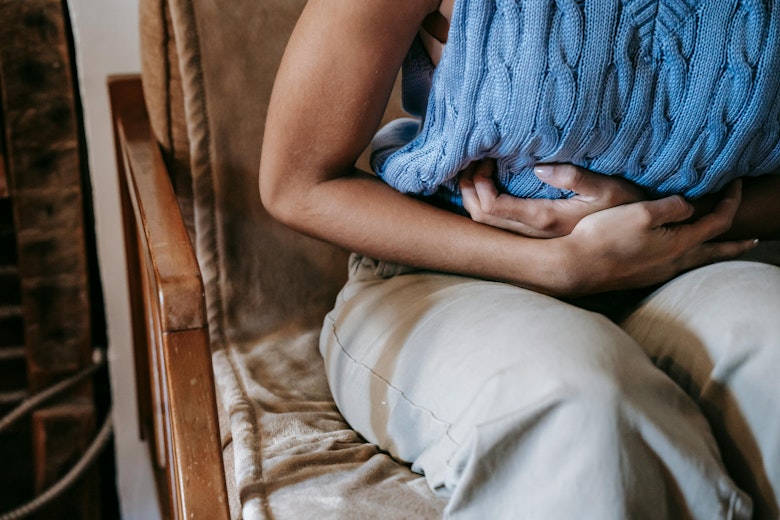
It's a useful prompt to check in with your daughter, because painful, disruptive, or unpredictable periods aren't just something teen girls have to live with.
The conversation works best when she leads, you listen, and you both know the line between normal cycle changes and signs that warrant a doctor's visit.
Why is menstrual health in the news this May?
Two things are happening at once.
May is National Menstrual Health Awareness Month.
And the World Health Organisation has called for experts to help develop the first-ever global guideline on menstrual health, with the application window closing on 5 May 2026.
The shared message across both is the same: heavy bleeding, debilitating cramps, missed school, and years-long waits for a diagnosis are common, but they aren't normal.
They deserve to be named, addressed, and treated.
Menstrual Hygiene Day falls on 28 May, rounding off a month designed to push past the "just get on with it" culture many of today's parents grew up with.
What's actually normal for a teen's period?
Teen periods take time to settle.
In the first two years, irregular periods are common, and so is variation in flow, length, and pain.
Roughly normal includes:
- Cycle length varies a lot and missed periods are common in teens (settling closer to 21 to 35 in adulthood)
- Period length of 2 to 7 days, with most teens bleeding 5 to 6 days (in a luna poll of 1,695 girls, nearly 1 in 4 (24%) said 5 days is their average)
- Mild to moderate cramps that respond to over-the-counter painkillers and a hot water bottle
- PMS symptoms like mood changes, breast tenderness, and bloating in the days before her period
- A first period anywhere between 9 and 16 (in a luna poll of 2,516 girls, 57% started at 11 or 12, and 13% at 10 or younger)
It's worth knowing she may not feel great about any of this.
In a luna poll of 2,226 girls, 78% feel a negative emotion during their period, and only 1.5% feel happy.
Acknowledge that, even when nothing is medically wrong.
When are painful or heavy periods a sign of something more?
This is where the awareness campaign matters.
Periods that stop her doing the things she usually does aren't a teen rite of passage, they're a signal to check in.
Look more closely if she has:
- Pain that stops her sleeping, going to school, or doing things she normally would
- Pain that doesn't respond to over-the-counter painkillers at the recommended dose
- Bleeding heavy enough to soak through a pad or tampon every hour or two
- Periods lasting longer than 7 days
- Bleeding between periods
- Cycles still very irregular more than two years after her first period
- Significant fatigue, paleness, or breathlessness during her period
Conditions like endometriosis (where tissue similar to the womb lining grows elsewhere) and fibroids (non-cancerous growths in the womb) can start in the teens but are often missed for years.
UK research suggests it takes an average of around 8 years to get an endometriosis diagnosis.
The "What's been normalised isn't normal" campaign is partly aimed at closing that gap.
In a luna poll of 1,440 girls, 69% said they've skipped or wanted to skip sport because of their period, and in another luna poll of 2,445 girls, 51% said their period changes their plans.
If that sounds like your daughter month after month, it's worth a conversation, then a doctor's appointment.
How do I start the conversation with my daughter?
Most teen girls don't want a Big Talk.
Short, low-pressure, repeated conversations land better than one Sunday afternoon sit-down.
What tends to help:
- Pick the moment, not the day, like in the car, on a walk, or while making dinner
- Start with a question, not a statement: "how have your periods been lately?" rather than "we need to talk about your period"
- Validate first, by saying something like "they can be properly horrible" before jumping to fixes
- Use the language she uses, like cramps, spotting, or moods, rather than clinical terms
- Share your own experience briefly if it's relevant, because a real example from you helps her describe hers
- Keep the door open, with something like "you can always grab me about this, even if it's a quick text"
In a luna poll of 1,732 girls, 1 in 3 (36%) said they learned about periods most from a parent or guardian, more than from any other source.
Whatever you say lands. Whether you say nothing also lands.
If you want help approaching the topic, luna’s guide on how to explain periods to your daughter may be a useful read.
What if she shrugs it off and says "it's fine"?
This is normal, and not always a problem.
Teen girls often need three or four small openings before they say something real.
When she shrugs:
- Don't push, but leave a clear opening, like "no rush, just shout if it changes"
- Make it easy not to talk to you directly, by leaving useful info where she'll see it (a book, an app on her phone like luna, a written note in her bag)
- Track patterns, not feelings, by gently noticing when she stays home, drops sport, or goes quiet
- Watch what she's not saying: if she's regularly cancelling plans during her period, that's information
Embarrassment is one of the biggest barriers.
In a luna poll of 2,229 girls, 30% said they feel embarrassed, uncomfortable, or prefer to keep their period private, and 47% are only okay talking about it with close friends or family.
Privacy doesn't mean she's not struggling.
For ongoing tracking that doesn't feel like surveillance, how to track your daughter's period walks through the practical side.
When should I take her to the doctor?
Trust your instinct.
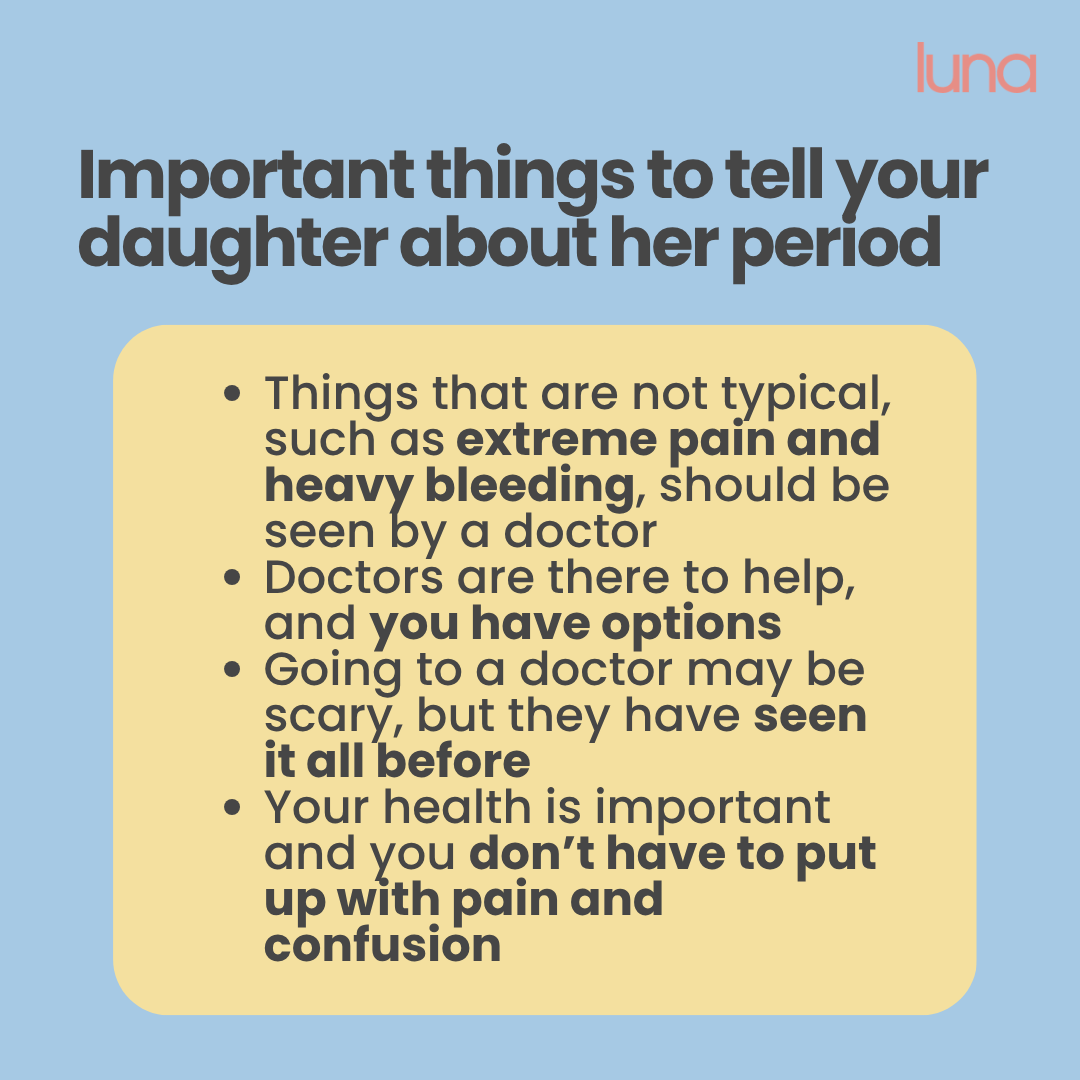
If her period is regularly stopping her doing what she usually does, it's worth booking an appointment, even if she says it's fine.
Strong reasons to see the doctor:
- Pain that isn't controlled by ibuprofen or paracetamol at recommended doses
- A heavy menstrual period that means she is bleeding through products every hour or two
- Periods longer than 7 days, or cycles shorter than 21 days, after the first two years of menstruating
- Missing school, sport, or sleep on a regular basis
- Signs of low iron associated with a period, like heavy fatigue, looking pale, lightheadedness or shortness of breath
- A change in her usual pattern that's lasted more than two or three months
Some teen girls feel embarrassed about seeing a doctor for period symptoms.
In a luna poll of 1,656 girls, 1 in 4 (26%) said embarrassment or shame is what stops them seeing a doctor, and 1 in 5 (19%) said they don't want their parent or carer to know. It can help to:
- Offer her a choice of doctor, including a female doctor if available
- Let her see the doctor alone if she'd prefer (anyone over 13 can usually be seen on their own)
- Help her write down what to say before the appointment
- Reassure her that doctors see this every day
FAQ
Is my daughter too young to have such painful periods?
Severe pain isn't about age.
A 12-year-old can have endometriosis and a 16-year-old can have completely manageable cycles.
If pain is stopping her doing what she'd otherwise do, age isn't the test, impact is.
For context on what's typical at her age, see stages of female puberty.
What painkillers are okay for teen period pain?
Ibuprofen and paracetamol at the doses on the packet are usually the best painkillers for teen period cramps.
If she's taking them every cycle and they aren't enough, that's a signal to see the doctor, not a reason to keep increasing the dose.
Should she be on the contraceptive pill for period pain?
The combined pill or other hormonal options can help with painful or heavy periods, and your doctor may suggest it.
It's not the only option, and it isn't right for everyone. The goal is informed choice, not a default.
My daughter says her period makes her miserable every month. Is that depression?
It can be. Severe pre-menstrual mood symptoms are real and have a name (PMDD, or premenstrual dysphoric disorder).
If she's repeatedly low, irritable, or hopeless in the days before her period and it lifts when bleeding starts, mention it to the doctor.
What if her period products aren't working for her?
Most teens use disposable pads as default as they're quick to acquire and and easy to use.
But if she's leaking, experiencing irritation, or skipping activities, the product may need changing.
Choosing the best period products for tweens and teens walks through the options.
If anything in this piece is making you reconsider what's been normalised in her cycle, talk to your doctor.
The whole point of awareness month is that "just get on with it" doesn't have to be the answer.
How we created this article:
luna's team of experts comprises GPs, Dermatologists, Safeguarding Leads and Junior Doctors as well as Medical Students with specialised interests in paediatric care, mental health and gynaecology. All articles are created by experts, and reviewed by a member of luna's senior review team.
Sources:
World Health Organization "Call for experts: new WHO guideline on menstrual health" | Accessed 07.05.26
https://www.who.int/news-room/articles-detail/call-for-experts--who-guideline-on-menstrual-healthFibroid Foundation "National Menstrual Health Awareness Month 2026" | Accessed 07.05.26
https://www.fibroidfoundation.org/2026/04/30/national-menstrual-health-awareness-month-2026-social-media-toolkit/NHS "Periods" | Accessed 07.05.26
https://www.nhs.uk/conditions/periods/NHS "Period problems" | Accessed 07.05.26
https://www.nhs.uk/conditions/periods/period-problems/Endometriosis UK "Getting diagnosed" | Accessed 07.05.26
https://www.endometriosis-uk.org/getting-diagnosed-0We'd love to keep in touch!
Sign up to our parent newsletter for emails on the latest teen trends, insights into our luna community and to keep up to date
By signing up, you are agreeing that we can use your email address to market to you. You can unsubscribe from marketing emails at any time by using the link in our emails. For more information, please review our privacy statement.