What to do if your daughter's period is making her miss school
What to do & when to seek help
Updated August 6, 2026 • Medically reviewed by Dr. Emma Dickie
Medically reviewed by Dr. Emma DickieIn this article
- In short
- Is it normal for my daughter to miss school because of her period?
- What's most likely keeping her off school?
- How can I help her manage period pain at school?
- What can I do about heavy bleeding at school?
- What if it's exhaustion or low mood, not pain?
- Should I write a note for school?
- When should I take my daughter to see a doctor?
- FAQ
- What to know before her next period
In short
Missing school because of periods is more common than you might think.
The fix often starts with managing pain and bleeding properly: heat, the right painkiller at the right time, suitable period products, and tracking her symptoms.
If she's missing school every cycle, soaking through products, or in pain that paracetamol or ibuprofen can't touch, that's a doctor's conversation.
Periods shouldn't get in the way of school.
Is it normal for my daughter to miss school because of her period?
Periods can be uncomfortable, and it is common for teens to miss school occasionally because of their periods, but they shouldn't routinely keep her off school.
If period pain is stopping her from doing her usual daily activities, she should see a doctor.
Some context from luna polls:
- 70% of girls have either skipped PE or wanted to because of their period (luna poll of 1,049 girls, September 2025)
- 29% say cramps and physical discomfort are the biggest challenge of having their period at school (luna poll of 2,492 girls)
- 13% say hormonal changes cause emotional struggles that affect their school day
- 31% say their school doesn't offer free period products, or not enough
So she's not unusual. But "common" doesn't mean "fine to leave alone".
The first step is working out what's actually keeping her off school.
What's most likely keeping her off school?
It's usually one (or more) of three things: pain, bleeding, or exhaustion.
Each has different fixes, so it helps to identify which is hitting her hardest.
The most common reasons periods pull teens out of school:
- Severe period pain that paracetamol or ibuprofen don't fully ease
- Heavy bleeding that means she's worried about leaks all day
- Exhaustion or low mood, especially in the days before her period
- Headaches or migraines linked to her cycle
- Anxiety about not having products, leaking, or being judged
- Bowel or bladder symptoms around her period that make sitting in class hard
If you're not sure which of these is the biggest factor, tracking 2 or 3 cycles can make it obvious. luna’s guide on how to track your daughter's period walks through what to log.
How can I help her manage period pain at school?
Pain is the most common reason teens miss school during their period, and the NHS has a clear list of things that help.
Most teens haven't tried them all.
Things that can ease period pain:
- A warm bath or shower before school
- A heat pad or hot water bottle (wrapped in a tea towel) for tummy or back
- Gentle massage of her tummy and lower back
- Gentle exercise: yoga, walking, swimming, cycling
- Paracetamol or ibuprofen taken at the start of pain (not after it's peaked)
Important on painkillers: discuss with a doctor or pharmacist before taking ibuprofen if she has asthma or stomach, heart, kidney, or liver problems.
Aspirin should not be taken by anyone under 16. Always check the leaflet and stick to the recommended dose for her age and weight.
Our guide on the best painkiller for teen period cramps covers what to take and when.
What can I do about heavy bleeding at school?
If bleeding is what's keeping her home, she's probably worried about leaks, smell, or being caught short.
The fix is a practical kit plus the right product mix.
Things that often help:
- Pair period pants with a pad on heavy days for backup
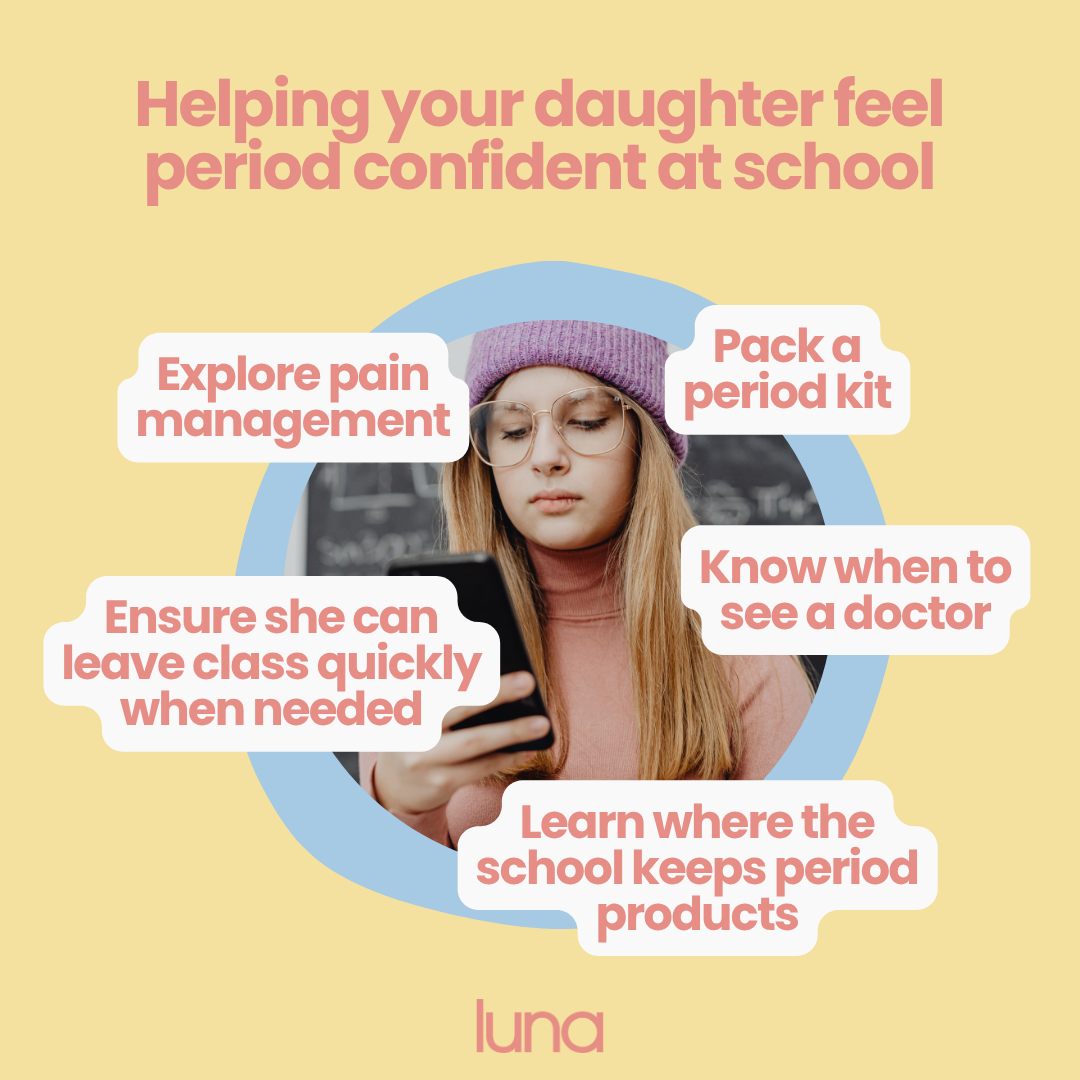
- Keep a small period kit in her bag: 2 to 3 spare products, spare pants, wipes, a small bag for used products
- Use higher absorbency or "night" pads during the day if bleeding is heavy
- Change every 4 to 6 hours, even if a product doesn't look full
- Ask the school where free period products are kept
- Speak to her form tutor or pastoral lead so she can leave class quickly when she needs to
luna’s guide on signs your teen has a heavy menstrual period explains what counts as heavy.
If you'd like a full product walkthrough, choosing the best period products for tweens and teens is a good start.
What if it's exhaustion or low mood, not pain?
Exhaustion and mood dips are common around periods, both before (PMS) and during.
They can make school feel harder, even without much pain.
What might be going on:
- PMS (mood swings, irritability, low mood, tiredness, headaches in the 2 weeks before)
- Iron deficiency from heavy bleeding (causing fatigue, dizziness, breathlessness)
- Period headaches, often in the 2 days before or first 3 days of her period
- Disrupted sleep due to discomfort
A luna poll of 1,684 girls found that 39% of teens get less than the recommended 8 hours of sleep a night. Periods can knock that further.
luna’s guide on why is my daughter so tired on her period? goes deeper, and helping your teen with PMS mood swings covers the emotional side.
Should I write a note for school?
Yes, if her absences are period-related and she's at risk of being marked unauthorised.
Most schools will record it as illness if a parent confirms in writing.
Some things worth knowing:
- A parent's note is usually enough for short, occasional absences
- Some schools may ask for a doctor's note for repeated absences (this isn't legally required, but practice varies)
- A luna poll of 1,774 girls found 62% would feel frustrated or embarrassed if their school required a doctor's note for period-related absences
- It's worth asking the school's pastoral lead whether they have a period policy, and whether she can leave class to change products without explaining each time
If she'd rather not say "period" on a note, "stomach pain" or "feeling unwell" are equally valid. The school doesn't need a clinical breakdown.
If she's reluctant to go to school more broadly, luna’s guide on my daughter won't go to school on her period covers the wider conversation.
When should I take my daughter to see a doctor?
If her periods are routinely keeping her off school, it's time to see a doctor.
Book a doctor's appointment if:
- Her period pain is stopping her doing her usual daily activities
- Her periods become more painful, heavier, or irregular
- She's bleeding through products in 1 to 2 hours, or doubling up
- She’s passing blood clots larger than a 10p coin during periods
- Her periods last longer than 7 days
- She's bleeding between periods
- She's tired, dizzy, or short of breath
- Painkillers and home measures aren't enough
Ask for an urgent doctor's appointment or call NHS 111 in the UK if her period pain is severe or worse than usual and painkillers haven't helped.
FAQ
How many days off school is too many?
There's no fixed number, but if she's missing 1 or more days every cycle, it's worth investigating.
The NHS treats period pain that affects daily life as something to look at, not something to wait out.
Will the school punish her for period-related absences?
Most schools won't, but practice varies. A note from you should cover it.
If you're worried, contact the school's pastoral lead or attendance officer to agree on how absences will be recorded.
Should she be on the pill for period pain?
The combined contraceptive pill is one option the NHS lists for severe period pain, and there's no minimum age.
Whether it's right for her depends on her health and her preferences, and is a conversation for your doctor.
Can periods cause anxiety about school?
Yes. A luna poll of 2,492 girls found 12% fear being judged or teased about their period at school, and 15% say school staff aren't supportive or aware.
Anxiety on top of physical symptoms is common.
What to know before her next period
She doesn't have to "just get on with it".
Severe periods are treatable, and small changes (better pain plan, more reliable products, a kit in her bag, a quiet word with school) often make the difference between staying home and going in.
If your daughter is in severe pain that painkillers aren't touching, ask for an urgent doctor's appointment.
How we created this article:
luna's team of experts comprises GPs, Dermatologists, Safeguarding Leads and Junior Doctors as well as Medical Students with specialised interests in paediatric care, mental health and gynaecology. All articles are created by experts, and reviewed by a member of luna's senior review team.
Sources:
NHS "Period pain" | Accessed 04.05.26
https://www.nhs.uk/symptoms/period-pain/NHS "Heavy periods" | Accessed 04.05.26
https://www.nhs.uk/conditions/heavy-periods/NHS "Period problems" | Accessed 04.05.26
https://www.nhs.uk/conditions/periods/period-problems/We'd love to keep in touch!
Sign up to our parent newsletter for emails on the latest teen trends, insights into our luna community and to keep up to date
By signing up, you are agreeing that we can use your email address to market to you. You can unsubscribe from marketing emails at any time by using the link in our emails. For more information, please review our privacy statement.