30 things you should never say to your teenage daughter
How to avoid any drama

Updated August 10, 2026 • Medically reviewed by Dr. Emma Dickie
Medically reviewed by Dr. Emma DickieIn this article
What should I never say to my teenage daughter?
When talking to your teenage daughter, avoid comments about body image, appearance, or comparisons to others.
These comments can be damaging during adolescence as they may unintentionally harm your teenage daughter’s confidence or shut down communication.
Also, try to avoid dismissing her feelings, minimising experiences like period pain, or criticising how she looks, eats, or expresses herself.
During adolescence, teens are still developing their confidence, identity, and emotional resilience.
This means that everyday comments can sometimes land more strongly than intended.
By knowing what type of phrases or topics to tread carefully around, you can avoid any drama and keep your connection strong.
What are some phrases to avoid with my teenage daughter?
Avoid commenting on their appearance or emotions, or highlighting anything they may feel embarrassed about.
Parents don’t mean to hurt their children, but certain phrases can stay with teens for years.
During adolescence, young people are especially sensitive to criticism, rejection, or feeling misunderstood.
Here are some common phrases that can affect teens.
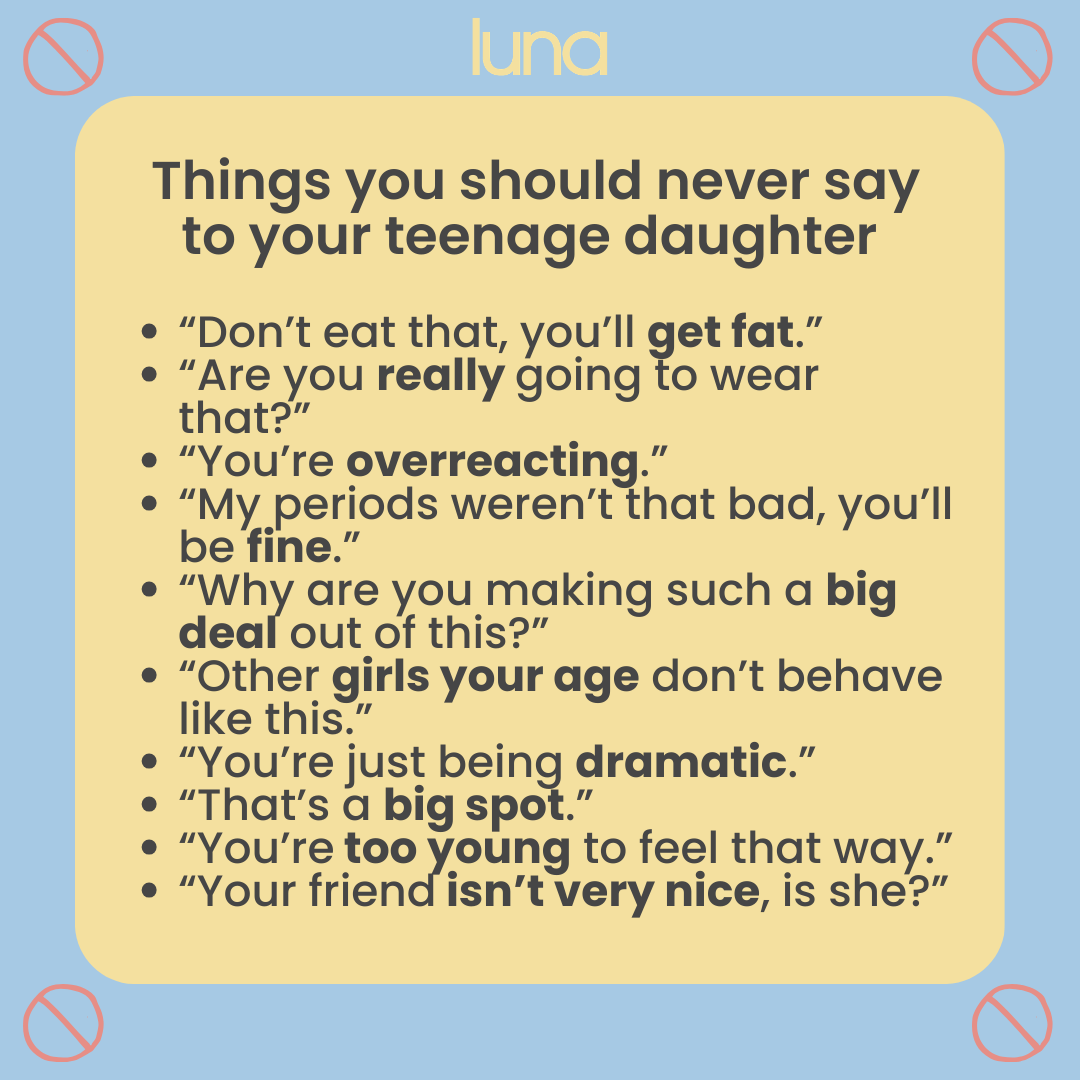
“Don’t eat that, you’ll get fat.”
Comments about food or weight can stick with teens far longer than parents realise (hence the phrase almond mum).
Many parents say things like this without thinking, especially if they grew up hearing similar messages themselves.
But during adolescence, body image is particularly sensitive.
Even casual remarks can influence how teens see their bodies or how they relate to food.
A more helpful approach is focusing on healthy eating and wellbeing rather than appearance.
“Are you really going to wear that?”
Teenagers often experiment with clothing and style as part of figuring out who they are.
Sometimes that means outfits parents find confusing, impractical, or just…very different from what they’d choose themselves.
While it’s natural to react, comments that sound judgemental can make teens feel criticised rather than guided.
“You’re overreacting.”
What feels like a small issue to an adult can feel enormous to a teenager.
Teens are still developing emotional regulation skills, which means reactions can seem bigger or more intense.
Saying “you’re overreacting” may unintentionally dismiss feelings that are very real to them.
Acknowledging the emotion first often leads to calmer conversations later.
“My periods weren’t that bad, you’ll be fine.”
Many parents try to reassure their daughters by comparing experiences.
The problem is that periods vary hugely from person to person.
What was manageable for one person might be painful or overwhelming for another.
Minimising symptoms can make teens feel embarrassed to talk about period pain, PMS mood swings, or questions they have about their bodies.
“Why are you making such a big deal out of this?”
Teenagers often experience emotions intensely - friendships, school pressure, social dynamics, and identity all feel very important at this stage of life.
When concerns are brushed off as “not a big deal,” teens may stop sharing them altogether.
Even if the issue seems small from an adult perspective, listening first can make a big difference.
“Other girls your age don’t behave like this.”
It’s natural for parents to compare sometimes, especially when they’re worried about behaviour or attitude.
But comparisons can make teens feel like they are constantly falling short.
Every teenager develops at a different pace, emotionally and socially.
Feeling accepted for who they are tends to build more confidence than feeling measured against others.
“You’re just being dramatic.”
Many teens hear this phrase when their emotions run high.
While it might be said lightly, it can teach teens that expressing feelings leads to criticism or dismissal.
Adolescence is a time of intense emotional learning, and feeling safe to express those emotions helps teens develop healthier coping skills over time.
“You should be more like…”
Comparisons to siblings, friends, or classmates rarely land the way parents intend.
Even if the comment is meant as motivation, it can feel like a message that who they are right now isn’t good enough.
Teens benefit more from encouragement that recognises their own strengths and individuality.
“Because I said so.”
Every parent reaches this point sometimes - especially during long negotiations about rules, curfews, or screen time.
Boundaries are important, but shutting down conversation completely can make teens feel powerless or unheard.
When possible, explaining the reasoning behind a rule helps teens understand expectations rather than simply resent them.
“That’s a big spot.”
Skin changes are a normal part of puberty, but they can feel like a huge deal to teens.
Most young people are already aware of every spot or breakout they have.
Drawing attention to teen acne, even casually, can increase embarrassment rather than help.
Reassurance or simply ignoring it often feels more supportive.
“You’re too young to feel that way.”
Teens can experience strong emotions and dismissing feelings because of their age can make them feel misunderstood or shut down.
Even if their perspective seems different from an adult’s, giving space to talk about those emotions helps teens process them more confidently.
“You’ll understand when you’re older.”
Parents often say this when a situation feels complicated or difficult to explain.
However, teens may interpret it as being dismissed or excluded from the conversation.
Explaining things in a simple, age-appropriate way helps teens feel respected and trusted.
“It’s just hormones.”
Hormones do influence mood during puberty, but reducing every emotion to hormones can make teens feel like their feelings aren’t taken seriously.
It’s more helpful to acknowledge the feeling first and learn constructive ways of talking to your teen about mental health.
“Your friend isn’t very nice, is she?”
Watching your teen struggle in a friendship can be incredibly hard.
Parents often want to jump in and protect them - especially if it seems like they’re being treated badly.
But directly criticising a friend can make teens defensive and less likely to open up.
Instead, focusing on how the friendship makes them feel (“How did that make you feel?”) can encourage reflection without putting them on the defensive.
"You could do with losing a bit of weight."
Direct comments about weight can land harder than almost anything else.
Research on parental weight talk has linked comments like this to body dissatisfaction, lower self-esteem and disordered eating in teenage girls.
Even when it's meant as concern for her health, she's likely to hear it as a verdict on her body. Focusing on how she feels, rather than her size, tends to be gentler ground.
"Just calm down."
When emotions are running high, being told to calm down rarely has that effect.
It can make the feeling itself seem like the problem, which usually adds pressure rather than releasing it.
Giving her a bit of space and coming back to it once things have settled often works better than tackling it in the heat of the moment.
"Stop crying."
Tears can be uncomfortable to sit with, especially when you don't yet know what's behind them.
But asking her to stop can teach her that big feelings need to be hidden rather than shared.
Letting her cry, and staying nearby, sends the opposite message: that she doesn't have to hold it together to be around you.
"You'd be so pretty if you just…"
Backhanded compliments about appearance tend to stick around.
Whether it's about her weight, her skin or her hair, the "if only" is often what she remembers, not the "pretty".
At an age when she's especially tuned in to how she looks, comments like this can quietly chip away at her confidence.
"It's just a phase."
New interests, styles, friendships or ways of describing herself can feel sudden to parents.
Calling it "just a phase" can feel like her feelings are being waved away as temporary or unimportant.
Even if some things do change with time, taking them seriously now shows her they matter to you because they matter to her.
"Why can't you just be happy?"
Low mood isn't something a teen can usually switch off on request.
Asking why she can't just be happy can leave her feeling like her sadness is a failing rather than something real.
If you're noticing her mood staying low for a while, a doctor can help you work out what support might help.
"You need to toughen up."
It's natural to want your daughter to feel resilient, especially if the world feels harsh.
But being told to toughen up can suggest her feelings are a weakness to fix.
Resilience tends to grow from feeling supported through hard things, not from being told to feel less.
"I'm so disappointed in you."
Few phrases carry as much weight as this one.
Where a telling-off fades, disappointment can settle into how she sees herself.
Being clear about the behaviour you're unhappy with, rather than aiming it at who she is, helps her separate a mistake from her worth.
"You never listen." / "You always do this."
Words like "always" and "never" turn one moment into a verdict on her character.
They also tend to invite a defence rather than a conversation.
Sticking to what actually happened this time, and how it left you feeling, usually keeps the door open rather than slamming it.
"Get off your phone, it's rotting your brain."
Screens are one of the most common flashpoints between parents and teens.
Dismissing everything on her phone as rubbish can also dismiss the friendships, interests and downtime that live there.
Curiosity about what she's actually doing tends to land better than a blanket verdict.
"You're so ungrateful."
When you've worked hard to give her things, it stings when it seems to go unnoticed.
But being called ungrateful can leave her feeling guilty rather than appreciative, and guilt rarely builds closeness.
Naming what you'd love to feel acknowledged for, without the label, is often heard more clearly.
"We don't talk about that."
Questions about periods, bodies, sex or relationships can catch you off guard.
Shutting them down, even out of awkwardness, can teach her these subjects are off-limits, so she takes them elsewhere.
Letting her know you're happy to talk, even if you need a moment to think first, keeps you in the conversation.
"You're only saying that for attention."
When a teen expresses distress, questioning whether she means it can be one of the most wounding responses.
It can make her far less likely to speak up next time, exactly when speaking up matters most.
If she says something that worries you about her feelings or her safety, taking it seriously and, where needed, speaking to a doctor or another professional is always the safer path.
"Boys won't like you if you act like that."
Comments that tie her behaviour or looks to being liked by boys can teach her to shrink herself to be accepted.
At this age she's still working out who she is and what she values.
Encouragement to be herself tends to build steadier confidence than advice shaped around someone else's approval.
"You're just not trying hard enough."
School pressure is real, and it's natural to want her to do well.
But "not trying hard enough" can miss what's actually going on, whether that's anxiety, tiredness or a subject she's genuinely stuck with.
Asking what's making it feel hard often gets you further than assuming she isn't bothered.
"I don't know what's wrong with you."
Said in frustration, this can sound to her like there's something fundamentally wrong with who she is.
Teens are often already asking themselves that question.
Naming the specific thing that's frustrating you, rather than aiming it at her as a person, helps her hear it without taking it to heart.
What are some better ways to talk to my teenage daughter?
Healthy communication with teens doesn’t mean avoiding boundaries or difficult conversations.
It simply means choosing language that keeps the door open rather than shutting it down.
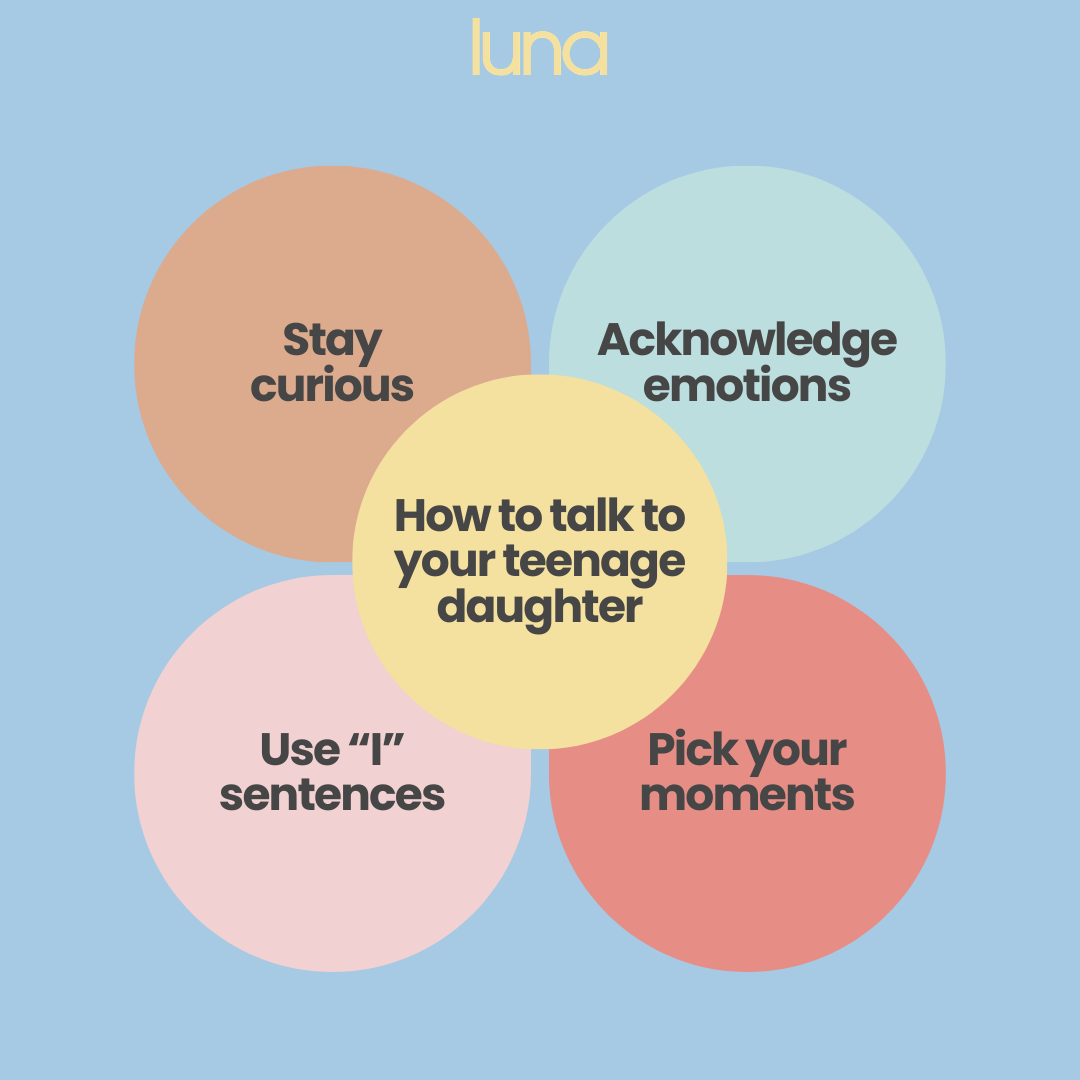
Some helpful approaches include:
- Avoid “you” accusations: instead of “you’re being rude,” try “I felt hurt by what just happened”
- Acknowledge emotions first: phrases like “I can see this is really upsetting you” help teens feel understood before problem-solving begins
- Stay curious rather than critical: questions such as “what made you choose that?” encourage conversation rather than defensiveness
- Offer guidance without judgement: teens are more receptive to advice when they feel respected rather than criticised
- Pick your moments: not every disagreement needs to become a lecture – timing can make a huge difference in how messages are received
What matters most when I talk to my daughter?
No parent communicates perfectly all the time.
Arguments, misunderstandings, and emotional moments are a normal part of raising teenagers.
What matters most is maintaining a relationship where your daughter feels safe coming back to you, even after disagreements.
Listening, apologising when needed, and staying open to conversation builds long-term trust.
Teenagers also benefit from having spaces where they can learn about their bodies, emotions, friendships, and growing independence in their own time.
luna gives girls access to reliable guidance on topics such as periods, body image, and puberty, helping reinforce the supportive conversations you’re already trying to have at home and help them feel less alone.
How we created this article:
luna's team of experts comprises GPs, Dermatologists, Safeguarding Leads and Junior Doctors as well as Medical Students with specialised interests in paediatric care, mental health and gynaecology. All articles are created by experts, and reviewed by a member of luna's senior review team.
We'd love to keep in touch!
Sign up to our parent newsletter for emails on the latest teen trends, insights into our luna community and to keep up to date
By signing up, you are agreeing that we can use your email address to market to you. You can unsubscribe from marketing emails at any time by using the link in our emails. For more information, please review our privacy statement.