How to get your daughter to wake herself up in the morning
Tired of being her alarm?
Updated September 16, 2026 • Medically reviewed by Dr. Emma Dickie
Medically reviewed by Dr. Emma DickieIn this article
- In short
- Why does my daughter find it so hard to wake up in the morning?
- What does my daughter actually need to wake up more easily?
- How do I get my daughter to set her own alarm?
- Does morning light actually help my daughter wake up?
- Could my daughter have delayed sleep phase syndrome?
- When does she need to see a doctor?
- FAQs
In short
If you've been waking your daughter up every morning for years, you're not alone.
Teens genuinely struggle with early mornings: it's biology, not laziness.
During puberty, the body clock shifts later, making early rising harder.
The fastest route to independent waking is a slow handover of responsibility: her own alarm, consistent wake times, and morning light.
Why does my daughter find it so hard to wake up in the morning?
Your daughter's brain is wired differently right now.
During the stages of puberty, most teenagers' body clocks shift later, a process called circadian phase delay (a shift in the internal clock that governs when we feel sleepy and when we wake).
According to NHS sleep specialists at Evelina London, the natural best time for most teenagers to fall asleep shifts to around 11pm to midnight.
That means her body genuinely wants to sleep later in the morning, too.
It's the same mechanism as jet lag: her internal clock is set to a different time zone from yours, and willpower alone can't override it.
What does my daughter actually need to wake up more easily?
The most important sleep tip for your teen is consistent wake times.
The NHS advises keeping wake times roughly the same every day, including weekends, because irregular patterns confuse the body clock.
Most teenagers need to sleep 9 to 9.5 hours a night, though the healthy range runs from 7 to 11 hours.
If your daughter needs to be up at 7am but her brain won't settle until 11pm, she's running a daily sleep deficit, and that makes any alarm feel impossible.
On weekends, long lie-ins make Monday mornings harder.
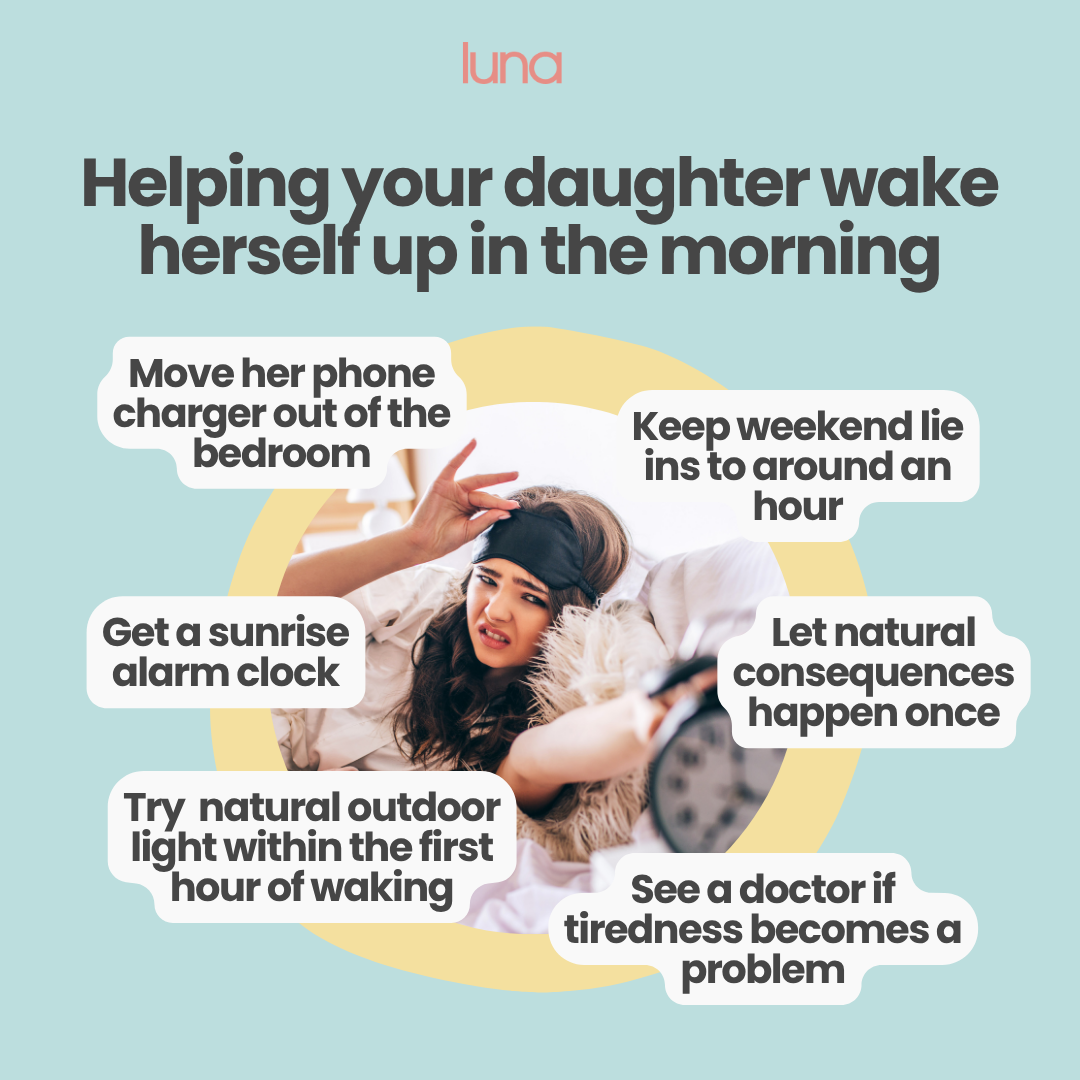
Sleep specialists advise keeping them to around an hour, and aiming not to sleep past 9 or 10am most days.
How do I get my daughter to set her own alarm?
The key is making it her responsibility, not yours.
Teens who choose their own alarm time tend to engage with it more.
Ownership matters.
Things worth trying:
- A sunrise alarm clock (one that gradually brightens the room before sounding) can make waking feel less abrupt, especially in winter
- Moving her phone charger out of the bedroom removes midnight scrolling and the temptation to snooze without really waking
- Letting natural consequences happen once, like being late, often shifts the dynamic more than a week of reminders
This is one piece of a bigger picture and luna's guide to encouraging independence in your teen covers how to hand over responsibility in a way that sticks.
Does morning light actually help my daughter wake up?
It really does.
At least 20 minutes of natural outdoor light within the first hour of waking is one of the most effective ways to reset a teenager's body clock.
Even on a grey UK day, outdoor light is significantly stronger than most indoor lighting.
Getting your daughter outside briefly after waking, or even sitting near a window while she eats breakfast, can start shifting the pattern over time.
Could my daughter have delayed sleep phase syndrome?
Delayed sleep phase syndrome (DSPS) is a clinical condition where the circadian delay is severe rather than typical.
It is more common during adolescence than at any other stage of life, and more prevalent than many parents realise.
The difference between typical teen sleep delay and DSPS is degree.
A teenager with DSPS may be genuinely unable to fall asleep before 2 or 3am no matter how tired she is, and cannot wake before midday without significant distress.
Signs worth knowing:
- She consistently can't fall asleep until very late, even when exhausted and in bed early
- She wakes naturally and feels fine at weekends at her own body's time, but struggles intensely on school days
- This has been going on for several months rather than during a particularly stressful patch
If this sounds familiar, it's worth speaking to a doctor.
DSPS is treatable, and options can include structured sleep therapy or, in some cases, melatonin.
When does she need to see a doctor?
If she's doing everything right and still exhausted most of the time, it's worth talking to a doctor.
Persistent tiredness can sometimes be linked to iron deficiency in teen girls or other health factors worth checking.
If she wants to explore sleep topics herself, luna's sleep content is available to her directly in the app, with everything reviewed by medical experts.
FAQs
Why does my daughter sleep through every alarm?
If she's significantly sleep-deprived, her brain will override it.
Deep sleep is very hard to rouse from.
Alarm placement matters too: if her phone is on her bedside table, she can silence it without fully waking.
Moving it across the room so she has to get up to turn it off changes the dynamic.
Should I keep waking my daughter up myself?
If missing school is a real risk, you may not have much choice in the short term.
But the goal most sleep specialists point to is a gradual handover: reducing how often you step in, and letting natural consequences do some of the work.
The longer she can rely on you to wake her, the less motivation she has to become her own alarm.
Could her phone be making mornings harder?
Almost certainly, if it's in her bedroom overnight.
The blue light from screens delays melatonin release, pushing back the time she falls asleep.
And if notifications wake her briefly in the night, the light exposure affects sleep quality even without her fully knowing.
luna has a full breakdown in how phones affect your daughter's sleep.
How we created this article:
luna's team of experts comprises GPs, Dermatologists, Safeguarding Leads and Junior Doctors as well as Medical Students with specialised interests in paediatric care, mental health and gynaecology. All articles are created by experts, and reviewed by a member of luna's senior review team.
Sources:
NHS "How to sleep well for teenagers" | Accessed 03.07.26
https://www.evelinalondon.nhs.uk/our-services/hospital/sleep-medicine-department/how-to-sleep-well-for-teenagers.aspxNHS "Sleep routines for young people and teenagers" | Accessed 03.07.26
https://www.cambspborochildrenshealth.nhs.uk/sleep/healthy-sleep-routines/sleep-routines-for-young-people-and-teenagers/Cleveland Clinic "Delayed sleep phase syndrome" | Accessed 03.07.26
https://my.clevelandclinic.org/health/diseases/14295-delayed-sleep-phase-syndrome-dspsWe'd love to keep in touch!
Sign up to our parent newsletter for emails on the latest teen trends, insights into our luna community and to keep up to date
By signing up, you are agreeing that we can use your email address to market to you. You can unsubscribe from marketing emails at any time by using the link in our emails. For more information, please review our privacy statement.