Could your daughter have an ovarian cyst?
What an ovarian cyst means

Updated September 11, 2026
In this article
In short
An ovarian cyst is a small, fluid-filled sac that can form on an ovary.
They're very common once your daughter starts having periods, and most cause no symptoms at all.
Cysts usually settle on their own within a few months.
It's only worth seeing a doctor urgently if she has sudden, severe pain, or pain along with feeling sick or being sick.
What is an ovarian cyst?
A cyst is simply a sac of fluid that forms on or inside an ovary.
Most are what are called functional cysts, which form as a normal part of ovulation rather than as a sign of anything wrong.
They happen when a follicle doesn't release its egg properly, or doesn't shrink back down afterwards.
Most disappear on their own within a few months.
Why is my daughter suddenly getting ovarian cysts?
It's more to do with timing than anything else.
Cysts become far more common once periods start, since they're closely tied to ovulation.
One study of teenage girls found cyst frequency rose sharply through puberty, peaking at age 15.
Before that, they're relatively rare.
What symptoms should I look out for?
Most cysts cause no symptoms at all, and are only ever picked up if a scan is done for another reason.
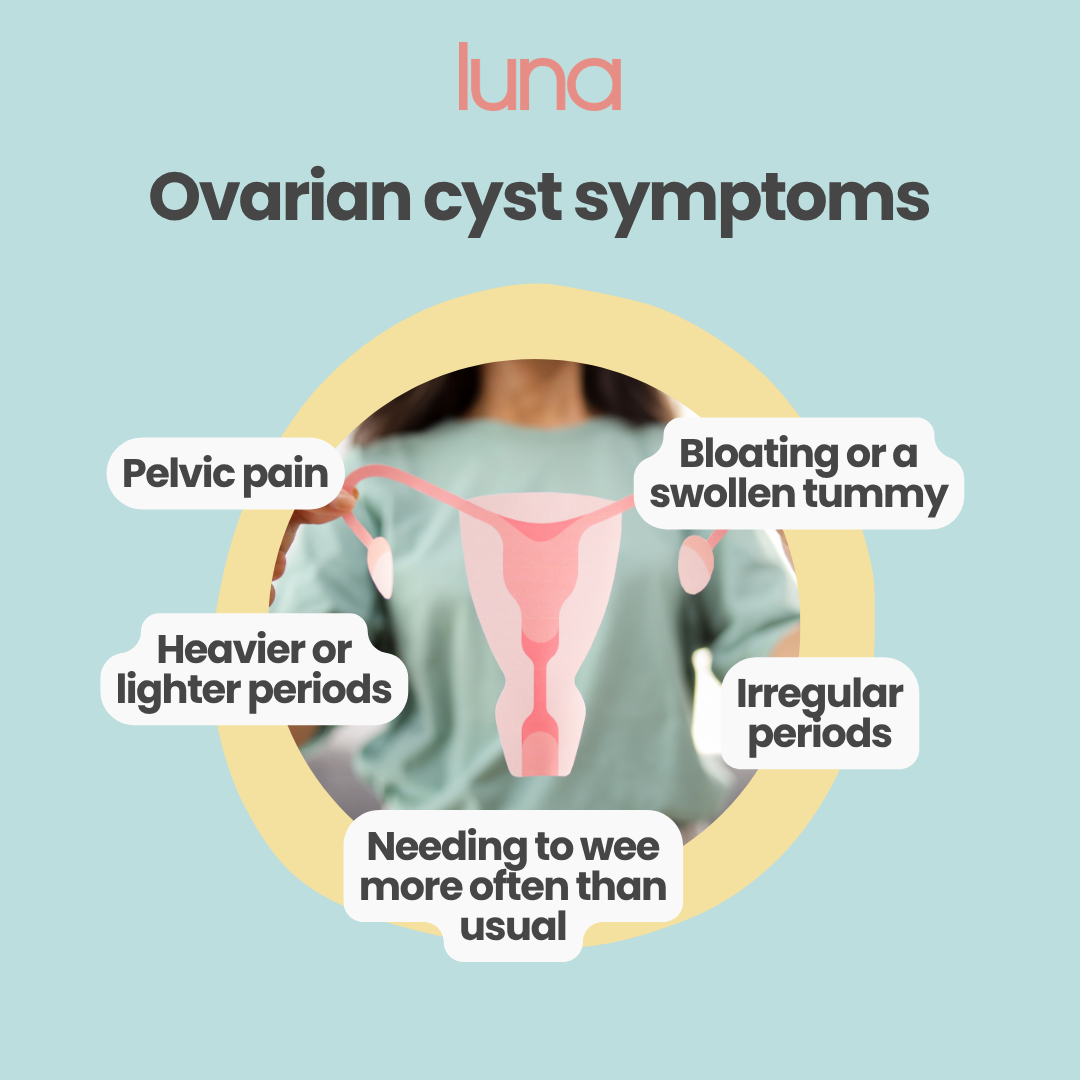
When symptoms do show up, they can include:
- Pelvic pain, ranging from a dull ache to something sharper
- Bloating or a swollen tummy
- Needing to wee more often than usual
- Periods that are heavier, lighter or more irregular than normal
When there are symptoms, it's useful to go to the doctor.
When should I take my daughter to the doctor?
See a doctor if she has ongoing pelvic pain or any of the symptoms above.
It's worth an urgent same-day appointment, or a call to 111, if the pain comes on suddenly and severely, or if it's paired with feeling or being sick.
This combination can sometimes mean a cyst has ruptured or the ovary has twisted, which needs prompt attention.
Is an ovarian cyst the same as PCOS?
Not quite, though the two get mixed up a lot.
If your daughter has PCOS, now called PMOS, she may not have ovarian cysts, despite what the name suggests.
The "cysts" in the name actually refer to a higher number of small follicles seen on a scan, which is a different thing from fluid-filled ovarian cysts.
This is actually one of the reasons why the name was changed!
How are ovarian cysts treated?
Most cysts just need watching. A doctor may suggest a follow-up scan in a few weeks to check it's shrinking on its own, which is the case for the vast majority.
Treatment is really only considered if a cyst is large, causing ongoing symptoms, or looks unusual on a scan.
Surgery is uncommon in teenagers, and doctors will always aim to protect the ovary itself.
Could it be something else?
Pelvic pain in teenagers has a few possible causes, and a cyst is only one of them.
Could my daughter have endometriosis covers another common one worth ruling out if pain keeps coming back.
If your daughter wants to explore these conditions herself, luna has expert-reviewed content on periods and health that she can read in her own time.
FAQs
Can an ovarian cyst affect my daughter's fertility?
Not usually. Most cysts don't affect the ovaries long term, and doctors will always try to preserve the ovary if any treatment is needed.
Can cysts come back after they've gone?
Yes, it's common for functional cysts to recur since they're linked to each cycle of ovulation. One cyst clearing up doesn't mean she won't get another later.
Is it normal to have a cyst before periods even start?
It's less common but not unheard of. If a cyst shows up before her first period, a doctor may want to check things a little more closely, simply because it's less typical.
How we created this article:
luna's team of experts comprises GPs, Dermatologists, Safeguarding Leads and Junior Doctors as well as Medical Students with specialised interests in paediatric care, mental health and gynaecology. All articles are created by experts, and reviewed by a member of luna's senior review team.
Sources:
NHS "Ovarian cyst" | 11.09.26
https://www.nhs.uk/conditions/ovarian-cyst/NHS "Ovarian cyst: causes" | 11.09.26
https://www.nhs.uk/conditions/ovarian-cyst/causes/Doğan M et al. "Age-specific frequencies and characteristics of ovarian cysts in children and adolescents" | 11.09.26
https://pmc.ncbi.nlm.nih.gov/articles/PMC5363166/We'd love to keep in touch!
Sign up to our parent newsletter for emails on the latest teen trends, insights into our luna community and to keep up to date
By signing up, you are agreeing that we can use your email address to market to you. You can unsubscribe from marketing emails at any time by using the link in our emails. For more information, please review our privacy statement.