Could my daughter have endometriosis?
Signs to spot & how to get a diagnosis
Updated May 4, 2026
In this article
- In short
- Can teenagers really get endometriosis?
- What are the signs of endometriosis in teenage girls?
- Why is endometriosis often missed in teens?
- How is endometriosis diagnosed?
- Could her symptoms be something else?
- What treatments help teens with endometriosis?
- What can I do at home to help her?
- FAQ
- A small note before you book
In short
Yes, teenage girls can have endometriosis. It's a condition where tissue similar to the womb lining grows outside the womb, causing very painful periods, heavy bleeding, pelvic pain, and exhaustion.
It's often missed in teens because the symptoms get put down to "normal" period pain. The first step is your GP, who can investigate and refer her on. Treatment can manage symptoms well.
Can teenagers really get endometriosis?
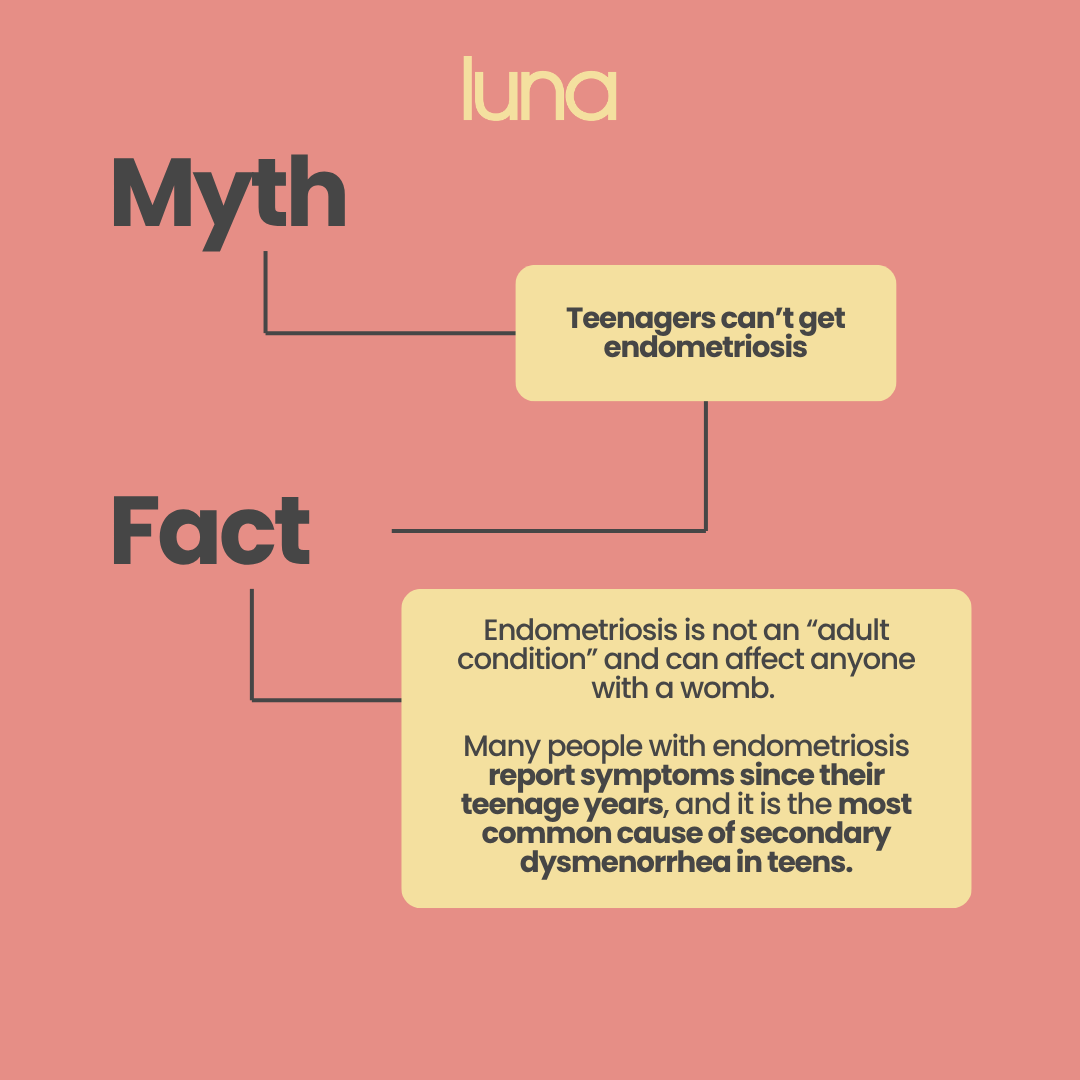
Yes. Endometriosis can affect anyone with a womb, from when periods start in puberty all the way through to menopause. It's not an "adult" condition.
Most women with endometriosis report symptoms since their teenage years, and this condition is the most common cause of secondary dysmenorrhea (period pain that is caused by a health condition) in adolescence.
However, it can be hard to spot in younger girls, because:
- Early periods are often irregular anyway, so unusual symptoms blend in
- Teens may not have anything to compare their pain to
- Adults around them may assume bad periods are just "part of growing up"
- Girls themselves may not realise their symptoms are unusual
On top of this, Endometriosis UK has reported that the average wait time to get diagnosed with the condition is 9 years and 4 months.
This means that even if your daughter is seeing a doctor about her period pain, she may not actually get diagnosed until adulthood.
luna hears from parents whose daughters had been struggling for years before anyone mentioned the word endometriosis. If something feels wrong, it's worth asking the question.
What are the signs of endometriosis in teenage girls?
The hallmark sign is period pain that stops her from doing normal things, but there's a wider cluster of symptoms worth knowing.
The NHS groups them into period symptoms and ones that can happen at any time.
Signs that show up during her period:
- Severe period pain that stops her doing normal activities
- Very heavy menstrual bleeding (changing pads or tampons every 1 to 2 hours, or bleeding through clothes)
Signs that can happen at any time in her cycle:
- Pelvic or lower back pain
- Pain when she pees or poos
- Extreme tiredness or fatigue
- Low mood or anxiety
A luna poll of 1,049 girls found that 70% have either skipped PE or wanted to because of their period.
Skipping things is normal sometimes: skipping things every cycle, every month, isn't.
If your daughter's bleeding is unusually heavy or long, luna's guides on signs your teen has a heavy menstrual period and why has my daughter had her period for 3 weeks? are a useful next read.
Why is endometriosis often missed in teens?
Because period pain is so common, severe pain often gets explained away.
Common reasons it gets missed:
- Pain is dismissed as "just bad periods"
- Teens are told their cycles will settle on their own
- Short GP appointments don't allow for detailed history taking
- Girls feel embarrassed to describe symptoms in front of a doctor
- Some symptoms (bowel pain, fatigue, low mood) aren't obviously linked to periods
- Ultrasounds don't always show endometriosis, so a "clear" scan can be misleading
A luna poll of 1,656 girls found that 1 in 4 say embarrassment or shame stops them from seeing a doctor, and 1 in 5 avoid the doctor because they don't want a parent or carer to know.
That's worth keeping in mind: she may downplay her symptoms more than she would if she felt fully comfortable.
How is endometriosis diagnosed?
Diagnosis usually starts with a GP appointment and may involve scans or, eventually, a small operation called a laparoscopy.
There isn't one single test that confirms endometriosis straight away.
The typical pathway looks like this:
- GP appointment, including questions about her symptoms and family history
- A physical examination (which may include a gentle abdominal exam)
- Blood tests, to rule out other causes such as anaemia or thyroid problems
- An ultrasound, sometimes via the tummy and sometimes internal (decided based on her age and what she's comfortable with)
- An MRI scan if the picture is still unclear
- Referral to a gynaecologist if symptoms are severe or unexplained
- A laparoscopy (keyhole surgery with a small camera), which is the only way to confirm endometriosis definitively
Tracking her symptoms before the appointment makes a real difference. luna has a guide on how to track your daughter's period that walks through what to log.
Could her symptoms be something else?
Yes, several conditions cause similar symptoms, which is part of why diagnosis can take time.
Other possible causes worth knowing about:
- Adenomyosis: womb lining tissue grows into the muscle of the womb, often causing very heavy and painful periods
- Fibroids: non cancerous growths in or around the womb (rarer in teens)
- Pelvic inflammatory disease (PID): an infection of the reproductive organs
- Irritable bowel syndrome (IBS): can cause cramping, bloating and bowel changes that overlap with endo
- Polycystic ovary syndrome (PCOS): affects ovulation and can cause irregular, heavy or absent periods. Read our guide on signs of PCOS in teen girls
- Bleeding disorders such as von Willebrand disease, especially if heavy bleeding has been a problem from her very first period
Telling her GP about all her symptoms, even ones that don't seem period related, helps narrow things down faster.
What treatments help teens with endometriosis?
There's no cure for endometriosis, but treatment can manage symptoms well. The NHS describes a stepped approach, starting with medication and only moving to surgery if needed.
Common treatments offered to teens:
- Over the counter painkillers such as paracetamol or ibuprofen, taken at the right time and right dose
- Prescription painkillers such as mefenamic acid for stronger pain
- Hormone treatments, including the combined contraceptive pill, progestogen only options, or a hormonal coil (intrauterine system)
- Tranexamic acid tablets to reduce heavy bleeding
- Referral to a specialist endometriosis service if symptoms are very severe
- Laparoscopic surgery to remove patches of endometriosis, usually only after other treatments have been tried
For day to day pain management, luna's guide on the best painkiller for teen period cramps covers what to take and when.
What can I do at home to help her?
Plenty. Home support won't treat endometriosis, but it can take the edge off symptoms and help her feel more in control between appointments.
Things that can help include:
- Heat: a heating pad, heat patch, or warm bath on her lower belly
- Gentle movement, like walking or yoga, on the days she feels up to it
- Healthy eating with enough fruit, vegetables, and protein
- Staying hydrated to ease bloating
- Prioritising sleep, especially in the week before her period
- Mindful movement or relaxation practices to help with pain related stress
- Tracking her symptoms so she has a clear record for her next appointment
If exhaustion is a big part of her experience, luna's guide on why is my daughter so tired on her period? goes deeper.
And if she's missing school regularly, you may find my daughter won't go to school on her period helpful too.
FAQ
At what age can a teen be diagnosed with endometriosis?
There's no minimum age. Endometriosis can be diagnosed from when periods begin. It just often takes longer in younger teens because symptoms get attributed to normal period pain.
Will an ultrasound show endometriosis?
Sometimes. Ultrasound can pick up some signs (like cysts caused by endo), but a clear scan doesn't definitely diagnose endometriosis. A laparoscopy is the only way to confirm it.
Does endometriosis run in families?
It can. Endometriosis is more common in people whose close relatives also have it, which is why your GP will ask about family history.
Will the pill make her infertile later?
No. Hormonal treatments such as the combined pill don't affect long term fertility. They pause some of the symptoms while she's taking them, and her cycle returns when she stops.
Could her period pain just be normal?
It might be, but pain that stops her from doing normal things isn't something to wait out. The NHS is clear: see a GP if symptoms are affecting her everyday life, work, or relationships.
A small note before you book
Trusting your gut here matters. If something feels off, it's worth asking the question, even if you've been brushed off before. Endometriosis is treatable, and the right care can change her life.
If your daughter is in severe pain, bleeding so heavily she feels dizzy or faint, or you're worried about her safety, contact NHS 111 or A&E.
How we created this article:
luna's team of experts comprises GPs, Dermatologists, Safeguarding Leads and Junior Doctors as well as Medical Students with specialised interests in paediatric care, mental health and gynaecology. All articles are created by experts, and reviewed by a member of luna's senior review team.
Sources:
PubMed "Endometriosis in Adolescence" | Accessed 4 May 2026
https://pmc.ncbi.nlm.nih.gov/articles/PMC3474254/Kids Health "Endometriosis" | Accessed 4 May 2026
https://kidshealth.org/en/teens/endometriosis.htmlNHS "Endometriosis" | Accessed 4 May 2026
https://www.nhs.uk/conditions/endometriosis/Endometriosis UK "Endometriosis UK release new report highlighting alarming increase in endometriosis diagnosis times" | Accessed 4 May 2026
https://www.endometriosis-uk.org/endometriosis-uk-release-new-report-highlighting-alarming-increase-endometriosis-diagnosis-timesWe'd love to keep in touch!
Sign up to our parent newsletter for emails on the latest teen trends, insights into our luna community and to keep up to date
By signing up, you are agreeing that we can use your email address to market to you. You can unsubscribe from marketing emails at any time by using the link in our emails. For more information, please review our privacy statement.