What is RED-S, and could it affect your daughter?
RED-S in young athletes explained
Updated September 11, 2026
In this article
In short
RED-S, short for Relative Energy Deficiency in Sport, happens when your daughter isn't eating enough to cover both her training and her body's normal functions.
It affects far more than performance, it can disrupt hormones, bone health, mood, and immunity too.
RED-S is most common in sports where being light is seen as a performance advantage, or where there's a strong focus on aesthetics, like running, dance, and gymnastics.
It's usually reversible once energy balance is restored, and a doctor is the right first step if you're concerned.
What actually is RED-S?
RED-S stands for Relative Energy Deficiency in Sport.
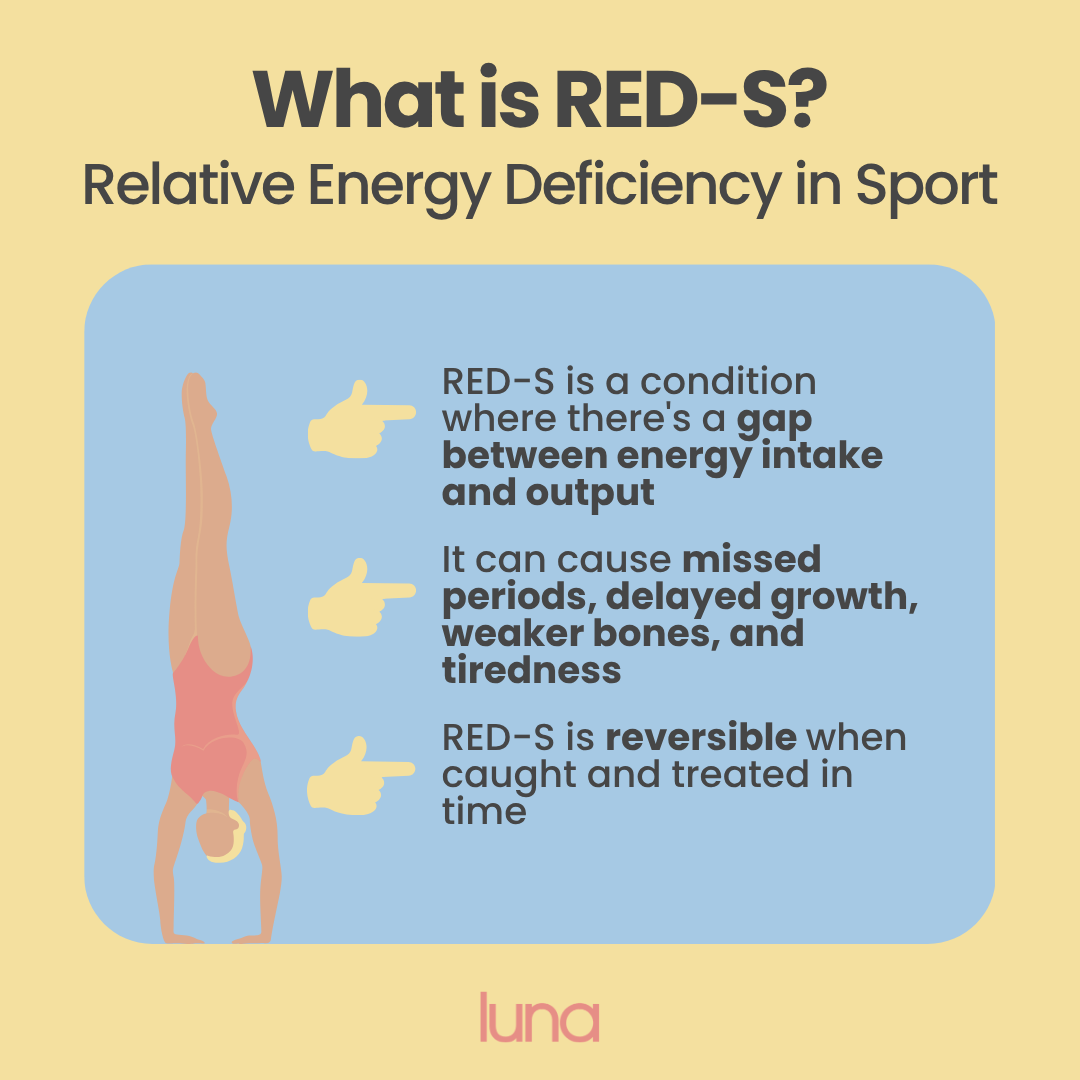
It happens when there's a gap between how much energy your daughter takes in and how much her training and everyday life demand, known as Low Energy Availability.
Think of it like her body running on a permanently low battery.
When that gap goes on too long, the body starts shutting down functions it sees as non-essential to survival.
What can RED-S actually affect?
Health effects can include:
- Missed or irregular periods
- Tiredness and low mood
- Delayed puberty or growth
- Weaker bones, including a higher risk of stress fractures
- Getting ill more often
- Low iron levels
Performance can suffer too, showing up as reduced endurance, more injuries, and a slower response to training, which is often what first gets a coach or parent wondering if something's off.
Why does this happen to sporty teenagers specifically?
It's not always about restricting food on purpose.
Training uses up a lot of energy, and it's easy for intake to fall behind without anyone intending it to, especially during a busy training block.
How is RED-S diagnosed?
There isn't a single test for it. A doctor will usually rule out other explanations first, then look at the pattern of symptoms alongside her training and eating habits together.
This is why it's worth mentioning everything you've noticed, not just the most obvious symptom, since RED-S rarely shows up as just one thing.
What actually helps?
Recovery centres on restoring energy balance, which usually means eating enough to properly fuel both training and everyday life.
In some cases, training may need to be reduced or paused for a while too.
A few things that tend to help:
- Healthy eating regularly through the day rather than around long gaps
- Fuelling training sessions with a carbohydrate-rich snack beforehand
- Refuelling with protein and carbohydrate after training
- Treating rest days as part of training, not time off from it
- Managing stress
It's not just formal exercise that counts toward her energy needs, everyday activity adds up too.
When should I take my daughter to a doctor?
If your sporty daughter has lost her period or if you’re noticing other signs of RED-S, it’s best to take your daughter to see a doctor.
RED-S is generally reversible, but catching it earlier makes recovery easier, particularly for bone health.
FAQs
Does RED-S only affect girls who are underweight?
No, RED-S can affect athletes at any body size. It's about the balance between energy in and energy out, not weight alone.
Will my daughter have to stop her sport altogether?
Not necessarily. Many recover while continuing to train, though a temporary reduction is sometimes recommended depending on how she's doing.
Is RED-S the same as an eating disorder?
Not always, though the two can overlap. RED-S is about energy balance and can happen without any intention to restrict food, but if you're worried about her relationship with eating specifically, it's worth raising that separately and directly with a doctor.
How we created this article:
luna's team of experts comprises GPs, Dermatologists, Safeguarding Leads and Junior Doctors as well as Medical Students with specialised interests in paediatric care, mental health and gynaecology. All articles are created by experts, and reviewed by a member of luna's senior review team.
Sources:
Oxford University Hospitals NHS Foundation Trust "Relative Energy Deficiency in Sport (RED-S): information for patients" | 11.09.26
https://www.ouh.nhs.uk/media/0f2nd3pe/115727energy.pdfTodd E, Elliott N, Keay N. “Relative energy deficiency in sport (RED-S)” | 11.09.26
https://pmc.ncbi.nlm.nih.gov/articles/PMC9172228/We'd love to keep in touch!
Sign up to our parent newsletter for emails on the latest teen trends, insights into our luna community and to keep up to date
By signing up, you are agreeing that we can use your email address to market to you. You can unsubscribe from marketing emails at any time by using the link in our emails. For more information, please review our privacy statement.