What is the 7-2-1 rule for periods?
Signs your daughter needs a doctor visit
Updated June 9, 2026
In this article
In short
The 7-2-1 rule is a checklist for spotting whether a period is medically heavy.
Any one of three signs counts: periods lasting 7 or more days, needing to change products more than every 2 hours, or passing clots larger than a 10p coin.
Around 1 in 5 women experience heavy menstrual periods, and in teens it can sometimes be the first sign of a treatable condition.
How do I know if my daughter's period is too heavy?
The 7-2-1 rule gives you a clear set of criteria, developed by the European Haemophilia Consortium to help identify heavy menstrual bleeding that warrants medical attention.
You only need to spot one sign, not all three.
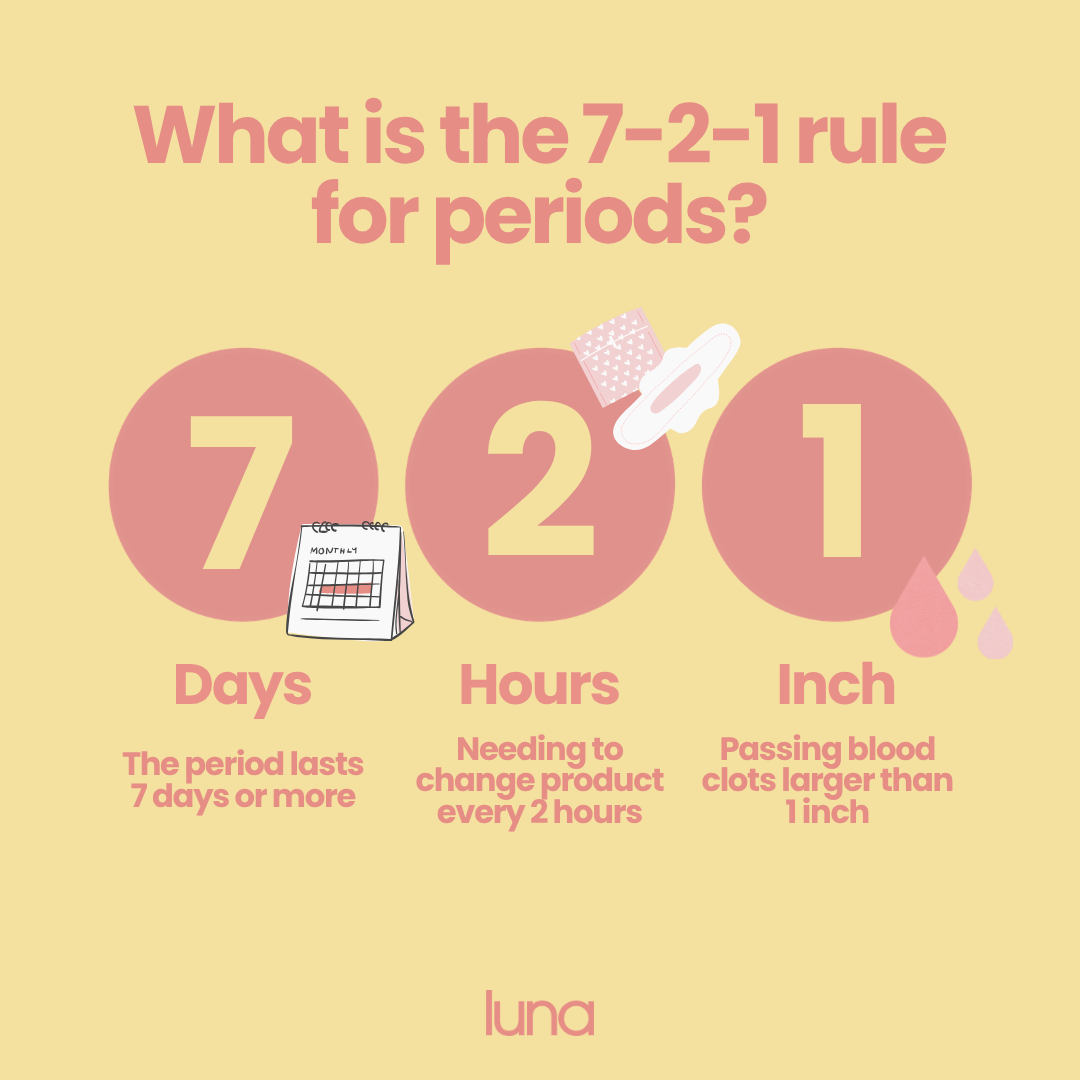
The three signs to look out for:
- 7: the period lasts 7 days or more
- 2: she needs to change products more often than every 2 hours
- 1: she's passing blood clots larger than a 10p coin
The NHS also flags a few other signs worth knowing: needing to use two types of products at once, such as a pad and a tampon together, or bleeding through to clothes or bedding.
Are my daughter's heavy periods something to worry about?
Heavy or irregular periods in the first year or two of puberty are very common, which can make it genuinely difficult to know what's typical for her age.
The most common cause of heavy periods in teenagers is anovulation, when the ovaries don't release an egg as expected during the cycle.
This is typical in early puberty and often settles as hormones regulate over time.
But if her periods consistently meet the 7-2-1 criteria, or they're affecting her daily life, school, or activities, a doctor's visit is worth it regardless of how long she's been having periods.
What could be causing my daughter's heavy periods?
The most common cause in teenagers is anovulation.
But sometimes heavy bleeding has another cause that responds well to treatment once it's identified.
Causes a doctor might explore include:
- Anovulation: the most common cause in teens, especially in the first 1 to 2 years of having periods
- Von Willebrand disease: an inherited condition where blood doesn't clot as it should, which can first appear as heavy periods
- PMOS (Polyendocrine Metabolic Ovarian Syndrome): which can cause irregular, sometimes heavy, bleeding
- Endometriosis: where tissue similar to the womb lining grows elsewhere in the body
- Iron deficiency: which heavy periods can cause over time, rather than the other way around
A doctor will usually start with a simple blood test to begin working through these.
Could my daughter have a bleeding disorder?
It's worth knowing that bleeding disorders are more common in teenagers with heavy periods than most people expect.
A recent study into adolescents with heavy menstrual bleeding found that around a third had an underlying bleeding disorder.
Von Willebrand disease is among the more common.
It's inherited, affects how blood clots, and heavy periods from the very start of puberty can be one of its earliest signs.
Other signs that may point to a bleeding disorder:
- Frequent or prolonged nosebleeds
- Bruising more easily than expected
- Bleeding gums
- Bleeding that's difficult to stop after a cut or dental work
If any of these sound familiar alongside the heavy periods, mention them when you see a doctor.
What will a doctor do about my daughter's heavy periods?
A doctor will usually start with a blood test to check for anaemia and, where there's reason to suspect it, clotting function.
What happens next depends on the results and how much the periods are affecting her quality of life.
Options a doctor may discuss with you:
- Tranexamic acid: a non-hormonal tablet that reduces blood loss, taken during the period
- The combined contraceptive pill: which can significantly reduce flow; this is a medical use, not just contraception
- An intrauterine system (IUS): a small device fitted inside the womb that reduces bleeding over time
- NSAIDs like mefenamic acid or naproxen: which can reduce both the flow and associated pain
If her periods are heavy but not noticeably affecting her daily life, a doctor may suggest watchful waiting rather than immediate treatment.
This is a valid approach, especially in the early years of puberty.
For practical help managing a heavier flow in the meantime, our guide to choosing the best period products for tweens and teens covers options worth knowing about.
FAQ
Does the 7-2-1 rule mean my daughter definitely has a problem?
Not necessarily.
Meeting one of the criteria is a prompt to see a doctor, not a diagnosis.
Around 1 in 5 women experience heavy periods, and for many it's manageable without treatment.
The rule exists because heavy periods can sometimes signal something treatable, and identifying it early makes a real difference.
What if my daughter doesn't tell me how heavy her periods are?
You might notice she's going through products quickly, asking to skip activities on the first couple of days, or seeming unusually tired or pale.
Tracking her cycle together makes patterns much easier to spot, and our guide to tracking your daughter's period is a simple way to start.
Can my daughter's heavy periods cause anaemia?
Yes. Losing a significant amount of blood each month can deplete iron stores over time, leading to iron deficiency anaemia.
Signs to look out for include tiredness, pale skin, and feeling faint or breathless.
A doctor can check for this with the same blood test used to investigate heavy periods.
Should I wait to see if her heavy periods settle on their own?
For teens in the first couple of years of puberty, heavy or irregular bleeding often does settle as hormones regulate.
If it's not affecting her daily life, watchful waiting is reasonable.
But if she's consistently meeting the 7-2-1 criteria or missing school because of her period, it's worth seeing a doctor sooner rather than later.
My daughter is embarrassed about seeing a doctor for her periods. What do I do?
This is really common.
It can help to frame it as a routine check, rather than suggesting something is definitely wrong.
Letting her lead the conversation with the doctor, and going in with her rather than dropping her off, can make a big difference.
You can usually request a female doctor when booking.
If her periods are ticking any of the 7-2-1 boxes, a conversation with a doctor is the most useful next step.
A blood test is the usual starting point: quick, and it gives you both something concrete to work from.
How we created this article:
luna's team of experts comprises GPs, Dermatologists, Safeguarding Leads and Junior Doctors as well as Medical Students with specialised interests in paediatric care, mental health and gynaecology. All articles are created by experts, and reviewed by a member of luna's senior review team.
Sources:
NHS "Heavy periods" | 05.06.26
https://www.nhs.uk/conditions/heavy-periods/NHS "Von Willebrand disease" | 05.06.26
https://www.nhs.uk/conditions/von-willebrand-disease/NICE "Heavy menstrual bleeding: assessment and management" | 05.06.26
https://www.nice.org.uk/guidance/ng88European Haemophilia Consortium "What is a heavy period?" | 05.06.26
https://community.ehc.eu/wp-content/uploads/2024/09/EHC-WomensDay_EN-copy.pdfThe Royal Children's Hospital Melbourne "Adolescent gynaecology - heavy menstrual bleeding" | 05.06.26
https://www.rch.org.au/clinicalguide/guideline_index/adolescent_gynaecology_menorrhagia/PubMed "Bleeding disorders in adolescents with heavy menstrual bleeding in a multicenter prospective US cohort" | 05.06.26
https://pmc.ncbi.nlm.nih.gov/articles/PMC7327636/We'd love to keep in touch!
Sign up to our parent newsletter for emails on the latest teen trends, insights into our luna community and to keep up to date
By signing up, you are agreeing that we can use your email address to market to you. You can unsubscribe from marketing emails at any time by using the link in our emails. For more information, please review our privacy statement.