What is tanmaxxing and should you worry?
The tanning trend explained for parents

Updated August 10, 2026
In this article
In short
Tanmaxxing is a social media trend that treats a deep tan as a goal to maximise, through heavy sun exposure, sunbeds, or unlicensed nasal tanning sprays and "tan jabs". It's an offshoot of looksmaxxing.
There's no safe tan: UV damage raises skin cancer risk, sunbeds are illegal for under-18s, and the tanning sprays are unregulated and linked to changing moles.
What exactly is tanmaxxing?
If you've seen the word on your daughter's feed or heard her mention it, it can sound harmless until you know what's behind it.
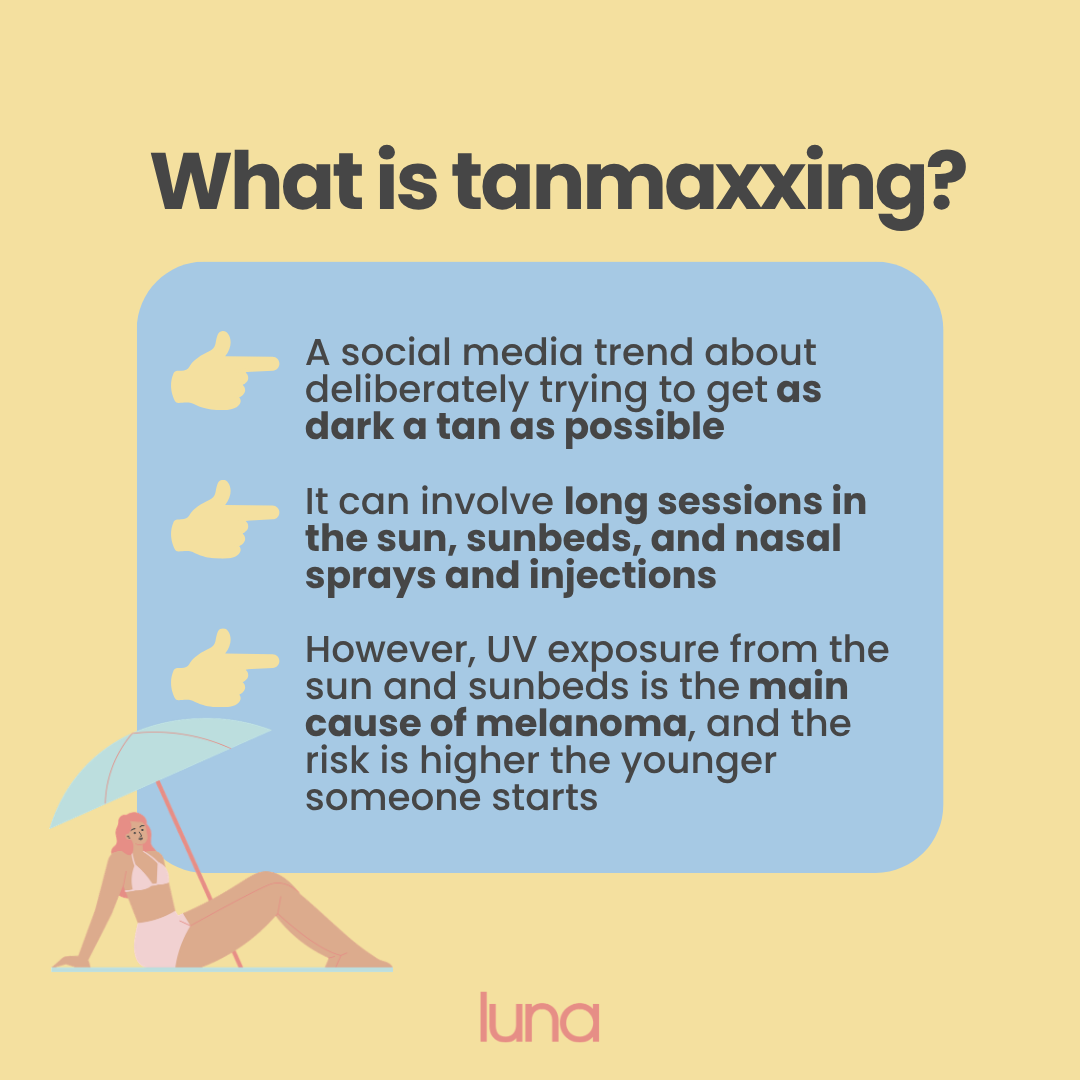
Tanmaxxing means deliberately trying to get as dark a tan as possible, treating a tan like a score to push as high as it will go.
It sits in the same family as looksmaxxing, where appearance is framed as something to optimise rather than simply live in.
In practice it can involve a few different things:
- Long, repeated sessions in direct sun, often without sunscreen or with oils that speed up burning
- Using sunbeds to build or "top up" a tan
- Buying nasal tanning sprays or injections (sometimes called "tan jabs") sold online to darken the skin faster
The first two are old risks with a new name. The third is newer, and it's the one most parents haven't heard of.
Where did tanmaxxing come from?
Tanmaxxing grew out of the wider looksmaxxing trend that's spread from online forums to your daughter's TikTok, where every feature becomes a project to improve.
Somewhere along the way, a tan got added to that checklist. Social media fills up with before-and-after clips, "how I got so dark" videos, and comments treating pale skin as a problem to fix.
It's one of several appearance trends moving fast through teen feeds right now.
luna's roundup of harmful TikTok trends parents need to know about covers others you might be seeing at the same time.
Is tanmaxxing dangerous for my daughter?
It can be, yes. The risk isn't really about vanity; it's about what UV light does to young skin.
Ultraviolet (UV) light from the sun and from sunbeds is the main cause of melanoma, the most serious type of skin cancer.
Damage from sun exposure builds up over a lifetime, and a lot of it happens while she's young, which is exactly why tanning as a teenager matters more than it might seem.
The numbers are sobering:
- Melanoma is one of the most common cancers in people aged 15 to 34 in the UK
- Research on indoor tanning has found that using sunbeds before the age of 20 can raise the risk of melanoma by 47%
A tan itself isn't a sign of health. It's the skin's response to damage, the body trying to protect itself after UV has already got in.
There's no safe way to build one, and the idea of a protective "base tan" is a myth.
luna gives teen girls a space to explore skin and body topics at their own pace, with content reviewed by medical experts rather than shaped by an algorithm rewarding the most extreme version of a trend.
Are nasal tanning sprays and tan jabs safe for my daughter?
No. These products are unlicensed, largely untested, and sold with no safety oversight at all.
The active ingredient in most of them is a substance called melanotan II, a lab-made hormone that triggers pigment in the skin.
It's usually sold as a nasal spray or an injection, often marketed on social media as a shortcut to a tan without the sun.
Here's what's worth knowing:
- Melanotan II has never been approved as a medicine anywhere, and regulators in the UK and elsewhere have issued warnings against using it
- Reported side effects include nausea, vomiting, and facial flushing
- More seriously, it's been linked to moles getting darker, new moles appearing, and existing moles changing, and there are concerns about a possible link to melanoma
Because these sprays are sold online rather than through a pharmacy, there's no way to know what's actually in the bottle.
Dermatology guidance is blunt on this point: it's not recommended that anybody use this drug.
How do I know if my daughter is tanmaxxing?
You won't always spot it straight away, and a bit of interest in tanning isn't the same as a problem.
Some signs worth gently keeping an eye on:
- Sunbathing for long stretches with no sunscreen, or using tanning oils to darken faster
- Talking about sunbeds, or asking to use them
- Unfamiliar nasal sprays or small vials in her room, or online orders you don't recognise
- Sunburn that keeps happening, or a tan that's noticeably deeper than usual
- Talking about her skin tone as something that's "not dark enough" or needs fixing
If her tanning seems tied to how she feels about her appearance more broadly, that's worth noticing too. luna's guide on what to do if your daughter has body image issues can help you make sense of that side of things.
How do I talk to my daughter about tanmaxxing?
Leading with "this causes cancer" can shut the conversation down before it starts, even though it's true.
Some parents find it helps to get curious first and learn why their teen wants to tan: ask what she's seen, who's posting it, and what she likes about the look.
That tells you whether this is idle curiosity or something she's actively trying.
From there, the facts tend to land better than a lecture. Being honest that a tan is skin damage, that sunbeds are illegal for her age group for a reason, and that the nasal sprays are genuinely risky gives her something concrete to weigh up, rather than a rule to push against.
It can also help to separate the wish from the method.
Wanting to feel good about how she looks is completely normal. It's the tanning that's the problem, and there are safe ways to get a glow, like fake tan, that don't carry any of the risk.
luna gives teen girls a space to ask questions about skin, sun safety, and how they look without judgement, with answers reviewed by medical experts.
FAQs
Is a base tan safe?
No. A "base tan" offers almost no protection from burning, and building one still means exposing the skin to the UV damage that raises skin cancer risk.
There's no level of tanning that counts as safe.
Are sunbeds legal for my under-18 daughter?
No. It's illegal for anyone under 18 to use sunbeds in the UK, in any setting, including salons, gyms, and hotels.
The law exists because using sunbeds young significantly increases the risk of skin cancer later.
What's the difference between fake tan and tanmaxxing?
Fake tan and gradual self-tanners sit on top of the skin and don't involve any UV exposure, so they're considered a safe way to look tanned.
Tanmaxxing, by contrast, relies on real UV or unlicensed drugs to change the skin itself, which is where the risk comes in.
Can tanmaxxing really cause skin cancer?
Yes. UV exposure from the sun and sunbeds is the main cause of melanoma, and the risk is higher the younger someone starts.
The tanning sprays involved carry their own separate concerns, including a possible link to melanoma.
What age do girls start tanmaxxing?
Tanmaxxing content reaches girls throughout the 11 to 18 age range via TikTok and Instagram.
The younger she is, the more useful an open, judgement-free conversation about what she's seeing online tends to be.
If your daughter's keen on the tanned look, the safest next step is swapping UV for a good fake tan, and getting her into the habit of daily sunscreen.
luna's guide to why SPF matters more than you think for teens is a good place to start. If you've noticed changing moles or spots that worry you, it's worth booking an appointment with your doctor to get them checked.
How we created this article:
luna's team of experts comprises GPs, Dermatologists, Safeguarding Leads and Junior Doctors as well as Medical Students with specialised interests in paediatric care, mental health and gynaecology. All articles are created by experts, and reviewed by a member of luna's senior review team.
Sources:
NHS "Sunscreen and sun safety" | 10.08.26
https://www.nhs.uk/live-well/seasonal-health/sunscreen-and-sun-safety/NHS "Melanoma skin cancer" | 10.08.26
https://www.nhs.uk/conditions/melanoma-skin-cancer/NICE "Sunlight exposure: risks and benefits" | 10.08.26
https://www.nice.org.uk/guidance/ng34DermNet "Melanotan II" | 10.08.26
https://dermnetnz.org/topics/melanotan-iiDermNet "Sun protection" | 10.08.26
https://dermnetnz.org/topics/sun-protectionAmerican Academy of Dermatology "Indoor tanning" | 10.08.26
https://www.aad.org/media/stats-indoor-tanningScience Direct "Skin cancer in the youth population of the United Kingdom" | 10.08.26
https://www.sciencedirect.com/science/article/abs/pii/S2213538316300479We'd love to keep in touch!
Sign up to our parent newsletter for emails on the latest teen trends, insights into our luna community and to keep up to date
By signing up, you are agreeing that we can use your email address to market to you. You can unsubscribe from marketing emails at any time by using the link in our emails. For more information, please review our privacy statement.