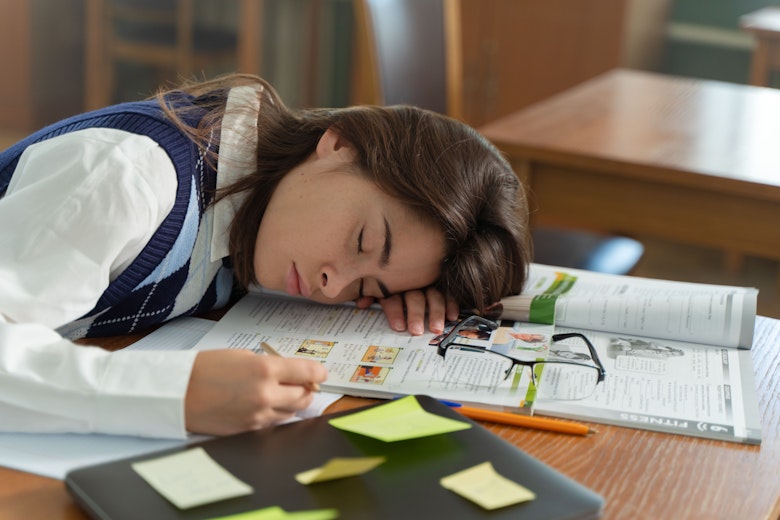
What if your daughter is falling asleep during lessons?
When tiredness is more than late nights
Updated August 4, 2026
In this article
In short
If your daughter keeps nodding off in lessons, the most likely reason is simple: she isn't getting enough sleep.
Teenagers need around 8 to 10 hours a night, and their body clock naturally shifts later during puberty.
But ongoing daytime sleepiness can also signal iron deficiency, glandular fever or low mood, so it's worth a doctor's check if it continues.
Why is my daughter falling asleep in class?
Most of the time it's because she simply isn't getting enough sleep, not because she's lazy or not trying hard enough.
Teenage bodies need more sleep than we tend to assume, and the teenage body clock works against early school starts.
When those two things collide, the middle of a maths lesson is exactly where it shows.
There are a handful of common reasons a teenager ends up this tired:
- She isn't getting enough hours overall
- Her body clock runs late, so she genuinely can't fall asleep early
- Late nights on her phone, messaging, or gaming
- A heavy stretch: exam stress, sport, a packed timetable
- Feeling low, anxious, or stressed
- An underlying physical cause, like iron deficiency or a recent virus
If she's mortified about it, that's worth knowing too.
Falling asleep in front of classmates can feel humiliating, and she may be masking how exhausted she really is.
How much sleep does my daughter actually need?
Most teenagers need around 8 to 10 hours a night, though some do fine on 7 and others need closer to 11.
During puberty, the brain starts releasing melatonin (the sleep hormone) later in the evening. That pushes her natural bedtime and wake time roughly two hours later than when she was younger.
So a 7am alarm can land right in the middle of her body's night, which is why waking your teenager up can feel like such a battle.
It's genuinely biological, not defiance. You can read more on how much sleep your teen really needs and why the timing shifts.
There's also a frustrating loop at play: being overtired can make it even harder to fall asleep at night, which leaves her more tired the next day.
Could it just be her phone keeping her up?
Often, yes. Late-night scrolling, messaging, and gaming are one of the most common reasons teenagers lose sleep.
It isn't only the light from the screen. It's that "one more video" is genuinely hard to put down, and every extra scroll nudges an already-late body clock later still.
A phone under the pillow can quietly cost her an hour or two most nights.
Some parents find that a shared wind-down time, or charging phones somewhere outside the bedroom, takes the pressure off her to switch off alone.
It's worth understanding how phones affect her sleep before deciding what feels right for your family.
When should I worry it's something medical?
If she's getting enough sleep but still falling asleep during the day, or the tiredness has dragged on for several weeks, it's worth speaking to a doctor.
Persistent daytime sleepiness that isn't explained by late nights can have a physical cause.
A doctor might look for:
- Iron deficiency anaemia, which is common in girls with heavy periods and often shows up as tiredness, breathlessness and paler skin
- Glandular fever, a virus most common in 15 to 24 year olds that can cause weeks of exhaustion
- A thyroid problem
- Sleep apnoea, where breathing stops and starts in the night, often with loud snoring
- Narcolepsy, where she falls asleep suddenly and can't help it
- Low mood, anxiety, or depression, which can leave her drained and sleeping far more than usual
If her tiredness comes with heavy periods, it's worth knowing that persistent tiredness could be iron deficiency, which a simple blood test can check for.
Some signs are worth a prompt appointment rather than a wait-and-see: gasping, snoring or choking in her sleep, falling asleep mid-conversation or mid-activity, or tiredness alongside weight loss or a real dip in mood.
Where to go next
If the tiredness is really about not getting enough sleep, small, consistent changes tend to help more than one big overhaul. These practical sleep tips for teens are a gentle place to start.
And if you sense it's more than tiredness, trust that instinct and book a doctor's appointment. You know when something's off with your daughter.
luna gives teen girls a space to explore sleep, energy and health topics at their own pace, with everything reviewed by medical experts and no one trying to sell her anything.
Frequently asked questions
Is it normal for teenagers to sleep so much?
Largely, yes. Teenagers need more sleep than adults and their body clock runs late, so long lie-ins and evening grogginess are common.
What's less usual is falling asleep during the day when she's had a full night's rest, which is worth checking with a doctor.
Could my daughter have narcolepsy?
It's uncommon, but possible. Narcolepsy is where someone falls asleep suddenly and can't fight it, sometimes mid-activity.
If she's dropping off in seconds despite sleeping well at night, mention it to a doctor, who can refer her to a sleep specialist if needed.
Can her period be making her this tired?
It can. Heavy periods are a very common cause of iron deficiency in girls, and low iron leaves her wiped out.
Teen hormonal shifts across her cycle can also affect energy and sleep, so a pattern that tracks with her period is worth noting.
Should I let her nap when she gets home?
A short nap can help, but a long late-afternoon sleep can push her bedtime even later and feed the cycle.
Some parents find that keeping naps to around 20 minutes, and before late afternoon, works better than a two-hour crash on the sofa.
What will the doctor do?
Usually they'll ask about her sleep, mood and periods, and often run a simple blood test to check her iron and thyroid levels.
If they suspect a sleep disorder, they can refer her to a specialist. It helps to bring a rough note of her sleep and wake times.
How we created this article:
luna's team of experts comprises GPs, Dermatologists, Safeguarding Leads and Junior Doctors as well as Medical Students with specialised interests in paediatric care, mental health and gynaecology. All articles are created by experts, and reviewed by a member of luna's senior review team.
Sources:
NHS "Tiredness and Fatigue" | 04.08.26
https://www.nhs.uk/symptoms/tiredness-and-fatigue/NHS "Excessive daytime sleepiness (hypersomnia)" | 04.08.26
https://www.nhs.uk/conditions/excessive-daytime-sleepiness-hypersomnia/NHS "Iron deficiency anaemia" | 04.08.26
https://www.nhs.uk/conditions/iron-deficiency-anaemia/NHS "Glandular fever" | 04.08.26
https://www.nhs.uk/conditions/glandular-fever/Oxford Health NHS Foundation Trust "Why has it got harder to get to sleep?" | 04.08.26
https://oxfordhealth.nhs.uk/camhs/self-care/sleep/what-happens/teenagers/We'd love to keep in touch!
Sign up to our parent newsletter for emails on the latest teen trends, insights into our luna community and to keep up to date
By signing up, you are agreeing that we can use your email address to market to you. You can unsubscribe from marketing emails at any time by using the link in our emails. For more information, please review our privacy statement.