When your daughter won't go to school: a guide to school refusal
Gentle steps back to school

Updated August 14, 2026
In this article
In short
When your daughter won't go to school, it's rarely defiance. More often it's emotionally based school avoidance (EBSA): she can't face it, usually because of anxiety, friendships, or something happening at school.
What helps most is finding the cause, working with the school on a gentle, gradual return, and getting support early, rather than forcing her through the gates.
Why won't my daughter go to school?
Most school avoidance isn't about being lazy or difficult.
It usually comes from a feeling she can't manage yet: anxiety, worries about friendships or bullying, falling behind, or a school day that feels overwhelming from start to finish.
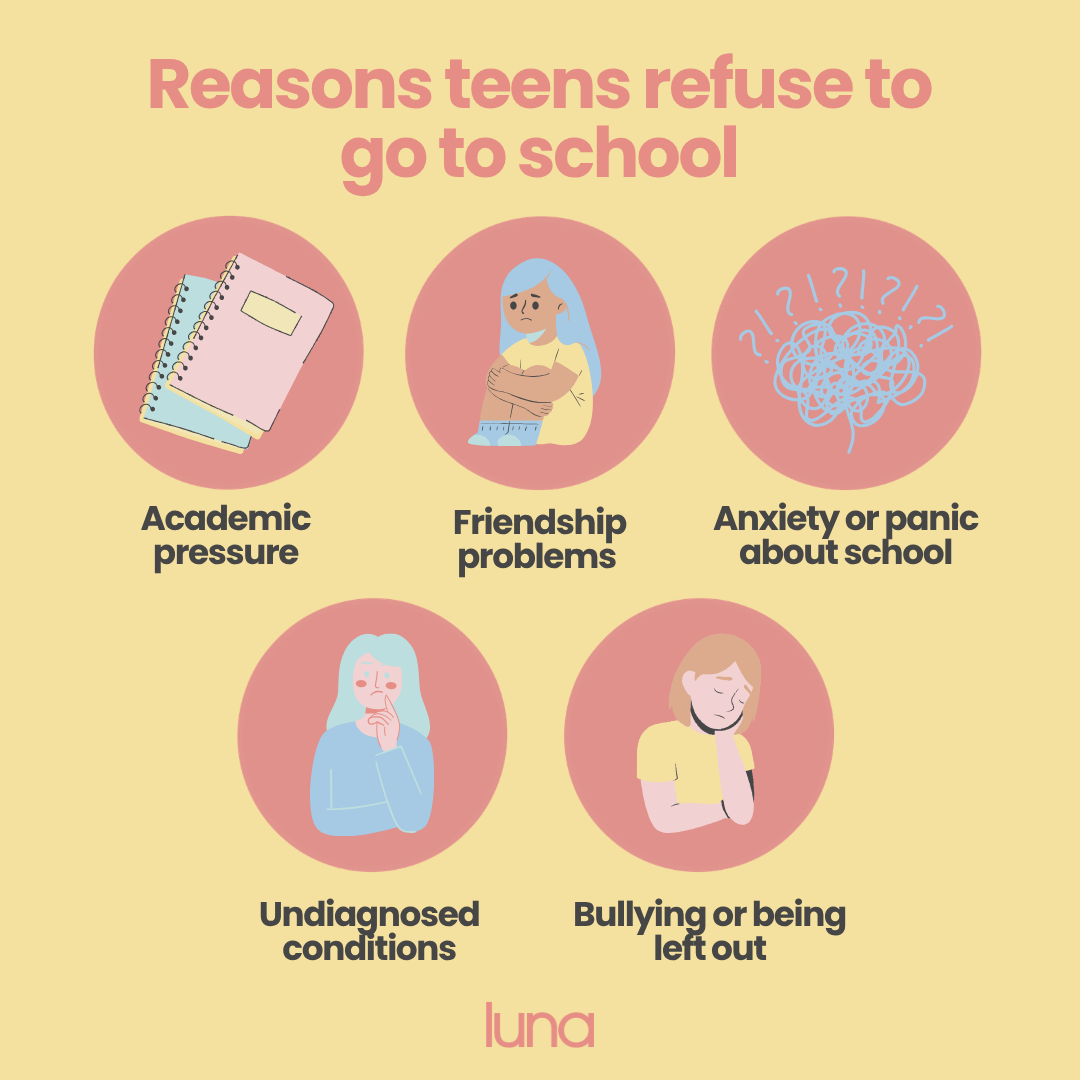
Common reasons behind school avoidance include:
- Anxiety, low mood or panic about being in school
- Friendship problems, bullying or feeling left out
- Struggling with the work or falling behind
- Sensory overload from noise, crowds or strict rules
- Something difficult at home, like grief or a family change
- An undiagnosed condition such as autism or ADHD, which often shows up later in girls
That last point matters more than many parents realise.
Girls are frequently diagnosed later than boys, and school can be the place where an unmet need first shows up as exhaustion or avoidance.
If that rings true, it can be worth getting your daughter assessed for ADHD or autism.
luna gives teen girls a space to explore how they're feeling at their own pace, with content reviewed by medical experts rather than driven by influencers or ads.
Is my daughter refusing school on purpose?
Almost never in the way it looks.
Professionals increasingly avoid the phrase "school refusal" because it implies a choice she's making, when in reality she often can't face going, rather than won't.
That's why you'll hear terms like emotionally based school avoidance instead.
It reflects what's actually happening: a genuine barrier, not a battle of wills.
The physical symptoms are real too.
Stomach aches, headaches, nausea, trouble sleeping, and full panic attacks before school are all common, and they don't disappear just because there's no obvious medical cause.
It can help to remember what one mum wrote for YoungMinds: your daughter probably wants to feel able to be in school just as much as you want her there.
In many cases, it simply doesn't feel possible yet.
If anxiety seems to be at the root of it, luna's guide on how to help with school anxiety goes deeper.
What do I do when my daughter won't get out of bed for school?
In the moment, staying calm and low-key tends to work better than a big push, even though that's far easier said than done at 8am with the clock ticking.
Some parents find these things help on a difficult morning:
- Keeping the routine calm and predictable, so there's less to react to
- Naming the feeling out loud ("this feels really hard right now") instead of arguing the facts
- Breaking it down into tiny steps: getting dressed, then the car, then the gate
- Agreeing a safe place or a person she can go to once she's inside
It's worth knowing that shouting or physically forcing her in without changing anything underneath can make the anxiety worse over time.
That doesn't mean giving up on school; it means addressing the reason she can't face it first.
How do I get my daughter back into school?
The approach with the best track record is a gradual, planned return built together with the school, not a single big morning where she goes back full-time.
A step-by-step return often looks like this:
- Ask for a meeting with her tutor, head of year, pastoral lead or SENCO (the school's special educational needs coordinator)
- Agree small, achievable targets, like visiting the building, doing one lesson, or a half day
- Put practical support in place, such as a safe space, a later start, an exit card or a reduced timetable
- Keep her connected to friends and routine even on the days she can't attend
- Write the plan down so home and school are following the same steps
If school has felt impossible for a long time, you might be weighing up other options entirely, including whether to let your daughter homeschool.
There's no single right answer, but it's worth understanding what each route really involves before you decide.
When should I get help for my daughter not going to school?
It's worth talking to someone sooner rather than later, particularly if this has lasted more than a couple of weeks, or she seems constantly anxious or low.
As a rough guide, the NHS suggests seeing a doctor when anxiety is constant, isn't getting better, or is clearly affecting her school, family life or friendships.
A doctor can rule out anything physical and, if needed, refer her to specialist support.
Talking therapies and cognitive behavioural therapy (CBT), a type of therapy that helps her manage anxiety by changing how she thinks and responds, are the treatments most often recommended for anxiety in young people.
Waits for services like CAMHS (Child and Adolescent Mental Health Services) can be long, so it's worth knowing what to do while your daughter waits for CAMHS in the meantime.
You don't have to sit on your hands until an appointment comes through.
One more thing that often gets missed: this is exhausting for you too.
Many parents in this situation describe feeling burnt out and alone, and looking after yourself is part of helping her, not a distraction from it.
FAQ
Can I be fined if my daughter won't go to school?
It's possible, but schools usually work with families who are engaged and trying, rather than moving straight to fines or prosecution.
If you're in regular contact with the school and following a support plan, that's the picture they want to see.
If you're worried, ask the school directly how they handle anxiety-related absence.
Is school refusal a mental health problem in itself?
Not exactly. It's better understood as a sign that something else is going on, very often anxiety, low mood, or an unmet need at school.
Teens who avoid school tend to have significantly higher levels of anxiety and depression than their peers.
That's why finding the underlying cause matters so much.
Could my daughter's period be making her miss school?
Sometimes, yes. Pain, heavy bleeding, tiredness, or worry about leaks can mean your daughter's period is making her miss school, and that's separate from anxiety-based avoidance.
If her absences follow a monthly pattern, it's worth looking at that angle too, and mentioning it to a doctor.
How long does school refusal usually last?
There's no set timeline. Some daughters turn a corner within weeks with the right support in place, others need months and a slower, staged return.
Early support and a consistent plan between home and school tend to make the biggest difference to how quickly things improve.
Should I just let her stay home?
Keeping her home for a day can feel like a relief for you both, but long stretches at home can make going back harder as anxiety grows.
The aim is usually to keep some connection to school going, even a very small one, while you work out and address the real cause.
What to remember
If today felt like a battle, be gentle with yourself. Most daughters who struggle with school do get back to it, and it rarely happens in one big leap.
It happens in small steps, with the right people around her.
Start by opening one quiet conversation with her and one with the school.
Those two steps get most families moving in the right direction, and if her worry feels bigger than school alone, a doctor is a good next port of call.
luna is there for her too, as a judgement-free space to explore how she's feeling, with everything reviewed by medical experts.
How we created this article:
luna's team of experts comprises GPs, Dermatologists, Safeguarding Leads and Junior Doctors as well as Medical Students with specialised interests in paediatric care, mental health and gynaecology. All articles are created by experts, and reviewed by a member of luna's senior review team.
Sources:
NHS "Anxiety disorders in children" | 14.08.26
https://www.nhs.uk/mental-health/children-and-young-adults/advice-for-parents/anxiety-disorders-in-children/YoungMinds "School anxiety and refusal" | 14.08.26
https://www.youngminds.org.uk/parent/parents-a-z-mental-health-guide/school-anxiety-and-refusal/YoungMinds "My daughter couldn't go to school: what I wish I had known" | 14.08.26
https://www.youngminds.org.uk/parent/blog/my-daughter-couldn-t-go-to-school-what-i-wish-i-had-known/Chen J et al. "School refusal behaviors: the roles of adolescent and parental factors" | 14.08.26
https://pmc.ncbi.nlm.nih.gov/articles/PMC11497732/We'd love to keep in touch!
Sign up to our parent newsletter for emails on the latest teen trends, insights into our luna community and to keep up to date
By signing up, you are agreeing that we can use your email address to market to you. You can unsubscribe from marketing emails at any time by using the link in our emails. For more information, please review our privacy statement.