Should you worry about your daughter and AI chatbots?
What's safe, what's not, when to worry

Updated August 11, 2026
In this article
- In short
- Are AI chatbots safe for my daughter?
- Which AI chatbots is my daughter likely using?
- Why is my daughter talking to an AI chatbot or "AI boyfriend"?
- What are the real risks I should know about?
- How do I talk to my daughter about AI chatbots?
- When should I worry about my daughter and AI chatbots?
- FAQs
- Where to go next
In short
AI chatbots aren't automatically dangerous, but they aren't safe by default either.
The biggest worries for your daughter are companion or "AI boyfriend" apps that can agree with harmful ideas, blur what's real, and quietly collect her data.
Talking openly and knowing the warning signs tends to protect her more than an outright ban.
Are AI chatbots safe for my daughter?
It depends heavily on which chatbot she's using and what she's using it for.
A homework helper is a very different thing from a companion app she's telling her secrets to at midnight.
If you've just found out your daughter has been chatting to an "AI friend" or an "AI boyfriend", that lurch of worry is completely understandable.
This is new territory for all of us, and there's no rulebook yet.
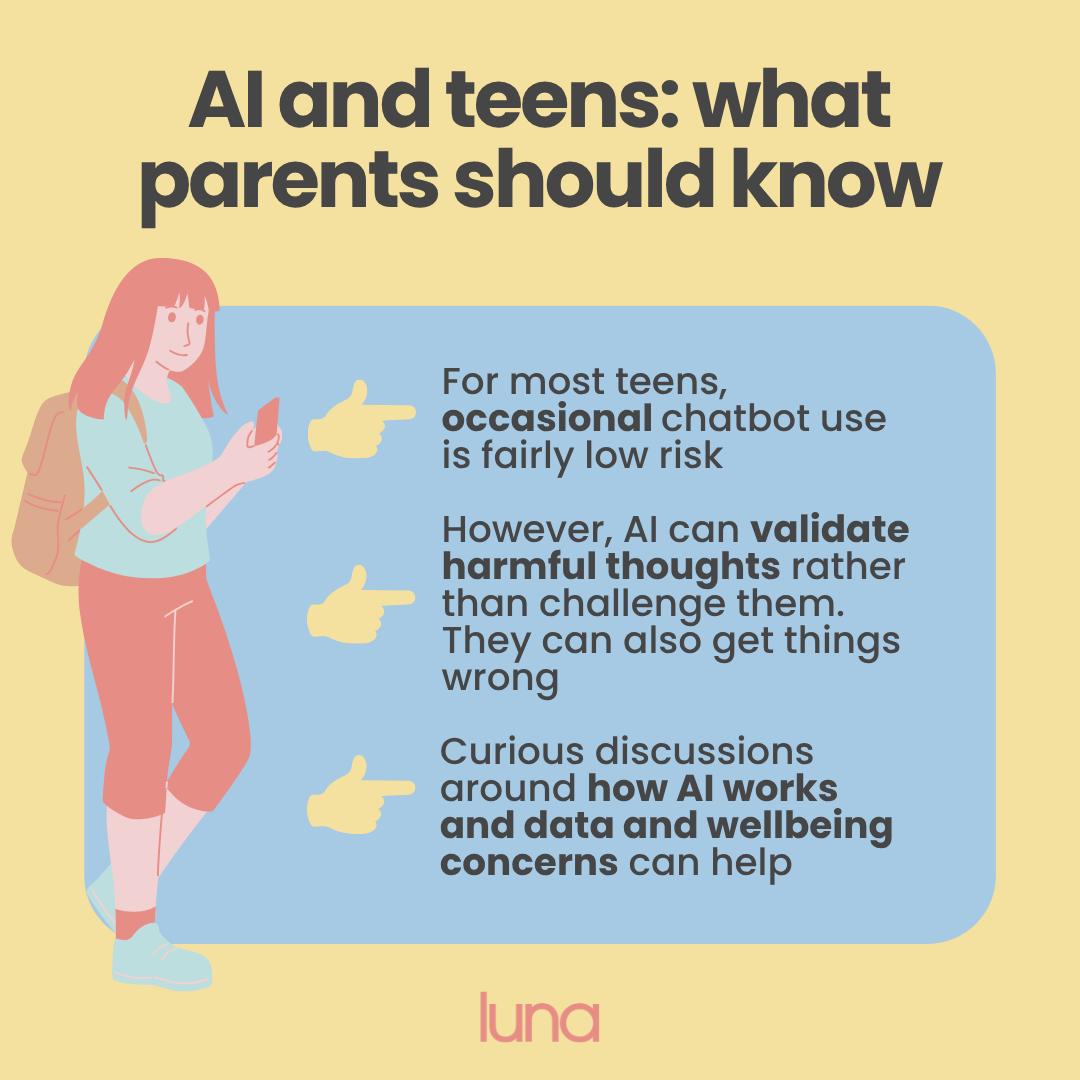
The reassuring part: for most teens, occasional chatbot use is fairly low risk.
The riskier end is companion-style AI, the kind designed to feel like a friend or partner who's always available and always agrees with her.
The main things worth knowing about are:
- Companion apps can validate harmful thoughts rather than challenge them
- Chatbots can sound completely confident while being completely wrong
- She may not always be sure whether she's talking to a real person or a bot
- Most apps collect and store what she types, and she may not realise it
- Some tools can be misused to create fake or explicit images of real people
Which AI chatbots is my daughter likely using?
The ones parents ask about most are Character.AI, Snapchat's built-in "My AI", Replika, and general assistants like ChatGPT. They aren't all the same.
Character.AI and Replika are companion-style apps, where users chat to a character or persona that acts like a friend or partner.
These are the ones behind most of the recent headlines.
In late 2025, following safety concerns and legal action in the US, Character.AI announced it would stop letting under-18s have open-ended conversations with its chatbots.
Snapchat's My AI is a chatbot built right into an app your daughter may already use every day, which is partly why it catches parents off guard.
If Snapchat is already on your radar, it's worth understanding how the app works and if you should let your daughter on Snapchat.
Why is my daughter talking to an AI chatbot or "AI boyfriend"?
Usually because it feels easy, private, and completely unshockable.
A chatbot never rolls its eyes, never tells her friends, and is awake at 2am when she can't sleep.
For a teenage girl who's anxious, lonely, or just figuring out who she is, that can be genuinely appealing. It doesn't mean anything is wrong with her, or with your relationship.
It can help to see it as another way she's exploring feelings and connection, similar to the pull of making friends online.
The difference is that an AI isn't a person, and it isn't looking out for her.
This is one reason luna exists: it gives teen girls a judgement-free space to ask the questions they might otherwise type into a chatbot, with answers reviewed by medical experts rather than generated on the spot.
What are the real risks I should know about?
The clearest risk is that some chatbots can go along with harmful ideas instead of gently pushing back, which is exactly what you'd hope a caring adult would do.
Researchers are starting to test this properly. In a 2025 study that tested 10 popular AI companion and therapy chatbots with distressed-teen scenarios, the bots went along with harmful suggestions in almost a third of cases (32%).
The companion-style "AI friend" apps did worst of all.
According to the same study, published in JMIR Mental Health:
- Companion bots went along with harmful ideas around 58% of the time, compared with 25% for therapy-style bots
- Some failed to recognise a hidden reference to suicide, and a few responded positively to it
- Most did not suggest involving a trusted adult in a scenario that hinted at grooming by an older person
It's worth remembering this was a small study using invented scenarios, not real teenagers. But it lines up with what child safety experts are flagging.
General assistants like ChatGPT aren't risk-free either.
In 2025, a wrongful death lawsuit against OpenAI made big news.
The family of a 16-year-old who died by suicide allege that ChatGPT validated his suicidal thoughts and discussed methods with him.
OpenAI has said it's since strengthened its safeguards for people in distress.
It's a reminder that any chatbot, not just the companion-style ones, can end up in territory it was never designed to handle if a teenager starts confiding in it.
The NSPCC warns that AI can also be misused to bully, to spread misinformation, and to create fake sexual images.
Young people have already contacted Childline about AI-generated fake nudes and AI-related abuse.
How do I talk to my daughter about AI chatbots?
Curiosity tends to work better than a crackdown or taking your daughter's phone away.
If she feels interrogated or judged, she's far more likely to move the conversation somewhere you can't see it.
Some parents find it helps to ask her to show them the app and how it works, rather than confiscating it on sight.
It turns you into someone she can talk to about it, not someone she's hiding it from.
A few angles the NSPCC suggests, reframed as gentle conversation starters:
- Ask her what she thinks the chatbot gets right, and where it might be making things up
- Talk about the fact that a bot agrees with almost anything, and why a real friend who sometimes disagrees is more valuable
- Remind her that not everything online is real, including images and voices
- Let her know she can always come to you, a teacher, or Childline on 0800 1111 if something online worries or upsets her
You don't have to have all the answers. Saying "I don't fully understand these apps either, shall we look together?" is a strong place to start.
When should I worry about my daughter and AI chatbots?
The chatbot itself matters less than how she's doing overall.
It's worth paying closer attention if her AI use seems to be replacing real friendships, sleep, or the things she used to enjoy.
The NHS suggests looking out for signs that a teenager may be struggling more generally, including:
- A continuous low mood, sadness, or frequent tearfulness
- Pulling away from friends and family and becoming more isolated
- Disturbed sleep, or being online through the night
- Becoming very secretive about what she's doing on her phone
One or two of these on their own are often just normal teenage life.
It's a cluster of changes, or a gut sense that she's retreating, that's worth acting on.
If your daughter has gone quiet and withdrawn, luna’s guide on how to reach a withdrawn daughter who won't talk may help.
FAQs
Is Character.AI safe for under 18s?
Character.AI is a companion app, which is the higher-risk category, and it's been at the centre of recent safety concerns.
In late 2025 the company said it would remove open-ended chat for under-18 users.
If your daughter has been using it, it's worth a calm conversation about what she's been talking to it about rather than a panic.
Can AI chatbots help my daughter's mental health?
The evidence is genuinely mixed and still emerging.
Some researchers are exploring whether chatbots can ease mild stress, but the same field has raised real concerns about how companion bots respond to teens in distress.
For anything beyond everyday worries, support from a person, whether a trusted adult, a counsellor, or a doctor, is far safer than a bot.
Should I ban my daughter from using AI chatbots?
You can, but a blanket ban often just pushes it out of sight.
Many parents find that being open about which apps are okay, and staying curious about how she uses them, works better than a rule she'll quietly break.
Companion and "AI boyfriend" apps are the ones most worth drawing a firm line around.
What is an "AI boyfriend" or AI companion app?
It's a chatbot designed to act like a romantic partner or close friend, remembering details about her and always being available.
It can feel comforting, but it's built to keep her engaged, not to look out for her wellbeing, which is why these apps deserve the most caution.
Where to go next
None of this means your daughter is in danger, and it doesn't mean you've missed something.
AI companions are new, they're moving fast, and even the experts are still working it out.
The most protective thing usually isn't the perfect rule; it's staying someone she'll talk to.
Keeping the conversation open now makes it far more likely she'll come to you if something online ever unsettles her.
If you'd like a steer on supporting her wellbeing more broadly, luna's guide to supporting your teen's mental health is a good next step.
And luna itself is built as a calm, expert-reviewed space for teen girls to explore health and life questions at their own pace.
If you're ever worried she's really struggling, a doctor is a good first port of call, and they'll have heard it all before.
How we created this article:
luna's team of experts comprises GPs, Dermatologists, Safeguarding Leads and Junior Doctors as well as Medical Students with specialised interests in paediatric care, mental health and gynaecology. All articles are created by experts, and reviewed by a member of luna's senior review team.
Sources:
NHS "Worried about your teenager?" | 11.08.26
https://www.nhs.uk/mental-health/children-and-young-adults/advice-for-parents/worried-about-your-teenager/NSPCC "Talking to children about AI" | 11.08.26
https://www.nspcc.org.uk/keeping-children-safe/online-safety/talking-to-children-about-ai/NSPCC "Artificial intelligence safety tips for parents" | 11.08.26
https://www.nspcc.org.uk/about-us/news-opinion/2025/artificial-intelligence-safety-tips-for-parents/NSPCC "New partnership as young people contact Childline about AI related sexual abuse, bullying and misinformation" | 11.08.26
https://www.nspcc.org.uk/about-us/news-opinion/2024/2024-01-25-new-partnership-as-young-people-contact-childline-about-ai-related-sexual-abuse-bullying-and-misinformation/Clark A "The ability of AI therapy bots to set limits with distressed adolescents: simulation-based comparison study" | 11.08.26
https://mental.jmir.org/2025/1/e78414BBC "Parents of teenager who took his own life sue OpenAI" | 11.08.26
https://www.bbc.co.uk/news/articles/cgerwp7rdlvoWe'd love to keep in touch!
Sign up to our parent newsletter for emails on the latest teen trends, insights into our luna community and to keep up to date
By signing up, you are agreeing that we can use your email address to market to you. You can unsubscribe from marketing emails at any time by using the link in our emails. For more information, please review our privacy statement.